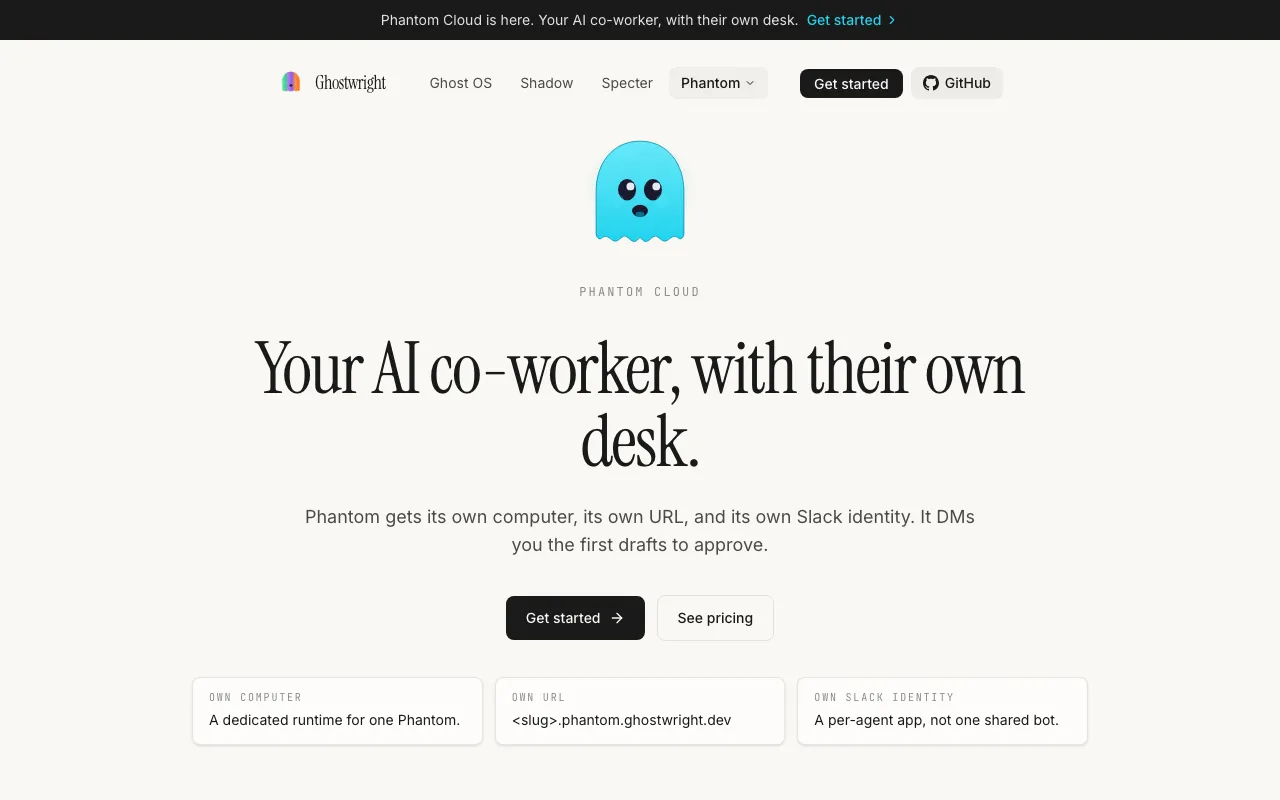
Phantom runs an AI agent on its own machine with Slack, web chat, email, MCP tools, encrypted credentials, and memory that survives between sessions.
Overview
Phantom is an AI co-worker meant to run on a dedicated computer rather than inside a disposable chat tab. It can install software, run databases, build dashboards, remember prior context, and communicate through Slack, a web chat route, email, and webhooks. It is built on the Claude Agent SDK and can create tools at runtime that persist across restarts.
You can choose among several model providers via YAML, including Anthropic by default plus OpenRouter, Ollama, vLLM, LiteLLM, or custom Anthropic-compatible endpoints, without changing tools or memory behavior. Optional self-evolution observes work patterns, proposes changes validated by a separate model, and keeps versioned rollbacks.
The recommended quick start uses Docker Compose, which starts supporting services such as Qdrant for memory and can notify you on Slack when ready. A managed offering also provisions a dedicated VM when you bring your own API key. Credentials are collected through secure forms with AES-256-GCM storage rather than plain config files.
Compared with assistants that share a laptop, Phantom emphasizes an isolated VM, shareable URLs for built artifacts, 24/7 availability, and MCP exposure so other agents can call read-only or custom tools. Communication channels can be extended at runtime, as when a deployment added Discord by building and containerizing a bot integration.
Key features
- Dedicated agent runtime VM
- Slack, email, and web chat
- Persistent memory store
- MCP server exposure
- Multiple LLM provider backends
- Self-evolution with rollback
- Runtime custom tool creation
- Encrypted credential collection
Use cases
- Team Slack AI assistant
- Scheduled ops and reports
- Shareable internal dashboards
- Custom MCP tools for agents
- Long-running automation jobs


 ChatGPT

 Claude Cowork