qmetrics.net

PDom

Client library for parallel DOM work in dedicated processes

Frameworks & PlatformsDesktop/CLI app
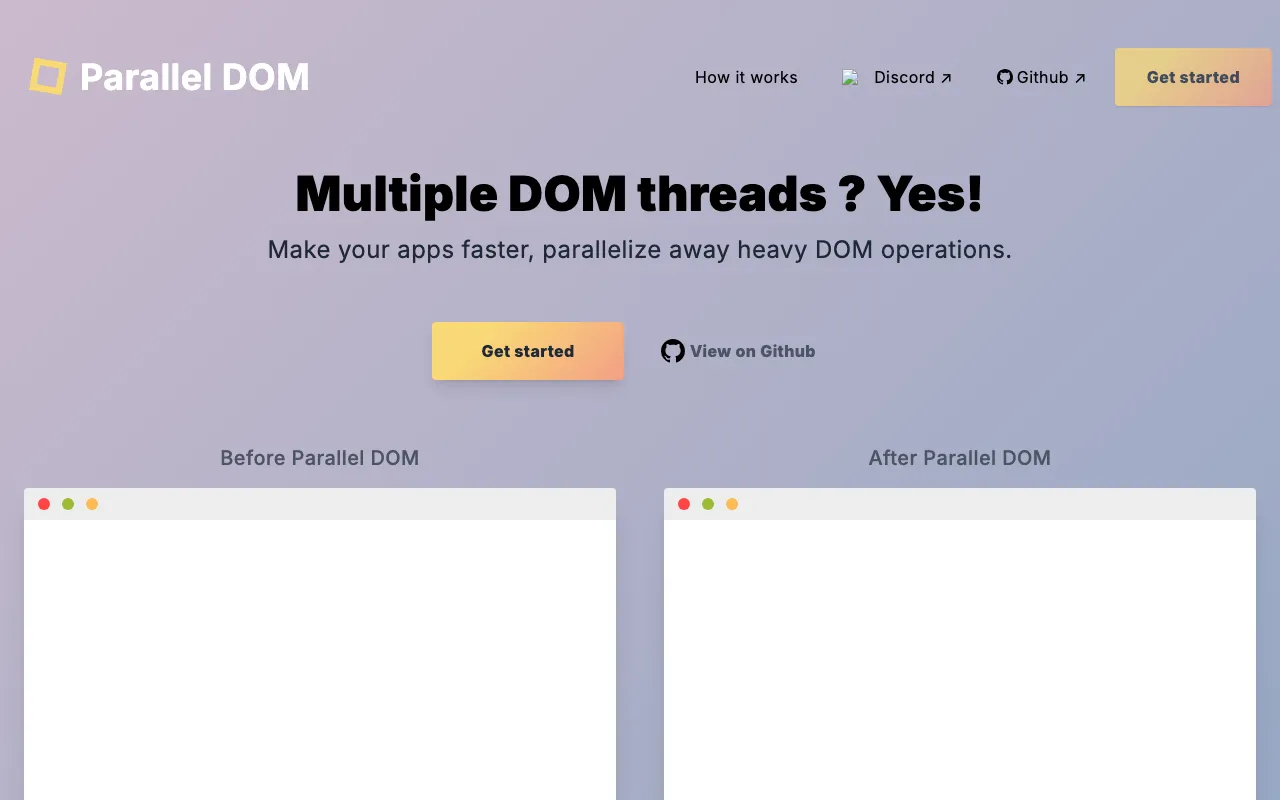
PDom screenshot

Parallel DOM offloads heavy DOM manipulation into sandboxed cross-origin iframes so Chrome and Edge can use separate processes. It offers JavaScript and React APIs with a self-hostable loader.

Overview

Parallel DOM (PDom) is a browser-side library that speeds web apps by running heavy DOM scripts in dedicated processes. It targets pages where DOM manipulation bottlenecks main-thread rendering, such as data visualization or interactive graphics.

The library exposes JavaScript and React APIs. For React, unserializable props such as JSX in props are not supported, while props callbacks work asynchronously. Usage follows a simple plug-in model so existing code can offload selected DOM subtrees.

Under the hood PDom creates a shell iframe on a subdomain, clones the target DOM element, and runs your script inside the isolated frame. Cross-origin isolation gives the iframe its own browser process, and the Origin-Agent-Cluster response header lets multiple PDom instances receive separate subframe processes.

Chrome and Edge are supported; other browsers fall back to single-threaded behavior. You may use the public hosted loader or self-host static assets on Vercel, GitHub Pages, Netlify, or your own static server with wildcard DNS and the Origin-Agent-Cluster header configured.

Key features

  • Parallel DOM in isolated iframes
  • JavaScript and React APIs
  • Origin-Agent-Cluster process split
  • Sandboxed iframe execution
  • Chrome and Edge support
  • Self-hosted static deployment option
  • Graceful degradation on other browsers

Use cases

  • Speed up heavy chart or animation DOM work
  • Run React subtrees off the main thread
  • Host your own PDom loader domain
  • Improve interactive data visualization pages

Similar software

ECC

Open-source agent engineering toolkit for coding harnesses

ECC adds planning, verification, review, memory, skills, and security scanning to coding agents such as Claude Code, Codex, and Cursor. It installs as plugins, packages, and managed adapters across multiple harnesses.

★ 311.7k⟳ 8 days agoMIT
Frameworks & PlatformsDesktop/CLI app

React

JavaScript library for web and native user interfaces

React helps developers build interfaces from reusable components that manage their own state. Views update declaratively when underlying data changes.

★ 253k⟳ 2 days agoMIT
Frameworks & PlatformsDesktop/CLI app

Flutter

Open-source UI framework for multi-platform apps from one codebase

Flutter is an SDK for building user experiences for mobile, web, and desktop from a single codebase. It uses the Dart language and compiles to native machine code or web targets.

★ 181.5k⟳ todayBSD-3-Clause
Open Source Alternative to:Ionic Enterprise

Bootstrap

Responsive HTML, CSS, and JavaScript front-end toolkit

Bootstrap supplies CSS, JavaScript, and Sass-based styles for building responsive, mobile-first sites. It ships prebuilt grid layouts, UI components, and optional JavaScript plugins.

★ 175.1k⟳ 2 days agoMIT

Langflow

Visual low-code builder for AI agents and workflows

Langflow is a visual builder for AI agents and workflows. Flows can be customized in Python and deployed as an API or as an MCP server, with support for major LLMs and vector databases.

★ 157k⟳ todayMIT
Open Source Alternative to:Relevance AIVoiceflow

LangChain

Framework for agents and LLM-powered applications

LangChain helps developers chain interoperable components and integrations to build agents and LLM-powered applications. It offers a standard interface for models, embeddings, vector stores, and related pieces.

★ 150.1k⟳ 2 days agoMIT






