qmetrics.net

Pathos

Python parallel and distributed map execution framework

Frameworks & PlatformsDesktop/CLI app
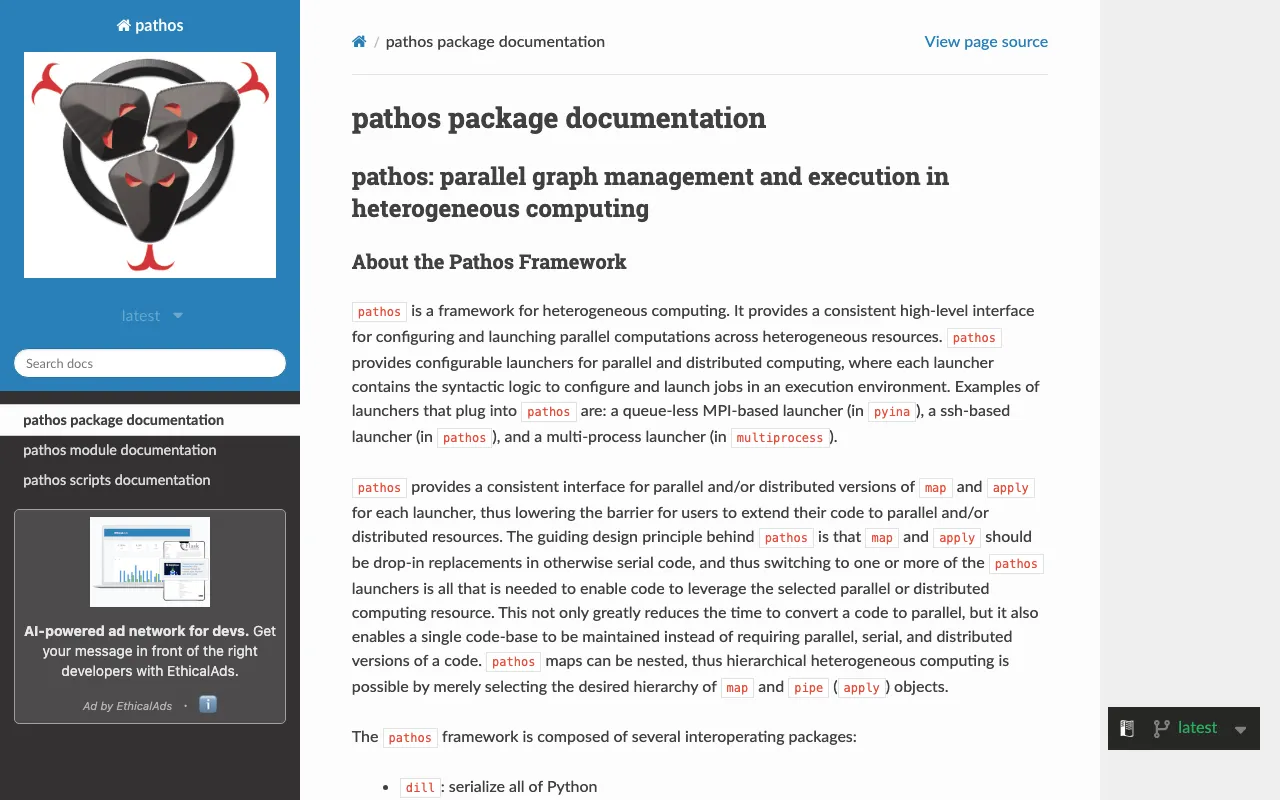
Pathos screenshot

pathos helps run map and apply workloads across local processes and remote hosts with configurable launchers and optional SSH-tunneled RPC.

Overview

pathos is a Python framework for heterogeneous parallel and distributed computing. It aims to make map and apply drop-in replacements in otherwise serial code by routing work through pluggable launchers for multiprocessing, SSH remotes, parallelpython-style pools, and related backends in the broader Pathos ecosystem.

The package can configure and start RPC services on remote machines, coordinate ports with a portpicker helper, and expose high-level pool.map interfaces that hide RPC details. Distributed map and pipe algorithms can mix local processors with remote workers, with basic load balancing or manual resource selection. Nested maps support hierarchical workflows.

Security-sensitive RPC traffic can be wrapped automatically in SSH tunnels. Lower-level APIs cover launching remote processes, copying files with scp, and managing tunnels. Convenience scripts pathosconnect and portpicker install to the user PATH for setup and testing.

Install with pip; it depends on companion packages such as dill, pox, ppft, and multiprocess. Worker pool types include serial, thread, process, parallel, and specialized secure connection classes for production-style distributed runs.

Key features

  • Distributed map and apply pools
  • SSH and scp remote launch
  • SSH-tunneled RPC
  • Multiple worker pool backends
  • pool.map high-level API
  • portpicker and pathosconnect scripts
  • Nested heterogeneous maps
  • Basic load balancing

Use cases

  • Parallel Python map workloads
  • Remote cluster calculations
  • Secure distributed RPC jobs
  • Hierarchical parallel pipelines

Similar software

ECC

Open-source agent engineering toolkit for coding harnesses

ECC adds planning, verification, review, memory, skills, and security scanning to coding agents such as Claude Code, Codex, and Cursor. It installs as plugins, packages, and managed adapters across multiple harnesses.

★ 311.7k⟳ 8 days agoMIT
Frameworks & PlatformsDesktop/CLI app

React

JavaScript library for web and native user interfaces

React helps developers build interfaces from reusable components that manage their own state. Views update declaratively when underlying data changes.

★ 253k⟳ 2 days agoMIT
Frameworks & PlatformsDesktop/CLI app

Flutter

Open-source UI framework for multi-platform apps from one codebase

Flutter is an SDK for building user experiences for mobile, web, and desktop from a single codebase. It uses the Dart language and compiles to native machine code or web targets.

★ 181.5k⟳ todayBSD-3-Clause
Open Source Alternative to:Ionic Enterprise

Bootstrap

Responsive HTML, CSS, and JavaScript front-end toolkit

Bootstrap supplies CSS, JavaScript, and Sass-based styles for building responsive, mobile-first sites. It ships prebuilt grid layouts, UI components, and optional JavaScript plugins.

★ 175.1k⟳ 2 days agoMIT

Langflow

Visual low-code builder for AI agents and workflows

Langflow is a visual builder for AI agents and workflows. Flows can be customized in Python and deployed as an API or as an MCP server, with support for major LLMs and vector databases.

★ 157k⟳ todayMIT
Open Source Alternative to:Relevance AIVoiceflow

LangChain

Framework for agents and LLM-powered applications

LangChain helps developers chain interoperable components and integrations to build agents and LLM-powered applications. It offers a standard interface for models, embeddings, vector stores, and related pieces.

★ 150.1k⟳ 2 days agoMIT