
TensorFlow
End-to-end machine learning platform and tooling ecosystem
TensorFlow is a machine learning platform with Python and C++ APIs, optional GPU packages, and companion libraries for data, training, deployment, and visualization.
PaddlePaddle speech toolkit for ASR, TTS, and audio
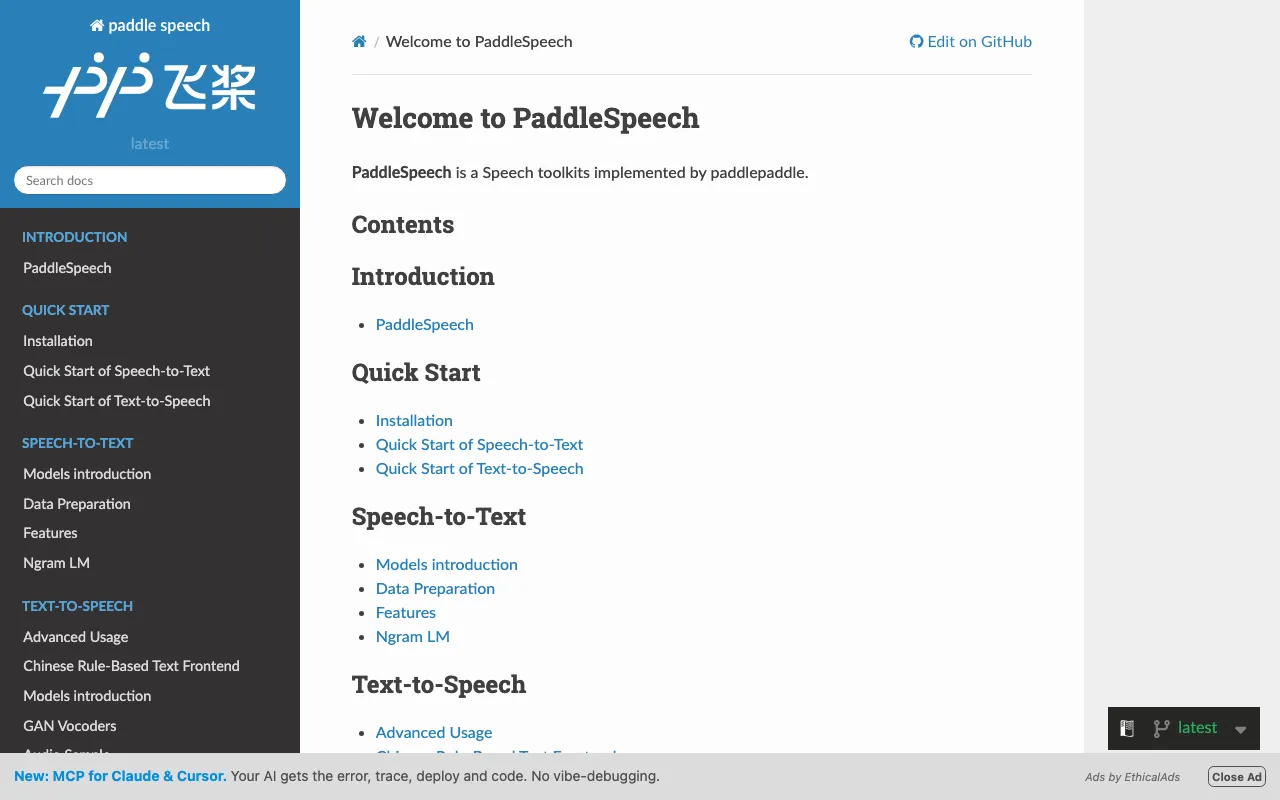
PaddleSpeech bundles speech and audio models on PaddlePaddle for recognition, synthesis, translation, speaker verification, keyword spotting, and related tasks. It offers command-line tools, Python APIs, and optional speech servers.
PaddleSpeech is a speech toolkit built on the PaddlePaddle platform. It targets industrial and research use with training, inference, testing, and deployment modules for core audio tasks.
Capabilities include automatic speech recognition (including streaming ASR with punctuation and timestamps), text-to-speech with a rule-based Chinese text frontend, speech translation from English to Chinese, speaker verification, keyword spotting, audio classification, punctuation restoration, voice conversion, and singing voice synthesis examples. It integrates mainstream datasets such as LibriSpeech, LJSpeech, AIShell, and CSMSC, and supports models including Conformer, Whisper, Wav2vec2, HuBERT, VITS, and FastSpeech2.
Users can start via the command line or Python APIs. PaddleSpeech Server exposes recognition, TTS, classification, speaker verification, and punctuation services, and a streaming server supports streaming ASR and streaming TTS. A web demo and Android TTS demo are also mentioned in project materials.
Installation is documented for Linux (recommended), Windows, and macOS with Python 3.8 or newer and a PaddlePaddle dependency. The design emphasizes ease of use alongside streaming production-oriented ASR and TTS systems.
End-to-end machine learning platform and tooling ecosystem
TensorFlow is a machine learning platform with Python and C++ APIs, optional GPU packages, and companion libraries for data, training, deployment, and visualization.

Shared model definitions for multimodal ML workloads
Transformers is a Python library that defines pretrained text, vision, audio, and multimodal models once in PyTorch for shared inference and training across the ecosystem.
Open-source RAG engine and agent context platform
RAGFlow ingests heterogeneous documents, builds retrievable knowledge, and supports agent workflows with citations. It can run on your own hardware with Docker or a from-source server stack.

Local LLM context compression library and proxy
Headroom shrinks tool outputs, logs, JSON, and chat history before LLM calls to cut input tokens while preserving retrievable originals. It offers a Python library, proxy, MCP tools, and agent wrappers.

Local desktop workspace to run and fine-tune AI models
Unsloth is a desktop application to chat with, fine-tune, and serve LLMs, diffusion, audio, and embedding models on your own hardware with optional agent integrations.
TensorFlow reference models and modeling utilities collection
The TensorFlow Model Garden hosts implementations of models and modeling solutions for TensorFlow, installable via pip as tf-models-official.