
TensorFlow
End-to-end machine learning platform and tooling ecosystem
TensorFlow is a machine learning platform with Python and C++ APIs, optional GPU packages, and companion libraries for data, training, deployment, and visualization.
PaddlePaddle LLM toolkit for training, tuning, and inference
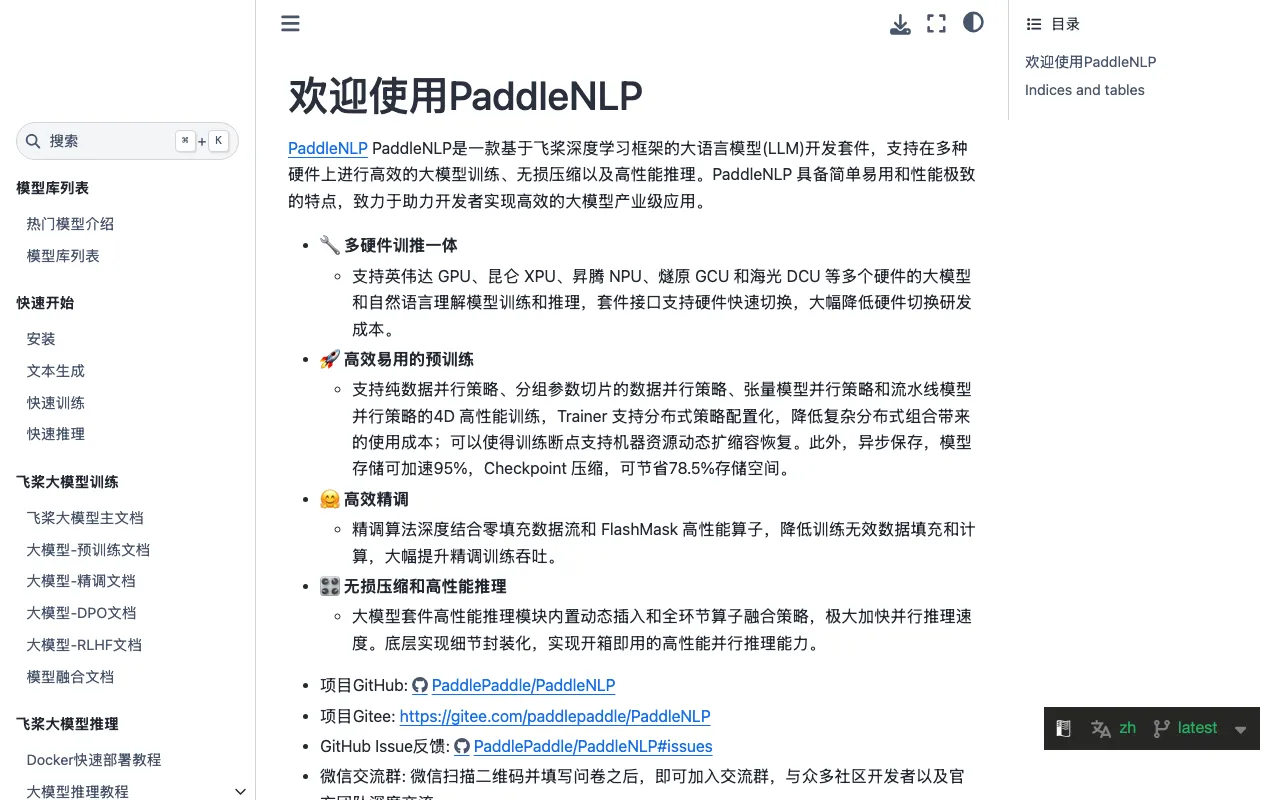
PaddleNLP is a PaddlePaddle-based suite for large language model training, compression, and high-performance inference across diverse AI hardware.
PaddleNLP targets industrial LLM workflows on top of the PaddlePaddle deep learning framework. It bundles APIs and trainers for pretraining, supervised fine-tuning, alignment, quantization, and deployment, with an Auto-style interface to load models and tokenizers quickly.
Hardware support spans NVIDIA GPUs, Kunlun XPU, Ascend NPU, Enflame GCU, and Hygon DCU, with interfaces meant to reduce cost when switching devices. Training features include configurable 4D parallel strategies, Unified Checkpoint storage with async saves and compression, and fine-tuning optimizations such as FlashMask-focused data paths.
The model zoo lists many open model families including LLaMA, Qwen, DeepSeek, ChatGLM, Baichuan, Mistral, Bloom, and PP-UIE for information extraction. Tables in the documentation summarize which architectures support parallelism, PEFT, alignment algorithms, merge tooling, and quantized inference formats.
Inference modules emphasize fused operators and parallel serving, with documentation for Docker deployment, static graph models, and tuning on heterogeneous devices. Installation requires Python 3.8+ and PaddlePaddle 3.0 rc1 or newer via pip or source.
End-to-end machine learning platform and tooling ecosystem
TensorFlow is a machine learning platform with Python and C++ APIs, optional GPU packages, and companion libraries for data, training, deployment, and visualization.

Shared model definitions for multimodal ML workloads
Transformers is a Python library that defines pretrained text, vision, audio, and multimodal models once in PyTorch for shared inference and training across the ecosystem.

Open-source RAG engine and agent context platform
RAGFlow ingests heterogeneous documents, builds retrievable knowledge, and supports agent workflows with citations. It can run on your own hardware with Docker or a from-source server stack.

Local LLM context compression library and proxy
Headroom shrinks tool outputs, logs, JSON, and chat history before LLM calls to cut input tokens while preserving retrievable originals. It offers a Python library, proxy, MCP tools, and agent wrappers.

Local desktop workspace to run and fine-tune AI models
Unsloth is a desktop application to chat with, fine-tune, and serve LLMs, diffusion, audio, and embedding models on your own hardware with optional agent integrations.

TensorFlow reference models and modeling utilities collection
The TensorFlow Model Garden hosts implementations of models and modeling solutions for TensorFlow, installable via pip as tf-models-official.