
TensorFlow
End-to-end machine learning platform and tooling ecosystem
TensorFlow is a machine learning platform with Python and C++ APIs, optional GPU packages, and companion libraries for data, training, deployment, and visualization.
Constrained structured output generation for LLM callers
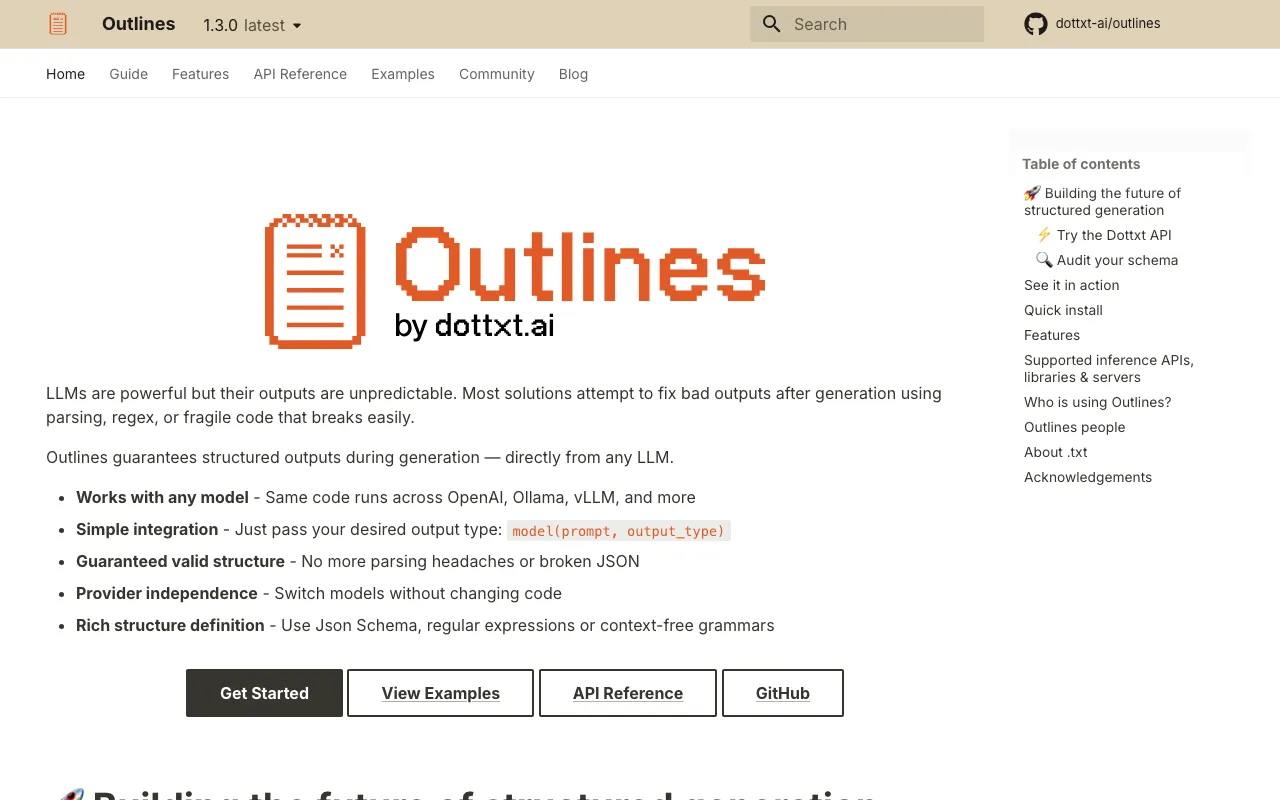
Outlines lets Python callers pass an output type so model text is steered into valid JSON, literals, regex, grammars, or function-call shapes during generation.
Outlines is a Python library aimed at reliable structured generation from large language models. Instead of prompting for free text and repairing responses afterward, callers specify a target type or schema and Outlines constrains decoding so outputs match that structure as they are produced.
Integration paths cover remote APIs and local servers such as OpenAI-compatible clients, Ollama, vLLM, Transformers, llama.cpp, MLX-LM, SGLang, TGI, and related stacks. Examples in the documentation walk through support triage, categorization, document typing, partial event parsing with fallbacks, meeting extraction for function calling, and templated prompts.
Feature areas include literals and enums, Pydantic and JSON Schema outputs, regular expressions, context-free grammars, function-signature-driven calls, reusable Jinja templates, and packaged application helpers. The design stays low-level so it can sit beside existing LLM code without imposing an agent framework.
The project is maintained by dottxt, which also offers a hosted API for schema-compliant generation; the open-source library remains the core integration surface for in-process use.
End-to-end machine learning platform and tooling ecosystem
TensorFlow is a machine learning platform with Python and C++ APIs, optional GPU packages, and companion libraries for data, training, deployment, and visualization.

Shared model definitions for multimodal ML workloads
Transformers is a Python library that defines pretrained text, vision, audio, and multimodal models once in PyTorch for shared inference and training across the ecosystem.

Open-source RAG engine and agent context platform
RAGFlow ingests heterogeneous documents, builds retrievable knowledge, and supports agent workflows with citations. It can run on your own hardware with Docker or a from-source server stack.

Local LLM context compression library and proxy
Headroom shrinks tool outputs, logs, JSON, and chat history before LLM calls to cut input tokens while preserving retrievable originals. It offers a Python library, proxy, MCP tools, and agent wrappers.

Local desktop workspace to run and fine-tune AI models
Unsloth is a desktop application to chat with, fine-tune, and serve LLMs, diffusion, audio, and embedding models on your own hardware with optional agent integrations.

TensorFlow reference models and modeling utilities collection
The TensorFlow Model Garden hosts implementations of models and modeling solutions for TensorFlow, installable via pip as tf-models-official.