
TensorFlow
End-to-end machine learning platform and tooling ecosystem
TensorFlow is a machine learning platform with Python and C++ APIs, optional GPU packages, and companion libraries for data, training, deployment, and visualization.
Toolkit for optimizing and deploying AI inference
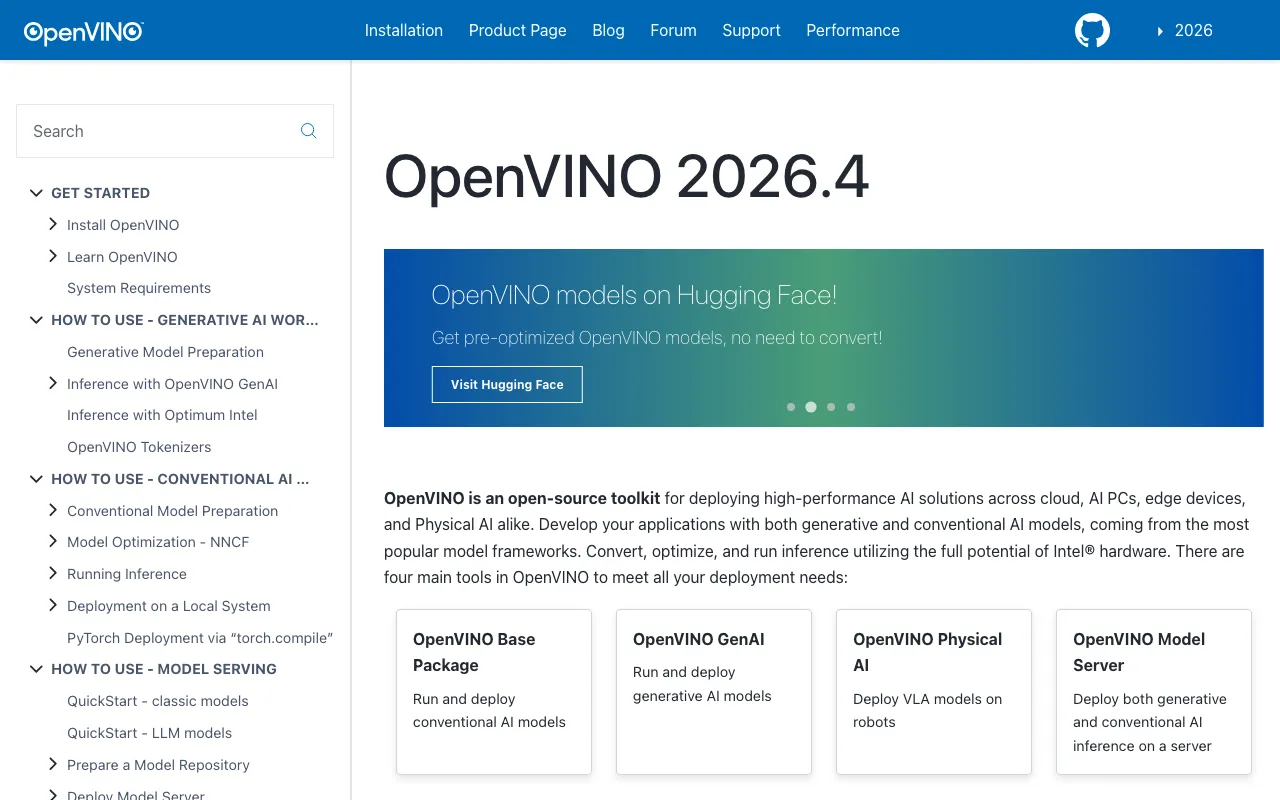
OpenVINO optimizes and runs deep learning models for inference across vision, speech, NLP, and generative AI workloads. It converts models from common training frameworks and targets Intel CPU, GPU, and NPU hardware.
OpenVINO is a toolkit for optimizing and deploying AI inference. It helps teams run conventional and generative models in applications ranging from cloud servers to edge devices and AI PCs, with emphasis on performance on Intel hardware.
You can bring models trained in PyTorch, TensorFlow, ONNX, Keras, PaddlePaddle, JAX/Flax, and related ecosystems. Models from Hugging Face transformers and diffusers can be integrated via Optimum Intel, and converted models can run without keeping the original framework installed.
Inference covers computer vision, automatic speech recognition, natural language processing with large and small language models, generative AI, and other common tasks. Runtimes support CPU (x86 and ARM), Intel integrated and discrete GPUs, and Intel NPUs. APIs are available in C++, Python, C, and NodeJS, plus a GenAI API for optimized generative pipelines.
You may link OpenVINO Runtime directly into applications for local inference, or use OpenVINO Model Server to serve inference from a separate process or in Kubernetes. Optional tooling includes model compression (NNCF), PyTorch torch.compile integration, and physical AI deployment paths for robot VLA models.
End-to-end machine learning platform and tooling ecosystem
TensorFlow is a machine learning platform with Python and C++ APIs, optional GPU packages, and companion libraries for data, training, deployment, and visualization.

Shared model definitions for multimodal ML workloads
Transformers is a Python library that defines pretrained text, vision, audio, and multimodal models once in PyTorch for shared inference and training across the ecosystem.

Open-source RAG engine and agent context platform
RAGFlow ingests heterogeneous documents, builds retrievable knowledge, and supports agent workflows with citations. It can run on your own hardware with Docker or a from-source server stack.

Local LLM context compression library and proxy
Headroom shrinks tool outputs, logs, JSON, and chat history before LLM calls to cut input tokens while preserving retrievable originals. It offers a Python library, proxy, MCP tools, and agent wrappers.

Local desktop workspace to run and fine-tune AI models
Unsloth is a desktop application to chat with, fine-tune, and serve LLMs, diffusion, audio, and embedding models on your own hardware with optional agent integrations.

TensorFlow reference models and modeling utilities collection
The TensorFlow Model Garden hosts implementations of models and modeling solutions for TensorFlow, installable via pip as tf-models-official.