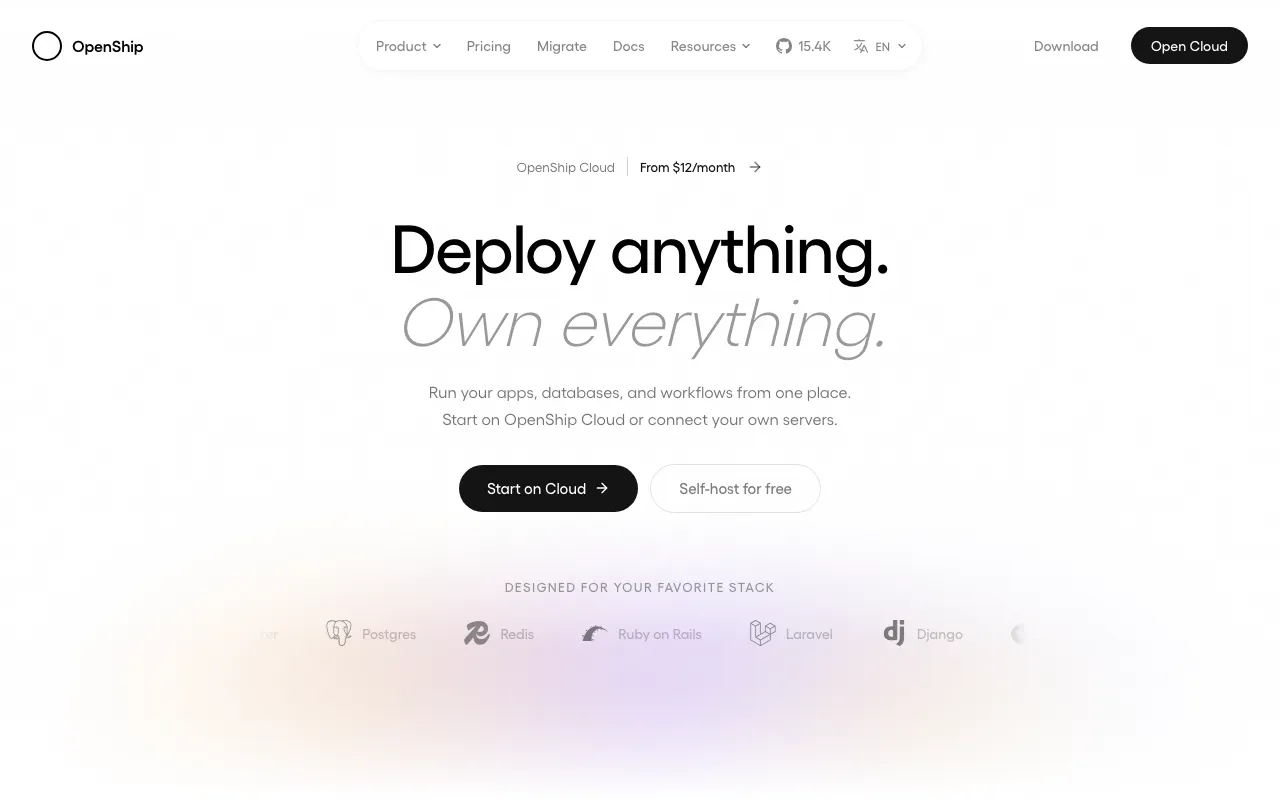
OpenShip builds, routes, and TLS-terminates applications from Git or local sources, managed through a desktop app, web dashboard, or CLI.
Overview
OpenShip is a deployment control plane that detects stack and commands from repository files, builds Docker images or bare releases, runs workloads, and configures reverse proxy routing with automatic Let's Encrypt certificates. Push-to-deploy via GitHub webhooks can rebuild only the services affected in a monorepo change.
Operators can run the control plane as a local desktop application, as an always-on self-hosted server, or rely on OpenShip Cloud for managed sandboxes. The server install can use Docker Compose on Linux to colocate Postgres, Redis, API, dashboard, and an OpenResty edge, or run a lighter bare-mode process elsewhere.
Beyond application hosting, the platform covers managed databases, domains, CDN-style edge options, built-in SMTP with DKIM and related DNS auth, backups, live logs, and metrics. A Ship SDK, REST API, and MCP endpoint support automation and AI-driven deploy workflows.
The same workflow targets cloud sandboxes, VPS providers, dedicated hardware, or multiple connected servers, with rollbacks and retained deployment history for recovered images.
Key features
- Push-to-deploy from GitHub
- Automatic Let's Encrypt TLS
- Docker and bare-metal run modes
- Desktop, web, and CLI interfaces
- Postgres, MySQL, MongoDB, Redis templates
- Built-in mail server option
- Scheduled backups and restores
- MCP and REST automation APIs
Use cases
- Solo developer deploys over SSH
- Team-hosted staging and production
- Multi-service Compose project shipping
- Hybrid cloud and owned-server workloads
- Agent-driven deploys via MCP clients
Open-source alternative to
 Google Analytics
“Privacy-friendly, cookie-free web analytics — a self-hosted alternative to Google Analytics.” source
Does the same job as
OpenShip doesn't name these products itself, but its own description shows it does the same job.

 Heroku
 Netlify
 Vercel