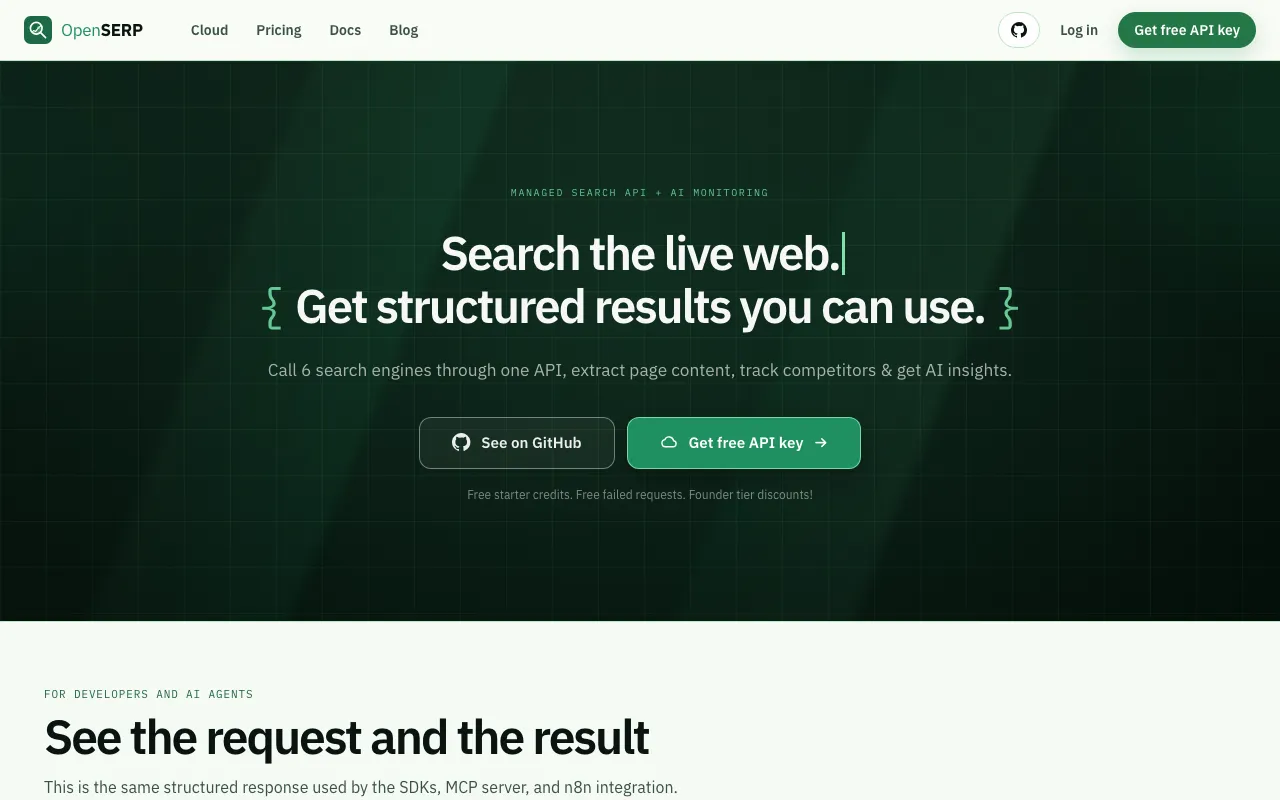
OpenSERP exposes Google, Bing, Yandex, Baidu, DuckDuckGo, and Ecosia through a REST API and CLI, returning ranked JSON and optional page Markdown.
Overview
OpenSERP is a free, self-hosted web search stack for AI agents, developers, and SEO workflows. It queries major search engines through browser-backed rendering or raw HTTP where supported, then returns structured JSON that preserves engine name, rank, snippets, and SERP features without per-query vendor billing.
A single server or Go binary can serve HTTP endpoints for engine-specific search, multi-engine megasearch, image search, and batch URL extraction to Markdown. A matching CLI can run searches without a long-lived server, and an MCP package lets tools such as Claude Code, Cursor, and Claude Desktop call search and extract operations from agent sessions.
Responses separate ads from organic results, support filters for language, region, dates, sites, and file types, and can attach extracted page content in one request. Operators can front requests with HTTP or SOCKS5 proxies, configure caching and rate limits, and integrate Open WebUI or custom agent code through ordinary HTTP.
The project also offers a separate hosted API with metered credits, while the MIT-licensed open-source edition is intended to run entirely on infrastructure you control with no API key required for the self-hosted path.
Key features
- Six search engines one JSON schema
- Browser-rendered SERP capture
- REST API and standalone CLI
- MCP tools for AI clients
- Page extraction to Markdown
- Multi-engine megasearch merge
- Proxy, cache, and rate-limit controls
- Docker image and prebuilt binaries
Use cases
- Grounding LLM and RAG pipelines
- Agent web search without paid APIs
- SEO rank and SERP monitoring
- Programmatic competitor research
- Open WebUI built-in web search
Does the same job as
OpenSERP doesn't name these products itself, but its own description shows it does the same job.