
TensorFlow
End-to-end machine learning platform and tooling ecosystem
TensorFlow is a machine learning platform with Python and C++ APIs, optional GPU packages, and companion libraries for data, training, deployment, and visualization.
Sandbox runtime for isolated AI agent code and tool execution
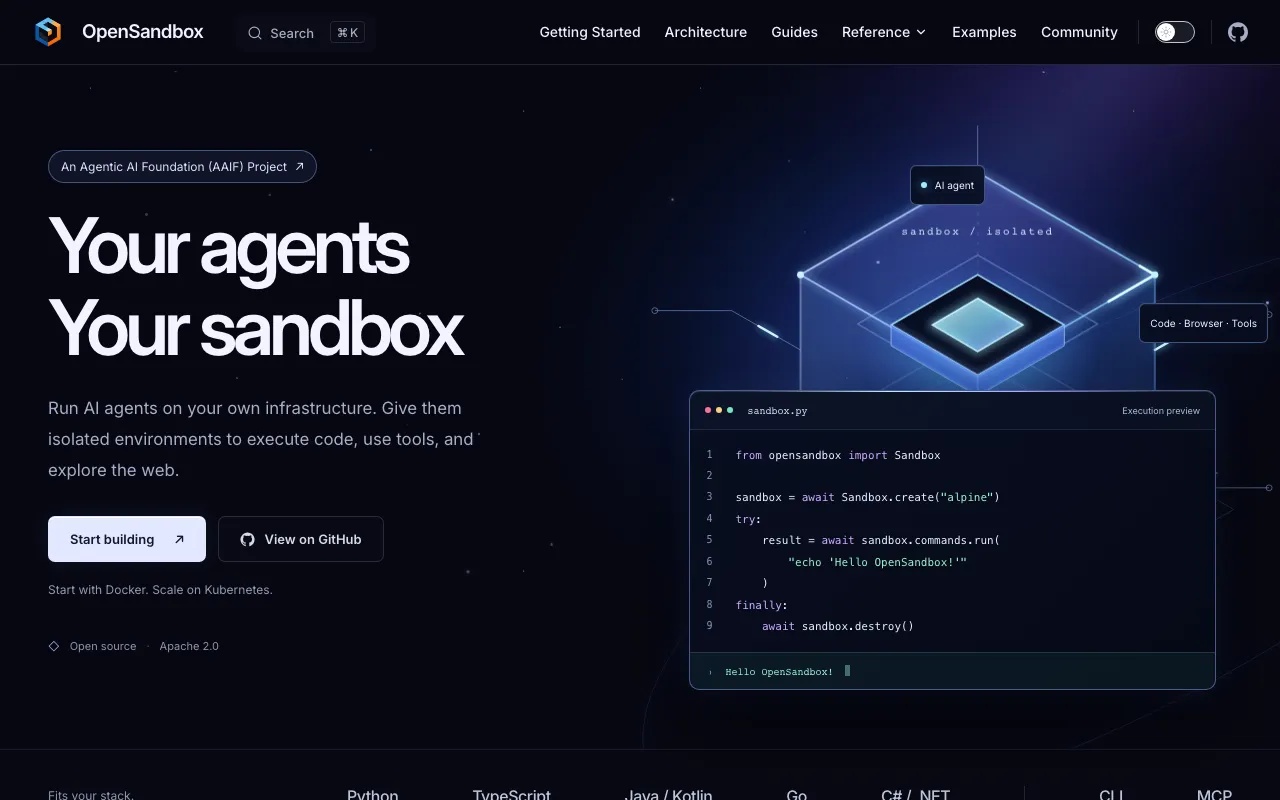
OpenSandbox provisions isolated environments where agents run commands, edit files, and use browsers or desktops. Start locally with Docker and scale the same API on Kubernetes.
OpenSandbox is a sandbox runtime aimed at AI agent workloads. It gives agents isolated environments to execute code, run shell commands, manage files, and automate browsers or full desktops while integrators control networking and credentials from outside the sandbox.
Local development uses Docker with a sandbox server and language SDKs for Python, TypeScript, Java, Go, and .NET, plus an osb CLI and MCP server for editor and agent clients. Kubernetes deployment adds a fast runtime built around Firecracker microVMs with documented warm-start timings and pause or resume preserving memory and disk state.
Operational controls include ingress and egress policies per sandbox, a credential vault that injects outbound secrets without exposing them inside workloads, resource pools, and batch creation for evaluation and reinforcement-learning style trials. Examples cover coding agents, code interpreters, Playwright automation, and benchmark harnesses.
The project is part of the Agentic AI Foundation and publishes official container images to multiple registries. Documentation covers architecture, deployment, API contracts, and release verification practices for production pinning.
End-to-end machine learning platform and tooling ecosystem
TensorFlow is a machine learning platform with Python and C++ APIs, optional GPU packages, and companion libraries for data, training, deployment, and visualization.

Shared model definitions for multimodal ML workloads
Transformers is a Python library that defines pretrained text, vision, audio, and multimodal models once in PyTorch for shared inference and training across the ecosystem.
Open-source RAG engine and agent context platform
RAGFlow ingests heterogeneous documents, builds retrievable knowledge, and supports agent workflows with citations. It can run on your own hardware with Docker or a from-source server stack.
Local LLM context compression library and proxy
Headroom shrinks tool outputs, logs, JSON, and chat history before LLM calls to cut input tokens while preserving retrievable originals. It offers a Python library, proxy, MCP tools, and agent wrappers.

Local desktop workspace to run and fine-tune AI models
Unsloth is a desktop application to chat with, fine-tune, and serve LLMs, diffusion, audio, and embedding models on your own hardware with optional agent integrations.
TensorFlow reference models and modeling utilities collection
The TensorFlow Model Garden hosts implementations of models and modeling solutions for TensorFlow, installable via pip as tf-models-official.