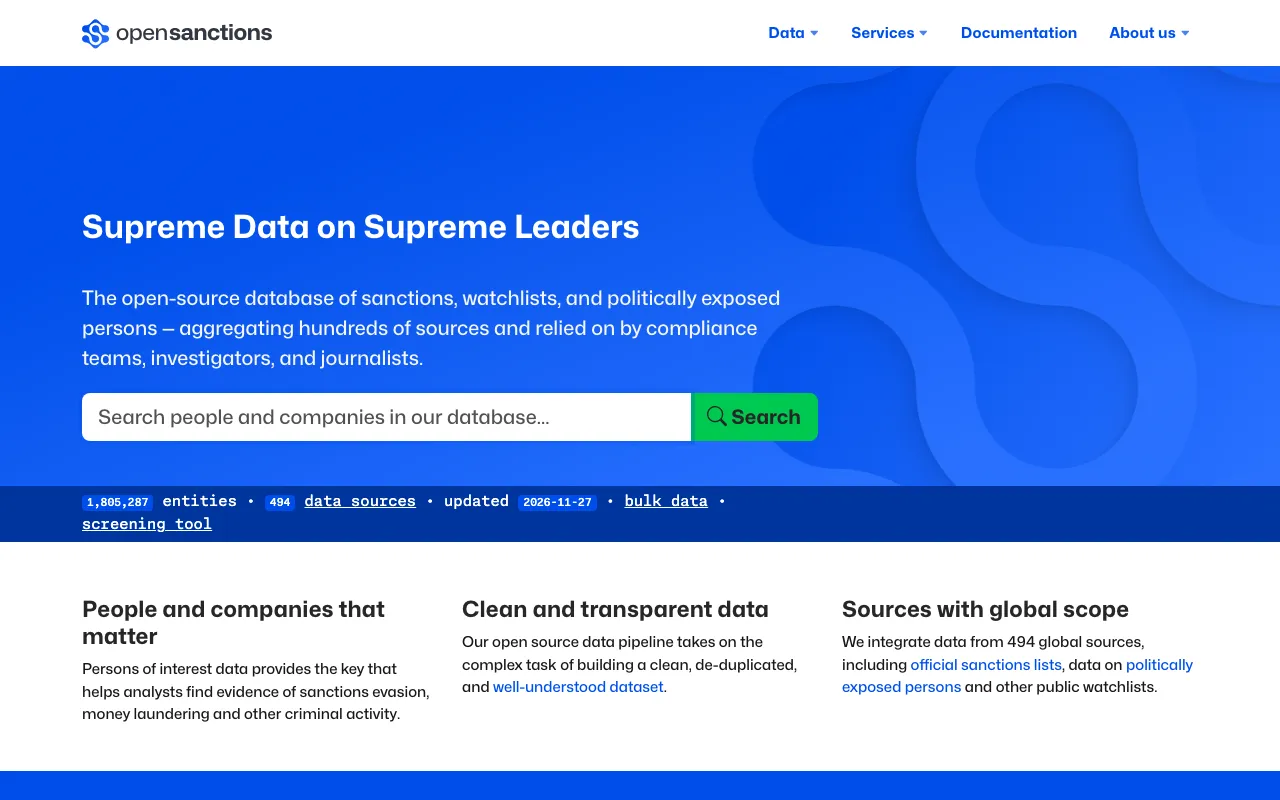
OpenSanctions gathers sanctions, politically exposed persons, and watchlist data from many official and public sources. Compliance teams, investigators, and journalists use it for screening and research.
Overview
OpenSanctions is an open database that combines sanctions listings, politically exposed persons (PEPs), and other watchlist entities from hundreds of global sources. Its pipeline ingests raw source material, normalizes structures, deduplicates records, and publishes datasets suited to screening and investigative work.
The project builds on the Follow the Money (FtM) JSON data model for anti-corruption and sanctions-related entities. Published collections range from consolidated sanctions rolls to broader default distributions and specialized sets such as maritime sanctions, regulatory watchlists, and criminal entities.
Consumers can work with bulk exports, a screening API, and tooling that connects into automated workflows. An MCP server is offered for sanctions and PEP checks inside LLM agents with auditable answers. Non-commercial use is free; commercial users may license bulk data or use the screening API.
Persons-of-interest data is positioned to help analysts tie together evidence around sanctions evasion, money laundering, and related financial crime. The maintainers stress transparent sourcing and a pipeline aimed at clean, deduplicated datasets.
Key features
- Hundreds of integrated global sources
- Sanctions, PEP, and watchlist collections
- Follow the Money data model
- Bulk data exports
- Screening API
- MCP server for agent workflows
- Deduplication and normalization pipeline
- Multiple topical dataset distributions
Use cases
- Customer and counterparty sanctions screening
- Investigative journalism on financial crime
- Compliance risk and KYB workflows
- Agentic sanctions checks in LLM tools
- Bulk analytics on designated entities