 Drata
 Vanta

lynis
Agentless security auditing for Unix-like systems
Lynis runs on the host to scan Linux, macOS, and other UNIX systems for hardening gaps, vulnerable packages, and compliance issues.

Open-source compliance automation platform for SOC 2, ISO 27001 and more
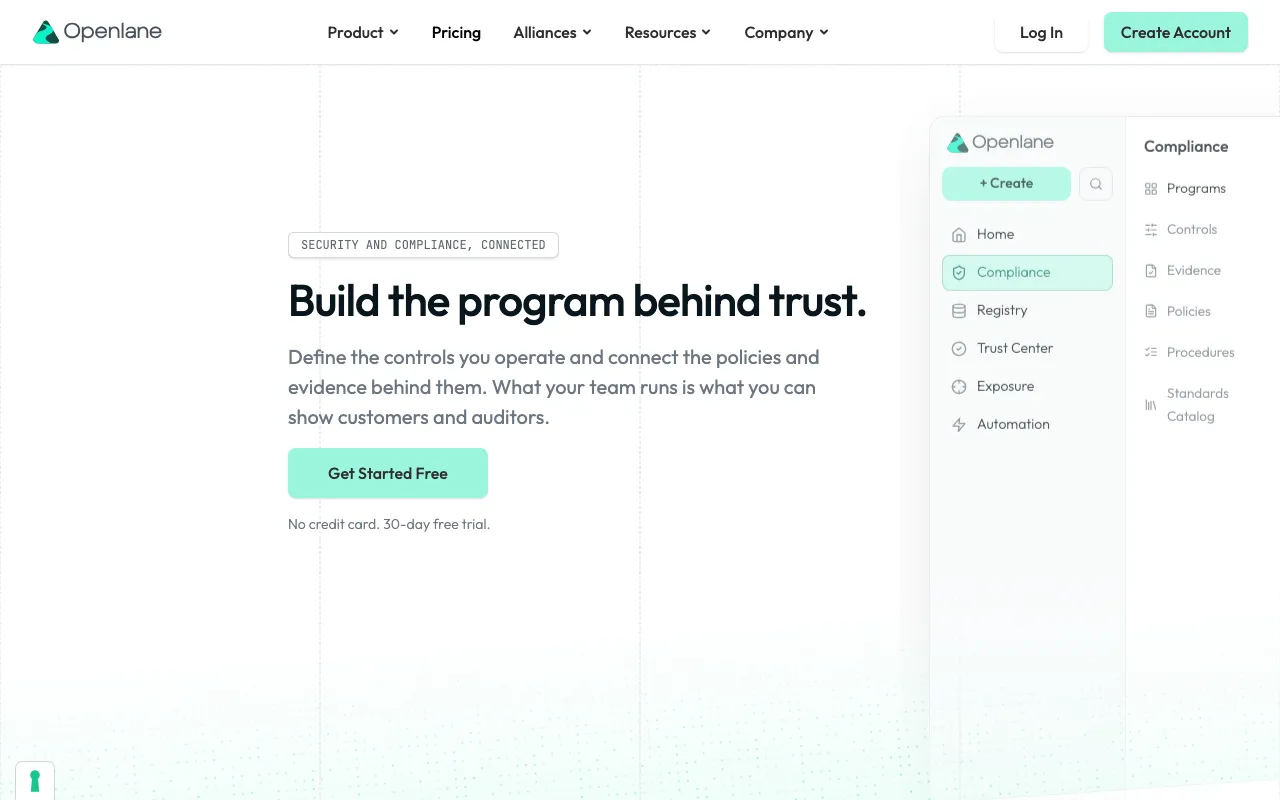
Compliance management platform that links controls, policies, vendors and evidence in one system of record. It maps one program across multiple frameworks and integrates with tools like GitHub, AWS and Google Workspace.
Openlane is a compliance automation platform that serves as a system of record for a compliance program. It tracks the people, systems and vendors in scope, the policies and controls that govern them, and the evidence that supports them. Policies, controls, evidence and programs come with editors, approvals, comments and full history.
Control sets for frameworks such as SOC 2, ISO 27001 and NIST 800-53 can be imported, and a single control can satisfy requirements across several frameworks. A registry imports personnel and contractor lists from a directory, vendors from a CRM, and assets from a CMDB or spreadsheets. An exposure area covers domain scanning and vulnerability integrations with GitHub, AWS Security Hub and GCP Security Command Center, with remediation tracking.
Automation features connect to tools such as Google Drive, GitHub, Entra ID, AWS and GCP. They add configurable workflows and approvals, email campaigns, questionnaires and assessments for vendors or employees, and task assignment with reminders and escalation. A Trust Center is a branded portal on your own domain that publishes certifications, security documents and subprocessors.
Organization settings include granular RBAC, SSO, 2FA enforcement and auditor roles. The code here is the core server and orchestration services behind the Openlane cloud service. It is built on PostgreSQL, Redis, S3-compatible storage, ent, gqlgen and OpenFGA. Container images are published to the GitHub container registry, and Helm charts are not yet published.
Openlane doesn't name these products itself, but its own description shows it does the same job.
Agentless security auditing for Unix-like systems
Lynis runs on the host to scan Linux, macOS, and other UNIX systems for hardening gaps, vulnerable packages, and compliance issues.

Unified metadata context layer for data and AI workflows
OpenMetadata is a platform that unifies technical metadata, quality signals, lineage, semantics, and organizational memory into one graph for people and AI agents.

Multi-cloud security scanning with CLI and local console
Prowler runs thousands of configurable cloud and SaaS checks, maps results to compliance frameworks, and can be used from CLI, API, or a self-hosted web UI.

Database governance for schema changes, access and compliance
Bytebase is a control plane between people, AI agents and databases. It unifies change review, access rules and audit logging across many database engines.

General-purpose policy engine with declarative Rego rules
Open Policy Agent centralizes authorization and policy decisions across your stack. Services query OPA instead of hardcoding rules, using the Rego language and JSON input data.

Pluggable SDK for detecting and anonymizing sensitive data
Presidio finds and de-identifies personally identifiable information in text, images, and structured data. Teams plug in recognizers, connect external models, and run flows in Python, Spark, Docker, or Kubernetes.