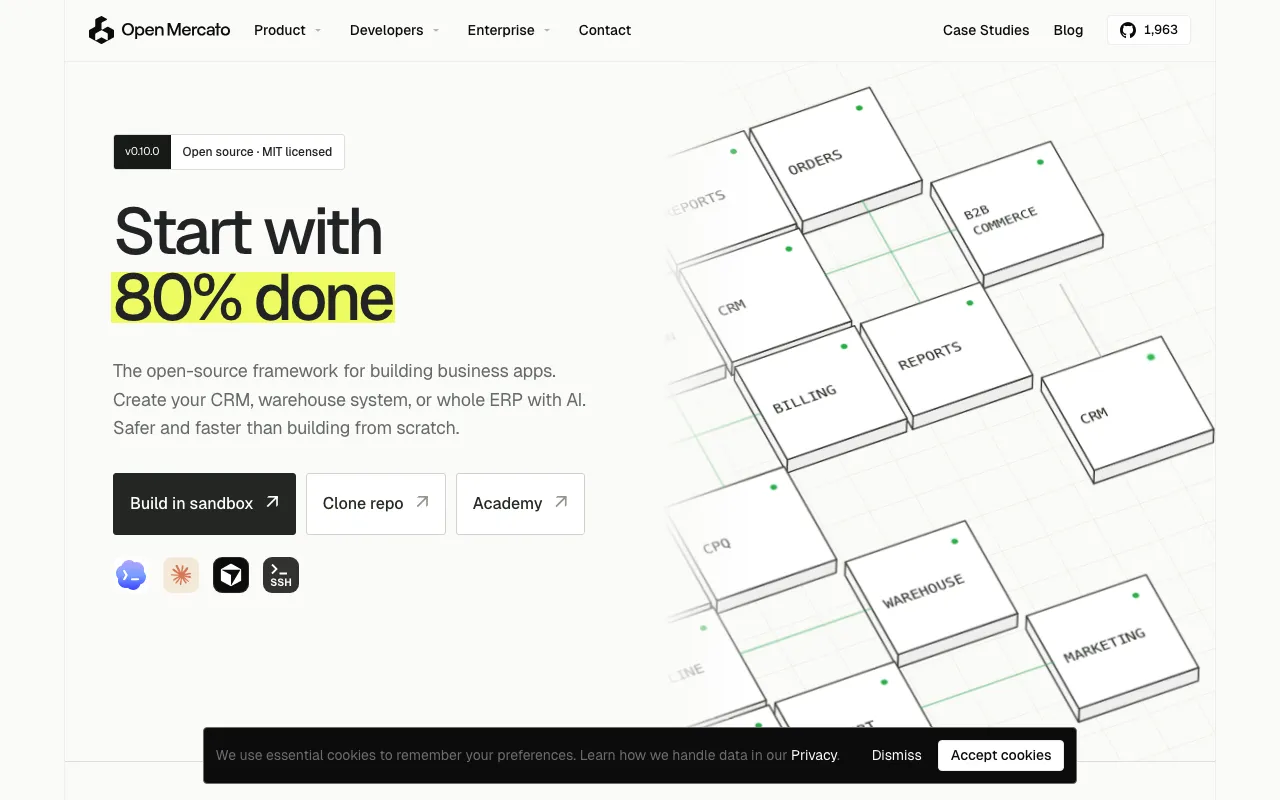
Open Mercato is an open-source TypeScript framework on Next.js and PostgreSQL that ships ready CRM, ERP, and commerce modules so teams start from a working back office.
Overview
Open Mercato is positioned as an AI-engineering foundation for business applications. It combines a Next.js and PostgreSQL stack with multi-tenancy, role-based access, events, and dozens of prebuilt modules covering customers, catalog, sales, warehouse, portal, and workflows. New projects can be scaffolded with create-mercato-app presets so a login-ready admin UI appears after setup.
It is aimed at AI coding tools such as Claude Code, Codex, and Cursor. Specs live beside code in .ai/specs/, and skills like om-help route agents through layered conventions instead of ad hoc structure. Cezar, an agentic development IDE in the ecosystem, runs tasks in isolated git worktrees and can automate work on schedules or GitHub events without merging on its own.
Local development typically uses yarn setup, which can start PostgreSQL, Redis, and Meilisearch via Docker Compose or attach to services you run yourself. Teams without a terminal can use Open Mercato Cloud, a hosted sandbox with browser-based VS Code, agents, and databases that is intended for development rather than production hosting.
Enterprise-oriented modules and cloud trial workspaces sit alongside the MIT-licensed core. CRM, warehouse, procurement, and commerce pieces can be composed into custom ERP-style systems while keeping ownership of the generated application code.
Key features
- Prebuilt CRM and ERP modules
- Next.js and PostgreSQL stack
- Multi-tenancy and RBAC
- AI agent specs and skills
- Cezar parallel agent runs
- Built-in MCP server
- Docker Compose dev services
- Module catalog for extensions
Use cases
- Scaffolding custom CRM or ERP backends
- AI-assisted business feature development
- Composable warehouse and sales operations
- Sandbox prototyping without local tooling






 Ionic Enterprise
