qmetrics.net

Omi

Signal-driven Web Components application framework

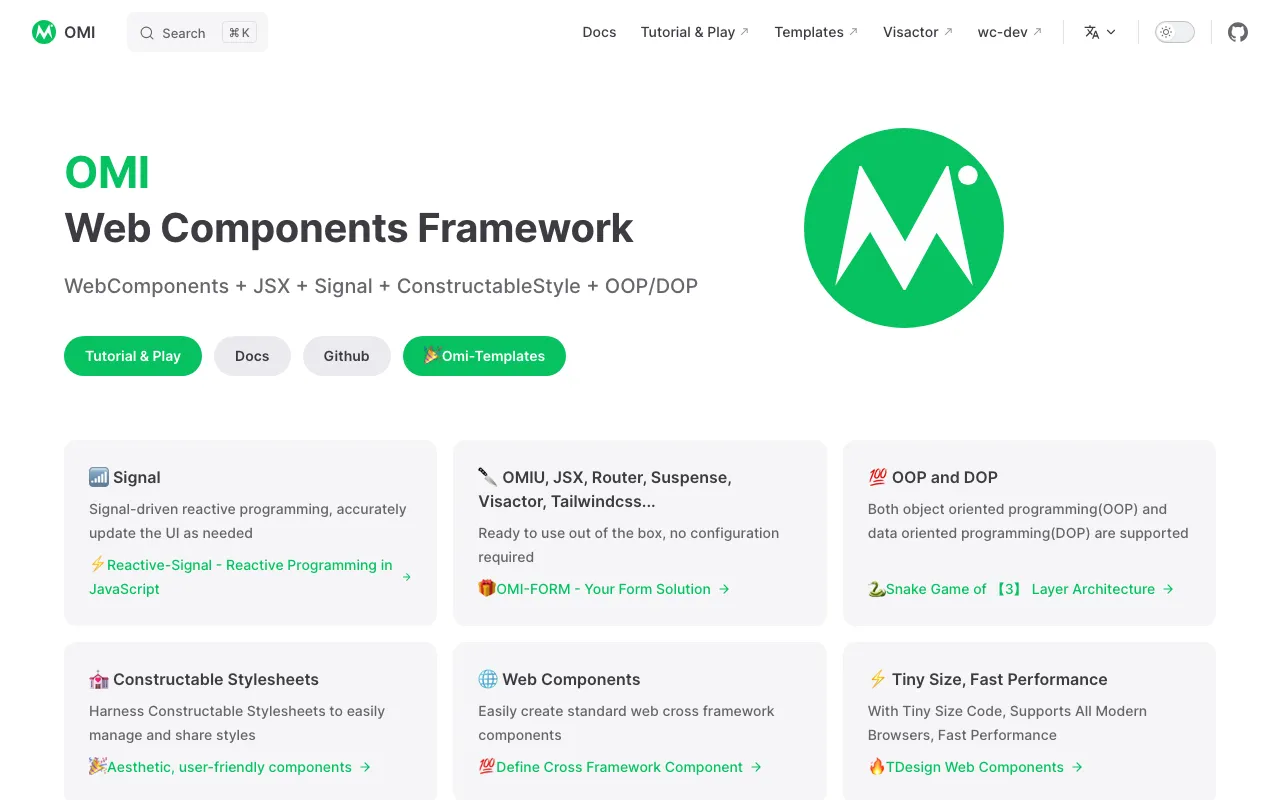
Omi screenshot

Omi is a compact framework for building Web Components with JSX, signals, and constructable stylesheets. Companion packages add routing, suspense, and UI kits.

Overview

Omi is a Web Components framework from Tencent that combines standard custom elements with JSX/TSX authoring, reactive signals, and constructable stylesheets for shared styling. It targets small bundle size and fast updates when signal-driven data changes.

The core npm package implements the runtime, while related packages such as omi-router handle single-page routing, omi-suspense coordinates async dependencies, and omi-transition or omi-ripple supply directives for DOM animations and material-style ripples. Starter templates scaffold Vite-based projects with TypeScript or JavaScript, Tailwind CSS, or SPA layouts.

Components built with Omi are intended to work across frameworks: documentation shows embedding the same custom element in Vue and React and listening for DOM events from those hosts. The ecosystem lists WeUI-based component sets, auto-animate bindings, and example apps such as a reactive snake game.

Project materials emphasize both object-oriented and data-oriented programming styles, with signal reactivity updating only the parts of the UI that depend on changed data. MIT-licensed templates and docs are published alongside the main framework site.

Key features

  • Web Components and shadow DOM
  • JSX and TSX components
  • Reactive signal updates
  • Constructable Stylesheets
  • SPA router package
  • Suspense async handling
  • Tailwind-ready starter kits
  • Cross-framework custom elements

Use cases

  • Reusable web components
  • Signal-driven SPAs
  • Vue or React embedded widgets
  • Tailwind-based UI kits
  • Lightweight component libraries

Tags

Similar software

ECC

Open-source agent engineering toolkit for coding harnesses

ECC adds planning, verification, review, memory, skills, and security scanning to coding agents such as Claude Code, Codex, and Cursor. It installs as plugins, packages, and managed adapters across multiple harnesses.

★ 311.7k⟳ 8 days agoMIT
Frameworks & PlatformsDesktop/CLI app

React

JavaScript library for web and native user interfaces

React helps developers build interfaces from reusable components that manage their own state. Views update declaratively when underlying data changes.

★ 253k⟳ 2 days agoMIT
Frameworks & PlatformsDesktop/CLI app

Flutter

Open-source UI framework for multi-platform apps from one codebase

Flutter is an SDK for building user experiences for mobile, web, and desktop from a single codebase. It uses the Dart language and compiles to native machine code or web targets.

★ 181.5k⟳ todayBSD-3-Clause
Open Source Alternative to:Ionic Enterprise

Bootstrap

Responsive HTML, CSS, and JavaScript front-end toolkit

Bootstrap supplies CSS, JavaScript, and Sass-based styles for building responsive, mobile-first sites. It ships prebuilt grid layouts, UI components, and optional JavaScript plugins.

★ 175.1k⟳ 2 days agoMIT

Langflow

Visual low-code builder for AI agents and workflows

Langflow is a visual builder for AI agents and workflows. Flows can be customized in Python and deployed as an API or as an MCP server, with support for major LLMs and vector databases.

★ 157k⟳ todayMIT
Open Source Alternative to:Relevance AIVoiceflow

LangChain

Framework for agents and LLM-powered applications

LangChain helps developers chain interoperable components and integrations to build agents and LLM-powered applications. It offers a standard interface for models, embeddings, vector stores, and related pieces.

★ 150.1k⟳ 2 days agoMIT