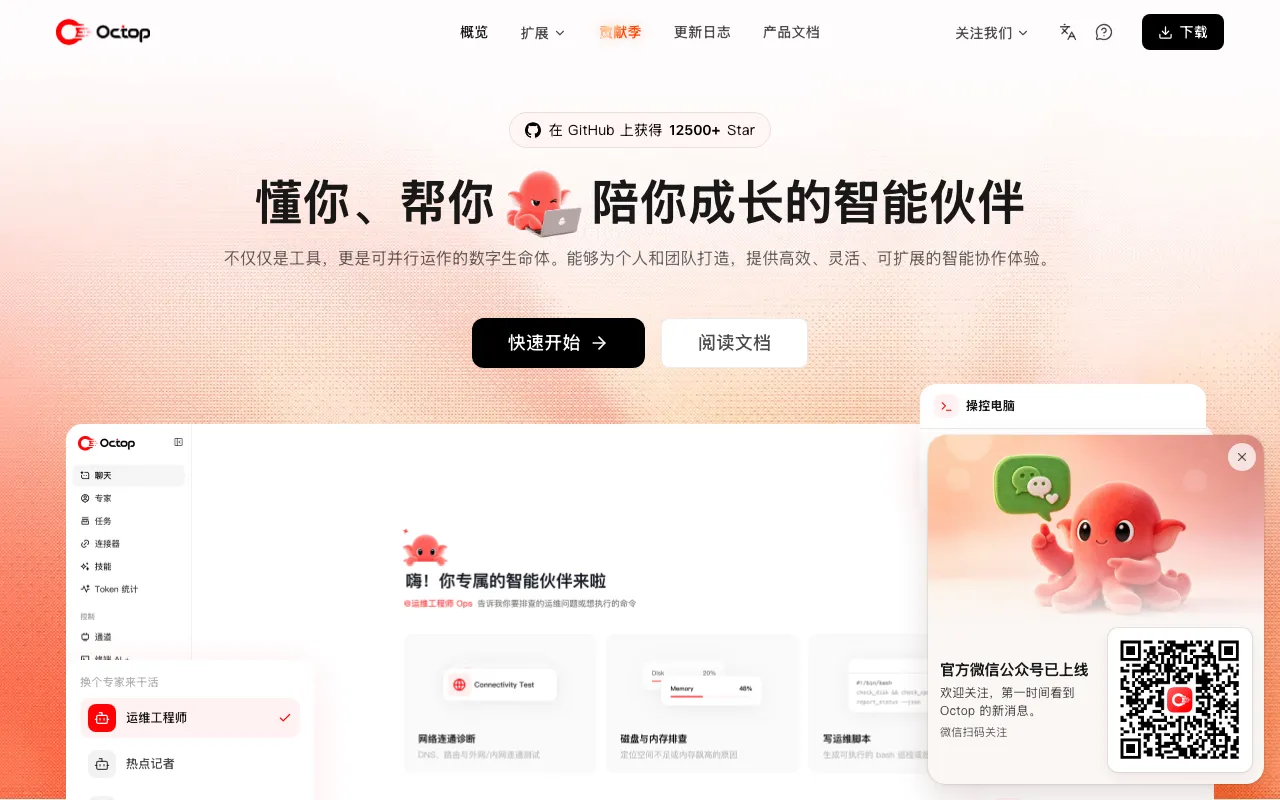
Octop runs on your own hardware as one process serving a web dashboard, CLI, and chat channels. It supports multiple users, specialized experts, knowledge bases, and IM integrations.
Overview
Octop is a self-hosted AI assistant platform for households and small teams. A single runtime exposes a web dashboard, terminal CLI, instant-messaging bridges, and scheduled jobs while keeping conversations, workspaces, and credentials under a local data directory by default.
Each user can maintain multiple experts with separate workspaces, model providers, channels, and cron tasks. Built-in persona templates, an expert library, optional expert sharing inside a deployment, and beta agent teams coordinate multi-step work across specialists. Knowledge bases provide RAG over private documents; plugins extend capabilities on demand.
Channels include Feishu, DingTalk, QQ, WeChat, Telegram, Discord, WeCom, and similar integrations, with unified message handling across surfaces. Security features include JWT multi-user isolation, tool approval flows, shell guardrails, and PII redaction. Workspace files can live on local disk, Docker sandboxes, PostgreSQL, or object storage separate from the control database.
Installation covers one-line shell installers, PyPI, Docker for production, Helm charts with PostgreSQL, and native desktop builds for Windows, macOS, and Linux. Remote desktop, browser automation, terminal assistance, and ACP links to external coding agents round out operational workflows.
Key features
- Multi-user JWT authentication
- Web dashboard and desktop clients
- IM channel integrations
- Expert library and agent teams
- RAG knowledge bases
- Cron and proactive automation
- ACP coding agent delegation
- Docker and Helm deployment
Use cases
- Family-shared private assistants
- Team task routing via IM
- Local-first developer copilot
- Scheduled reporting agents
- GUI and browser automation tasks


 ChatGPT
 Claude Cowork