
TensorFlow
End-to-end machine learning platform and tooling ecosystem
TensorFlow is a machine learning platform with Python and C++ APIs, optional GPU packages, and companion libraries for data, training, deployment, and visualization.
Self-hosted AI gateway with unified model APIs
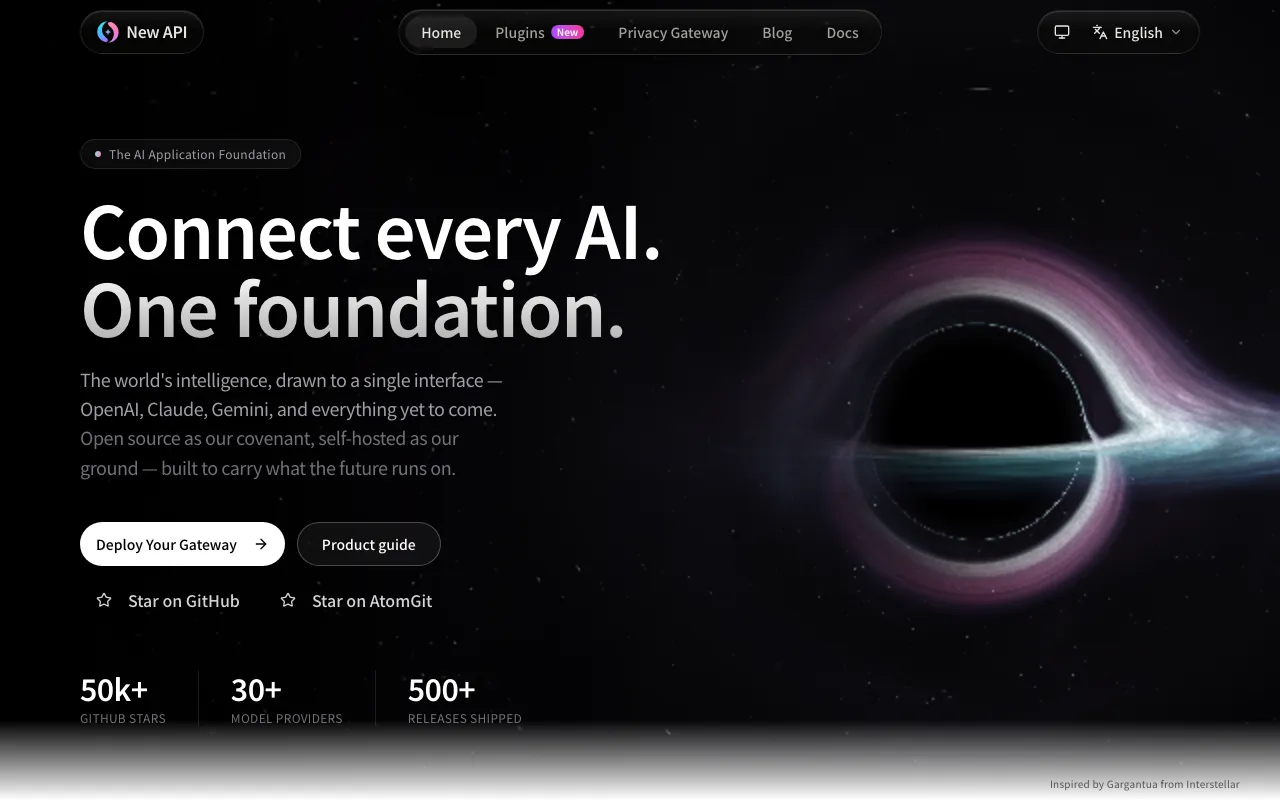
New API connects upstream LLM providers behind one consistent API and web console. Teams manage routing, keys, quotas, and costs without reconfiguring every client.
New API is a self-hosted gateway for applications, agents, and teams that need shared access to many upstream model services. It exposes OpenAI-, Anthropic-, and Gemini-style endpoints, routes traffic through configured channels, and centralizes authentication, usage logs, and billing-style accounting.
Upstream integrations include OpenAI, Anthropic, Google Gemini, Azure OpenAI, AWS Bedrock, Vertex AI, DeepSeek, Qwen, and other compatible providers. RelayKit converts requests and responses between the major text protocols, including streaming and WebSocket paths where the channel and model support them. The console lets administrators configure channels and models, review usage and audit logs, and try models in a playground.
Routing features include model mappings, channel priorities and weights, retries, channel affinity, and multiple upstream keys. Usage controls cover quotas, subscriptions, usage logs, cache accounting, and tiered pricing expressions. Access management supports users, groups, fine-grained permissions, API key limits, OAuth/OIDC, passkeys, two-factor authentication, and session handling. JavaScript task plugins can extend asynchronous image, video, and other task APIs.
Typical deployment uses Docker on Linux amd64 or arm64, with SQLite, MySQL, or PostgreSQL for the main database, optional Redis for shared caching and rate limits, and optional separate log storage including ClickHouse. A Compose stack can run the application with PostgreSQL and Redis. Local trials can start a single container bound to localhost with SQLite and a setup wizard for the first admin account.
End-to-end machine learning platform and tooling ecosystem
TensorFlow is a machine learning platform with Python and C++ APIs, optional GPU packages, and companion libraries for data, training, deployment, and visualization.

Shared model definitions for multimodal ML workloads
Transformers is a Python library that defines pretrained text, vision, audio, and multimodal models once in PyTorch for shared inference and training across the ecosystem.
Open-source RAG engine and agent context platform
RAGFlow ingests heterogeneous documents, builds retrievable knowledge, and supports agent workflows with citations. It can run on your own hardware with Docker or a from-source server stack.
Local LLM context compression library and proxy
Headroom shrinks tool outputs, logs, JSON, and chat history before LLM calls to cut input tokens while preserving retrievable originals. It offers a Python library, proxy, MCP tools, and agent wrappers.

Local desktop workspace to run and fine-tune AI models
Unsloth is a desktop application to chat with, fine-tune, and serve LLMs, diffusion, audio, and embedding models on your own hardware with optional agent integrations.
TensorFlow reference models and modeling utilities collection
The TensorFlow Model Garden hosts implementations of models and modeling solutions for TensorFlow, installable via pip as tf-models-official.