 Granola
 Otter
 Fireflies.ai

MemPalace
Local-first semantic memory for AI agents
MemPalace stores conversation text verbatim and retrieves it with semantic search. It exposes an MCP server and CLI for coding agents.

Local-first meeting and voice memory app for MCP-connected AI assistants
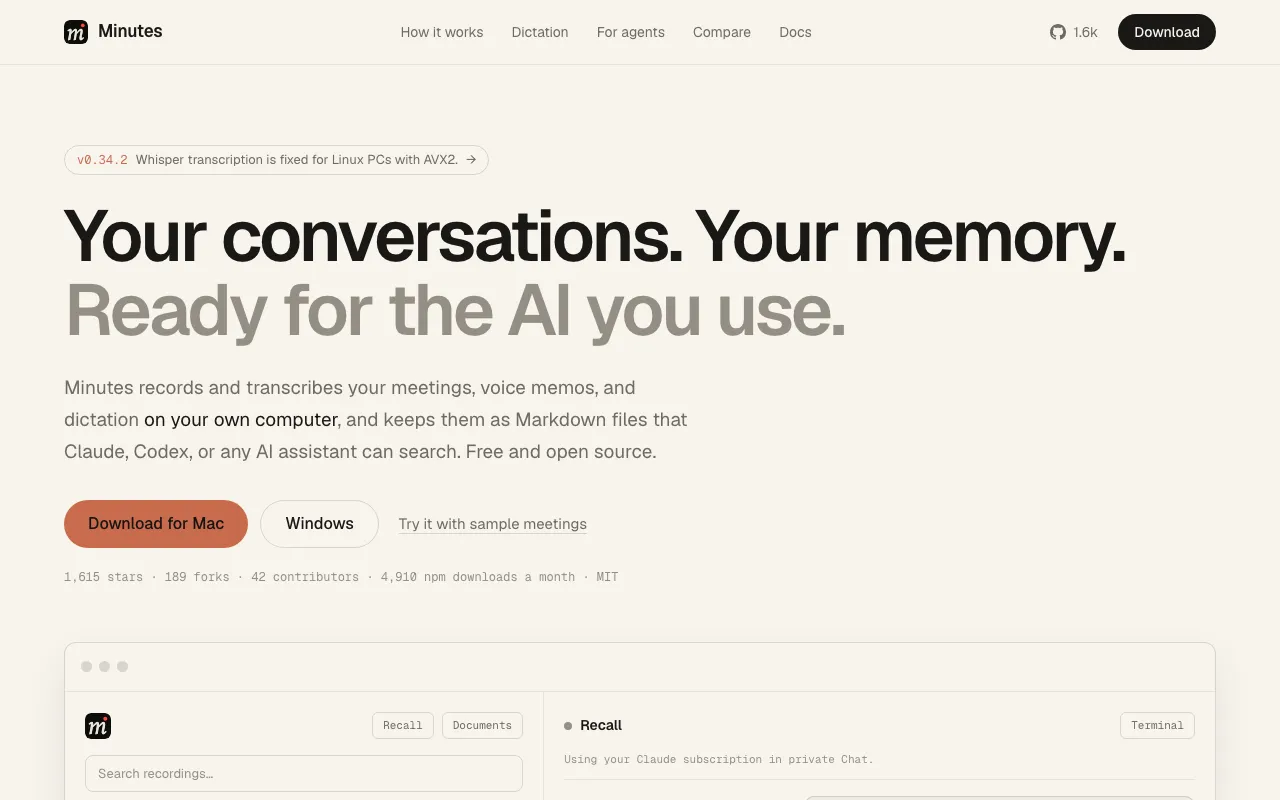
Records and transcribes meetings, calls, voice memos and dictation on your own device into Markdown files. Claude Code, Codex, Cursor or any MCP client can then search that history.
Minutes is a free, open-source conversation memory app. It records meetings, calls, voice memos and dictation, transcribes them on-device, and saves each conversation as a Markdown file with YAML frontmatter in ~/meetings/. Speakers, transcript, decisions and action items end up in a single file you can open, grep or use with Obsidian and Logseq.
AI assistants reach those files through an MCP server with 34 tools, a CLI with 60 commands, a TypeScript SDK, and a Claude Code plugin with 23 skills. Clients named include Claude Code, Codex, Cursor, OpenCode, Pi, Gemini CLI, Claude Desktop and Mistral Vibe. Answers cite the file they came from. A demo mode seeds five sample meetings so you can try queries without a microphone.
The desktop app (Apple Silicon Mac and Windows) sits in the menu bar and offers capture, dictation, Recall, documents and Coach. Dictation types at the cursor on a Mac or copies to the clipboard on Windows and Linux, applies rule-based cleanup such as self-corrections and voice commands, and saves each dictation as Markdown. Transcription can use Whisper or Parakeet models. A prebuilt CLI is available for Linux x86-64, and installation is also possible through Homebrew.
On privacy, capture, transcription and speaker processing run locally and audio stays on your machine. Text leaves the machine only if you choose a cloud assistant or summarizer and share context with it. Each file records its consent basis. Sensitive meetings keep notes without audio, and a Require mode blocks recording until consent is confirmed.
Minutes doesn't name these products itself, but its own description shows it does the same job.
Local-first semantic memory for AI agents
MemPalace stores conversation text verbatim and retrieves it with semantic search. It exposes an MCP server and CLI for coding agents.
Self-hosted, privacy-focused AI research notebook and Notebook LM alternative
Open Notebook is a self-hosted research workspace where you add sources, chat with AI about them, take notes and generate podcasts. It works with 20+ cloud or local AI providers.

Self-hostable personal AI assistant for searching docs and the web
Khoj is an open-source personal AI app that chats with local or online LLMs and answers questions from your documents and the web. It supports custom agents, scheduled automations and research.
Unofficial Python and CLI client for Gemini Notebook
notebooklm-py exposes Google Gemini Notebook (formerly NotebookLM) through a Python API, shell commands, MCP, and REST hooks. It targets automation and agent workflows beyond the web interface.

Private, offline NotebookLM-style AI desktop app for confidential documents
Free, open-source desktop app acting as a private AI agent over your own files. It answers with citations, edits and converts documents, and runs offline with a local or remote model, with no account.
Shared personal memory and skills across coding agents
memU captures agent session history into reusable Markdown skills and retrieves them before new tasks. Host adapters exist for Codex, Claude Code, Cursor, OpenClaw, and others.