
MemPalace
Local-first semantic memory for AI agents
MemPalace stores conversation text verbatim and retrieves it with semantic search. It exposes an MCP server and CLI for coding agents.
Shared personal memory and skills across coding agents
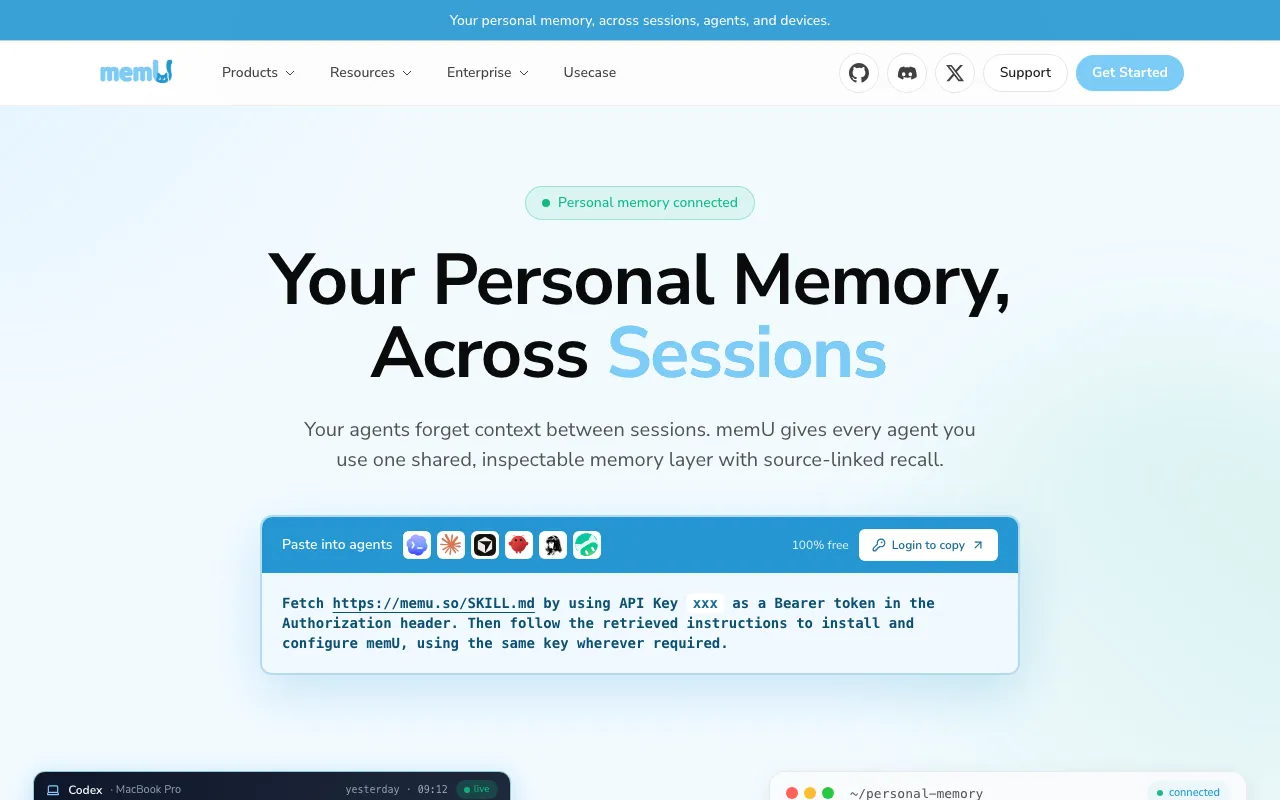
memU captures agent session history into reusable Markdown skills and retrieves them before new tasks. Host adapters exist for Codex, Claude Code, Cursor, OpenClaw, and others.
memU is an agent-driven memory system that stores personal context as inspectable wiki-style Markdown shared across sessions, agents, and devices. Scheduled bridging tasks read session logs from supported coding agents, let the agent distill durable skills, and commit results to a local or cloud-backed store.
Before answering, adapters inject retrieval so relevant memory enters the model context. Binaries such as memu-cursor, memu-claude-code, and memu-codex patch each host’s instruction file and register memorize workflows. One configuration in the user memu config file backs all hosts.
You can use managed cloud storage with an API key from memu.so or run locally with SQLite or Postgres plus pgvector and your own embedding provider. The CLI supports memorize, retrieve, doctor checks, and uninstall that preserves the memory store by default.
MemoryService itself does not call LLM APIs; judgment stays in the connected agent while memU embeds and indexes skill Markdown the agent writes.
Local-first semantic memory for AI agents
MemPalace stores conversation text verbatim and retrieves it with semantic search. It exposes an MCP server and CLI for coding agents.
Self-hosted, privacy-focused AI research notebook and Notebook LM alternative
Open Notebook is a self-hosted research workspace where you add sources, chat with AI about them, take notes and generate podcasts. It works with 20+ cloud or local AI providers.

Self-hostable personal AI assistant for searching docs and the web
Khoj is an open-source personal AI app that chats with local or online LLMs and answers questions from your documents and the web. It supports custom agents, scheduled automations and research.
Unofficial Python and CLI client for Gemini Notebook
notebooklm-py exposes Google Gemini Notebook (formerly NotebookLM) through a Python API, shell commands, MCP, and REST hooks. It targets automation and agent workflows beyond the web interface.

Private, offline NotebookLM-style AI desktop app for confidential documents
Free, open-source desktop app acting as a private AI agent over your own files. It answers with citations, edits and converts documents, and runs offline with a local or remote model, with no account.

Wearable AI for conversation capture, notes, and recall
Omi records conversations and screen context, transcribes in real time, and turns them into searchable summaries, tasks, and chat. It spans a pendant, phone and desktop apps, with an optional cloud backend.
 Fireflies.ai