qmetrics.net

MemPalace

Local-first semantic memory for AI agents

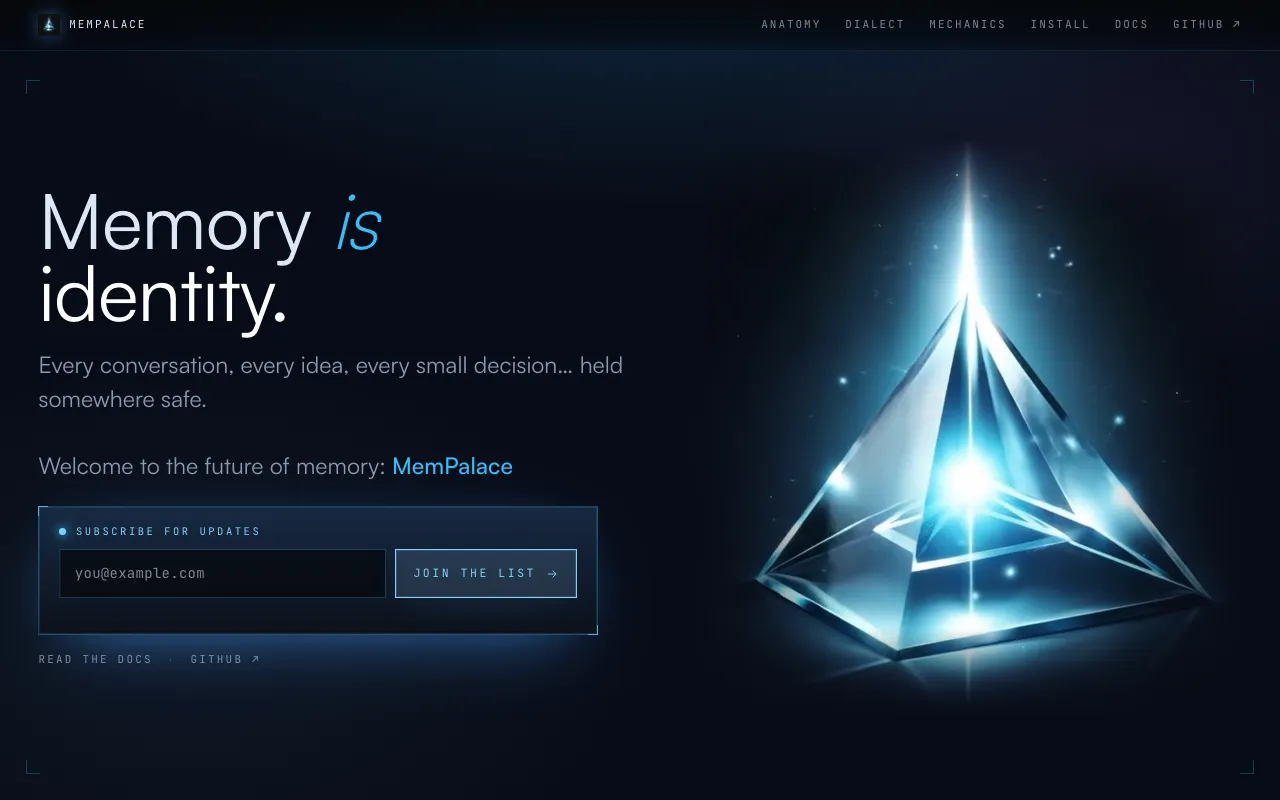
MemPalace screenshot

MemPalace stores conversation text verbatim and retrieves it with semantic search. It exposes an MCP server and CLI for coding agents.

Overview

MemPalace is a local-first memory system for AI workflows. It keeps original conversation and note text without summarizing, then indexes content for semantic recall. Data is organized into wings, rooms, closets, and drawers so searches can be scoped by people, projects, or time.

The default storage backend is embedded ChromaDB, with optional backends such as SQLite exact search, Milvus, Qdrant, and Postgres pgvector. Embeddings run on your machine by default, so routine use needs no cloud API. A temporal knowledge graph in SQLite tracks entity relationships with validity windows.

The MCP server exposes many tools for palace operations, graph queries, mining local files, agent diaries, and coordination. Docker images run the MCP server or CLI on amd64 and arm64 with persistent volumes. Hooks for Claude Code, Codex, and Cursor can auto-save sessions and recall before compaction.

Installation paths include uv or pipx for an isolated CLI, agent-guided setup skills, and compose files for team hubs. Retrieval benchmarks are published for LongMemEval and other suites using hybrid search without mandatory LLM reranking.

Key features

  • Verbatim storage with semantic recall
  • Pluggable vector backends
  • MCP server with broad tool surface
  • Palace indexing by entity and time
  • Local embedding without cloud keys
  • Temporal knowledge graph in SQLite
  • Docker and compose deployment
  • Auto-save hooks for major agents

Use cases

  • Long-horizon agent session memory
  • Mining local chat transcripts
  • Shared team memory hub
  • Recall before answering in IDEs
  • Offline semantic search over notes

Tags

Similar software

Open-Notebook

Self-hosted, privacy-focused AI research notebook and Notebook LM alternative

Open Notebook is a self-hosted research workspace where you add sources, chat with AI about them, take notes and generate podcasts. It works with 20+ cloud or local AI providers.

★ 42.3k⟳ 9 days agoMIT
Open Source Alternative to:NotebookLM

Khoj

Self-hostable personal AI assistant for searching docs and the web

Khoj is an open-source personal AI app that chats with local or online LLMs and answers questions from your documents and the web. It supports custom agents, scheduled automations and research.

★ 38.3k⟳ 3 months agoAGPL-3.0
Open Source Alternative to:Perplexity

Notebooklm Py

Unofficial Python and CLI client for Gemini Notebook

notebooklm-py exposes Google Gemini Notebook (formerly NotebookLM) through a Python API, shell commands, MCP, and REST hooks. It targets automation and agent workflows beyond the web interface.

★ 20.4k⟳ yesterdayMIT

SurfSense

Private, offline NotebookLM-style AI desktop app for confidential documents

Free, open-source desktop app acting as a private AI agent over your own files. It answers with citations, edits and converts documents, and runs offline with a local or remote model, with no account.

★ 17.1k⟳ 4 days agoApache-2.0
Open Source Alternative to:NotebookLM

memU

Shared personal memory and skills across coding agents

memU captures agent session history into reusable Markdown skills and retrieves them before new tasks. Host adapters exist for Codex, Claude Code, Cursor, OpenClaw, and others.

★ 14.6k⟳ yesterdayApache-2.0

Omi AI

Wearable AI for conversation capture, notes, and recall

Omi records conversations and screen context, transcribes in real time, and turns them into searchable summaries, tasks, and chat. It spans a pendant, phone and desktop apps, with an optional cloud backend.

★ 14k⟳ todayMIT
Open Source Alternative to:Fireflies.ai