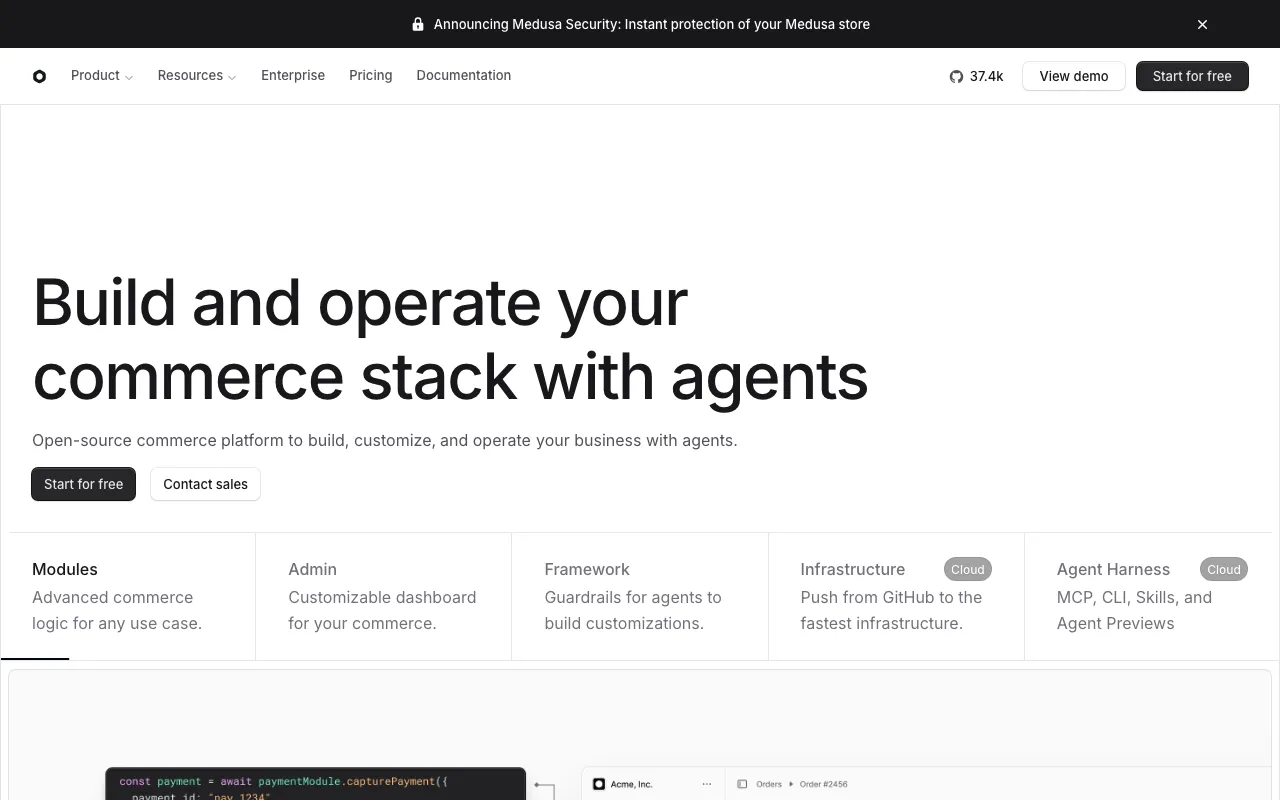
Medusa is an open-source commerce platform with a customization framework and admin dashboard. It supplies commerce primitives such as products, carts, orders and payments for B2B or DTC stores, marketplaces and PoS systems.
Overview
Medusa is an open-source commerce platform that combines ready-made commerce modules with a framework for customizing them. Developers use it to build B2B or direct-to-consumer stores, marketplaces, distributor platforms, point-of-sale systems and other applications, without writing core commerce logic such as products, carts, orders and payments from scratch.
A Medusa application consists of a server exposing Store and Admin APIs, plus an admin dashboard that can be extended. Commerce modules cover areas like product, cart, order and pricing. Infrastructure modules cover the event bus, caching, file storage, locking and workflow engine. Module providers add integrations such as Stripe payments, S3 file storage, SendGrid notifications, Redis, and authentication via email/password, GitHub, Google and OIDC. Official plugins include draft orders and loyalty.
The website lists functions such as product management with bundles and a bulk editor, multiple sales channels, inventory across multiple warehouses, multi-currency and region-specific tax and shipping settings, and a promotion engine with campaigns and B2B pricing. It also presents the framework as providing guardrails for AI agents that build customizations.
To run it locally you need Node.js and a PostgreSQL database. A create-medusa-app command sets up the server, the admin dashboard and optionally a Next.js starter storefront. Docker installation is also available. Medusa Cloud is a managed hosting option with automated deployments and AI tooling such as MCP and a CLI. The core is MIT-licensed, while some enterprise features need a commercial agreement.
Key features
- Commerce modules for products, carts, orders, payments
- Extensible admin dashboard
- Multiple sales channels
- Multi-warehouse inventory
- Multi-currency and regional tax settings
- Promotion engine with B2B pricing
- Payment, file and notification providers
- Framework with guardrails for AI agents
Use cases
- B2B commerce portals
- Direct-to-consumer online stores
- Marketplaces and distributor platforms
- Point-of-sale systems
- Multi-region, multi-store sales
Does the same job as
Medusa doesn't name these products itself, but its own description shows it does the same job.







 Ionic Enterprise