
REA
MCP and CLI reverse-engineering toolkit for agents
REA connects coding agents and terminals to local analysis tools for binaries, Electron apps, websites, .NET, and Android targets. Setup registers MCP access and investigation skills via npm.

Deep-learning file content type identification tool
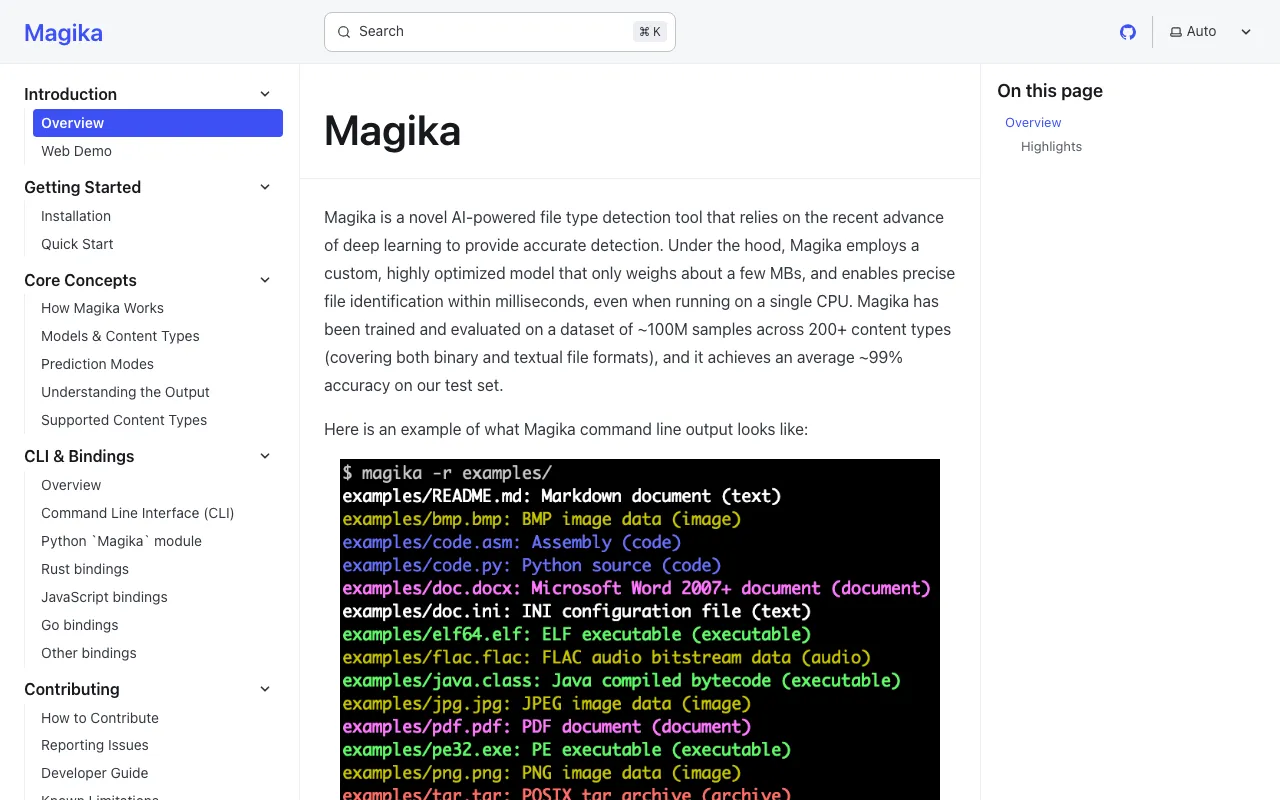
Magika detects file content types using a compact deep learning model, with millisecond inference on a single CPU. It ships as a Rust CLI, Python API, and other language bindings.
Magika identifies what kind of file you are dealing with by analyzing a small slice of file content with a lightweight neural model. It targets both binary and text formats and is designed for speed after an initial model load, with roughly five milliseconds per file on one CPU.
The tool supports batch and recursive directory scans and exposes several prediction modes that trade off confidence against guess quality. When confidence is low, it can return generic labels instead of a specific type. Bindings include a Rust command-line client, a Python module installable via pip, JavaScript and TypeScript (including a browser demo), Rust libraries, and work-in-progress Go support.
Google uses Magika in production to route Gmail, Drive, and Safe Browsing uploads toward appropriate security and policy scanners. Integrations also appear in VirusTotal and abuse.ch workflows. The project supports major desktop operating systems and optional GPU acceleration in newer release candidates.
MCP and CLI reverse-engineering toolkit for agents
REA connects coding agents and terminals to local analysis tools for binaries, Electron apps, websites, .NET, and Android targets. Setup registers MCP access and investigation skills via npm.
AI-guided terminal toolkit for authorized security testing
Hackingtool bundles many security utilities in one console with optional AI help to pick tools and commands. It targets Linux and macOS and is meant for authorized testing only.

AI-driven penetration testing for developers
Strix runs autonomous AI agents that probe applications like attackers, validate issues with proofs of concept, and integrate into CLI and CI workflows.
Android customization suite with root and modules
Magisk is open source software for tailoring Android 7.0 and newer devices. It provides root access, systemless module installs, boot image tools, and per-app code injection via Zygisk.

Autonomous AI penetration tester for web apps and APIs
Shannon analyzes web application source code, plans attack paths, and runs real exploits against staging targets. Only vulnerabilities confirmed with a working proof of concept appear in reports.

POSIX shell client for ACME SSL automation
acme.sh issues, renews, and installs SSL and TLS certificates via the ACME protocol using a single shell script with no Python dependency.