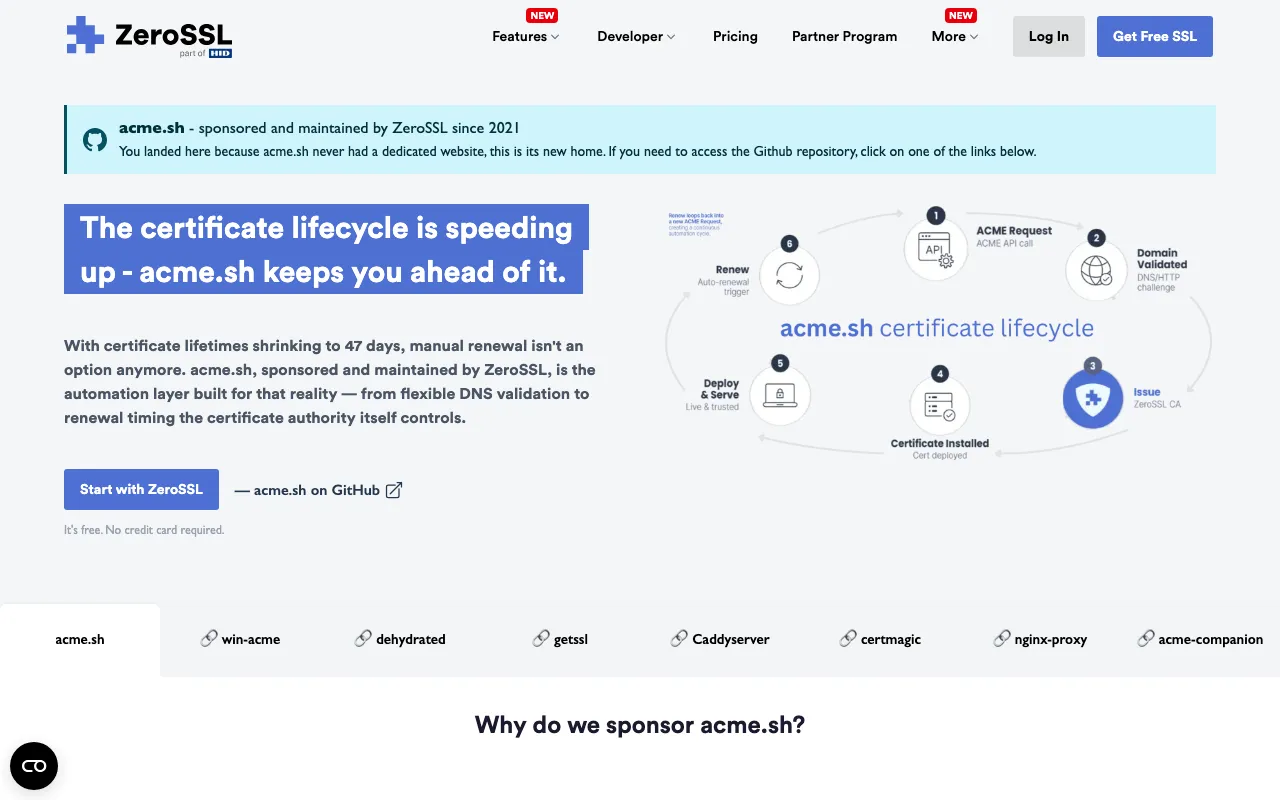
acme.sh issues, renews, and installs SSL and TLS certificates via the ACME protocol using a single shell script with no Python dependency.
Overview
acme.sh is an ACME protocol client implemented entirely in Unix shell. It is built to request, renew, and install certificates from multiple certificate authorities, with ZeroSSL as the default CA and support for Let's Encrypt, SSL.com, Google Public CA, and others.
Validation modes include webroot, standalone HTTP on port 80, standalone TLS-ALPN on port 443, Apache and Nginx integration, DNS challenges with many provider APIs, DNS alias mode, stateless mode, and DNS persist mode for renewals without repeated TXT edits. The tool supports ECDSA and RSA key sizes, SAN and wildcard certificates, and automatic cron-based renewal with optional email notifications.
Installation copies the script to the user home directory, sets an alias, and registers a daily cron job to renew certificates when needed. Certificate files can be installed to Apache or Nginx with a reload command so renewed certs reach the web server. The client runs without requiring root for normal installs, though standalone modes need permission to bind ports 80 or 443.
It is tested on a wide range of BSD, Linux, macOS, and Windows (Cygwin) environments, is Docker-ready, and supports IPv6. Sponsorship by ZeroSSL funds ongoing maintenance while the tool remains CA-agnostic in configuration.
Key features
- Pure shell ACME implementation
- Multiple CA support including ZeroSSL
- DNS API automation for 180+ providers
- Automatic renewal via cron
- ECDSA and wildcard certificates
- Apache and Nginx install hooks
- TLS-ALPN-01 validation mode
- ARI-driven renewal timing
Use cases
- Automating TLS on personal servers
- Wildcard certs via DNS-01
- Renewing certs without Python tooling
- Running ACME on minimal Linux images
- Installing certs into Nginx or Apache