
TensorFlow
End-to-end machine learning platform and tooling ecosystem
TensorFlow is a machine learning platform with Python and C++ APIs, optional GPU packages, and companion libraries for data, training, deployment, and visualization.

Open generative explorable 3D world models
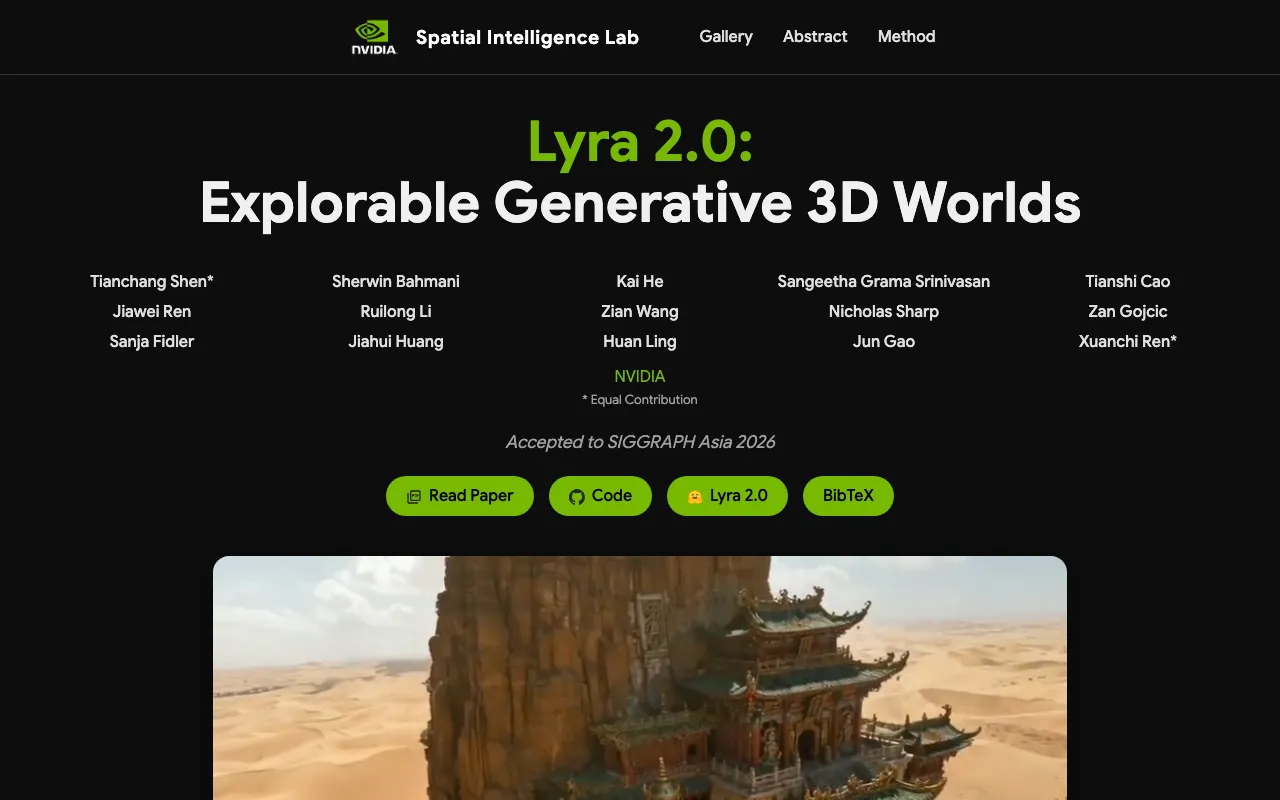
Project Lyra from NVIDIA provides open implementations for generative 3D and 4D worlds. Lyra 2.0 targets long-horizon, 3D-consistent explorable environments.
Project Lyra is a series of generative 3D world models released as open research code. Official implementations cover Lyra 1.0 and Lyra 2.0, including inference, training, and an interactive GUI for Lyra 2.0.
Lyra 1.0 focuses on feed-forward 3D and 4D scene generation from a single image or video via video diffusion self-distillation. Lyra 2.0 generates camera-controlled walkthrough video and lifts it to 3D with feed-forward reconstruction, aiming for persistent worlds users can navigate over long trajectories.
The Lyra 2.0 approach addresses spatial forgetting with per-frame geometry for routing past views and temporal drifting with self-augmented training on degraded histories. An interactive explorer lets users plan camera paths; output can be exported as 3D Gaussians or meshes, with examples tied to simulation tools such as Isaac Sim for robotics scenarios.
Model weights, papers, and project pages are published alongside the code. Licensing splits Apache 2.0 for source and separate terms per model release.
End-to-end machine learning platform and tooling ecosystem
TensorFlow is a machine learning platform with Python and C++ APIs, optional GPU packages, and companion libraries for data, training, deployment, and visualization.

Shared model definitions for multimodal ML workloads
Transformers is a Python library that defines pretrained text, vision, audio, and multimodal models once in PyTorch for shared inference and training across the ecosystem.

Open-source RAG engine and agent context platform
RAGFlow ingests heterogeneous documents, builds retrievable knowledge, and supports agent workflows with citations. It can run on your own hardware with Docker or a from-source server stack.

Local LLM context compression library and proxy
Headroom shrinks tool outputs, logs, JSON, and chat history before LLM calls to cut input tokens while preserving retrievable originals. It offers a Python library, proxy, MCP tools, and agent wrappers.

Local desktop workspace to run and fine-tune AI models
Unsloth is a desktop application to chat with, fine-tune, and serve LLMs, diffusion, audio, and embedding models on your own hardware with optional agent integrations.

TensorFlow reference models and modeling utilities collection
The TensorFlow Model Garden hosts implementations of models and modeling solutions for TensorFlow, installable via pip as tf-models-official.