Core rendering engine: CSS and JavaScript patterns to ship native Android, iOS, and web UIs from one codebase
Overview
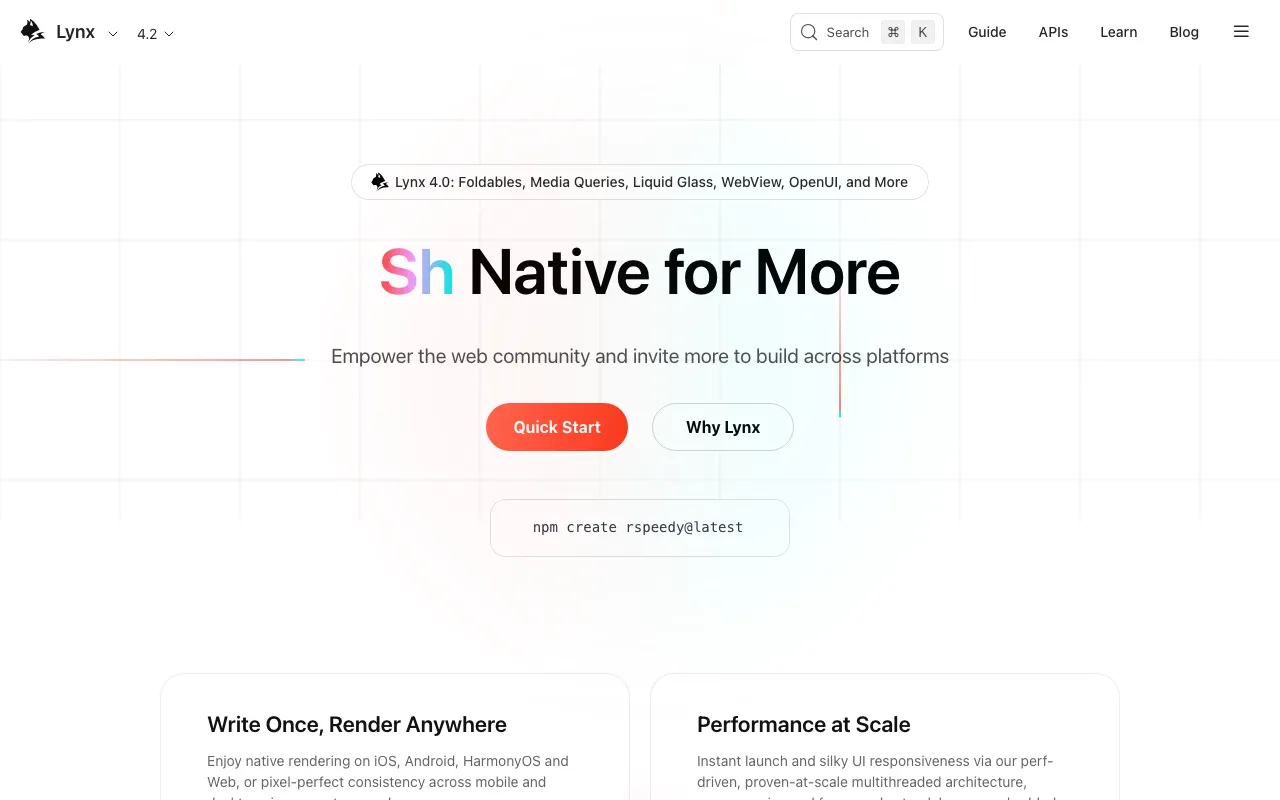
Lynx is a family of technologies aimed at using existing web skills to build native user interfaces for mobile and web from a single codebase. Rendering can target Android, iOS, HarmonyOS, web, and desktop through a custom renderer, with a multithreaded engine intended for responsive launch and interaction whether the runtime stands alone or embeds in another app.
The programming model draws on CSS and familiar web libraries, with ReactLynx as an official framework option and integrations for Vue, Octane, and Haskell’s Miso through shared APIs. Lynx apps can target iOS 10 and Android 5.0 (API 21) or newer; macOS is the recommended development host, while Windows and Linux support is not yet fully verified.
Lynx Explorer is the official companion app for trying Lynx, bundling ReactLynx-based screens across Android, iOS, Harmony, Windows, and macOS runtimes. New projects can be scaffolded with tooling such as npm create rspeedy, and documentation on lynxjs.org covers getting started, hello-world samples, and embedding Lynx in an existing application.
The engine tracked here is one part of the broader Lynx family; other components live in sibling projects under the same organization. Tutorials on the site walk through gallery layouts and main-thread scripting patterns for responsive UI work.
Key features
- Single codebase for Android, iOS, and web
- CSS and JavaScript-oriented development model
- Multithreaded rendering engine
- Framework integrations including ReactLynx and Vue
- Native rendering or consistent custom renderer output
- Lynx Explorer for cross-platform preview
- Embeddable or standalone runtime
- Desktop targets alongside mobile and web
Use cases
- Cross-platform mobile apps from web skills
- Embedding native Lynx UI in existing apps
- Exploring Lynx via Lynx Explorer
- Building with ReactLynx or other supported frameworks
- Consistent UI across mobile and desktop web




 Ionic Enterprise


