qmetrics.net

Locutus

Tree-shakeable TypeScript standard-library ports from many languages

Frameworks & PlatformsDesktop/CLI app
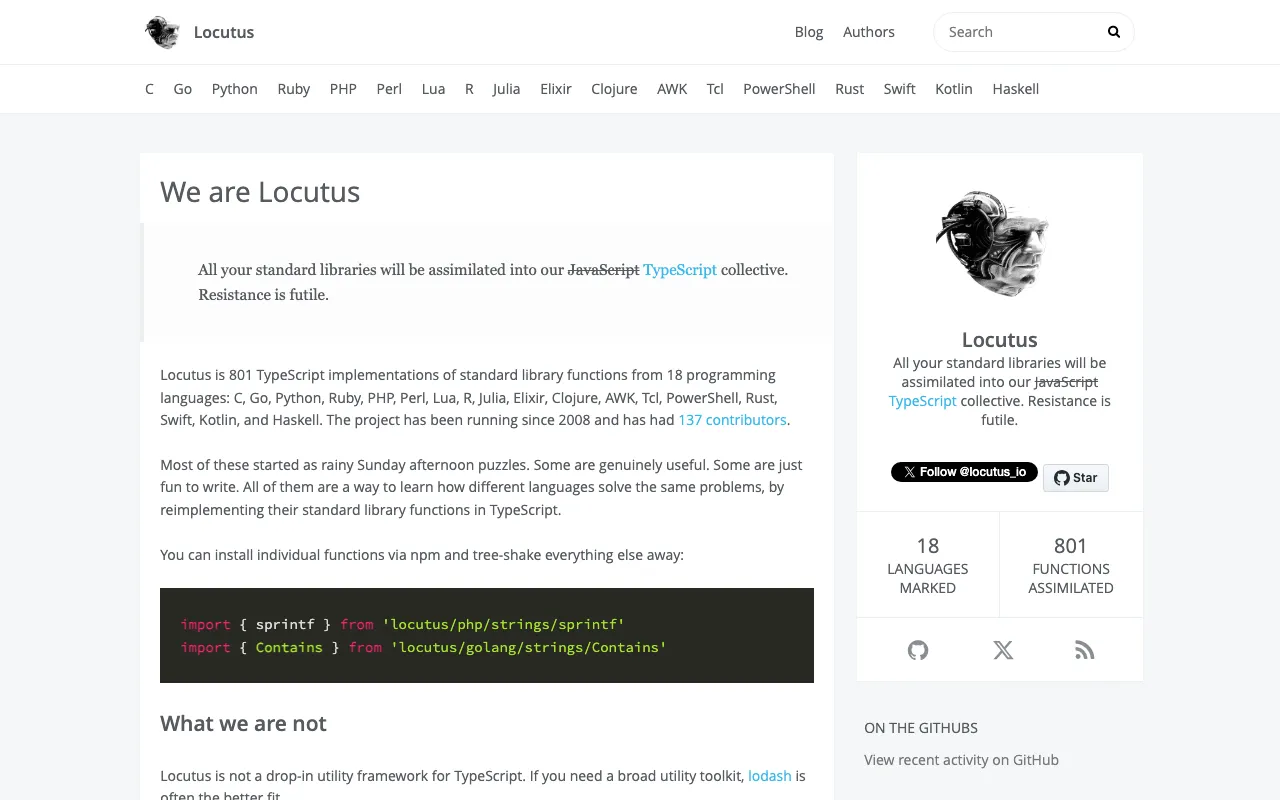
Locutus screenshot

npm package of individually importable TypeScript functions that reimplement standard-library behavior from PHP, Go, Python, Ruby, and other languages.

Overview

Locutus brings standard-library functions from other programming languages into TypeScript. Each routine is published as its own importable module so bundlers can tree-shake unused code, rather than pulling in a monolithic utility layer.

Hundreds of functions cover namespaces such as PHP strings and arrays, Go time and strings, Python math and itertools, Ruby collections, and additional languages including Perl, Lua, R, Rust, and Haskell. The project ports semantics and behavior while keeping JavaScript-native values at the API boundary, without recreating foreign data structures or runtime models in TypeScript.

Install via npm using deep paths per function, which is recommended for size-sensitive browser builds instead of importing whole category indexes. Optional PHP compatibility treats plain objects as associative arrays when locutus.objectsAsArrays is enabled. Published output targets modern Node and ES2022 module formats; snippets on function pages may need transpilation or polyfills on older browsers.

Locutus is not positioned as a broad drop-in utility framework like lodash; it fits when you need parity with another language’s stdlib call or a single familiar function. Function pages document maturity so adopters can judge fitness before use.

Key features

  • Per-function deep npm imports
  • Ports from many programming languages
  • Tree-shakeable modular layout
  • JavaScript-native API values
  • PHP objects-as-arrays mode
  • Browser and Node consumption
  • MIT-licensed core functions
  • Community-maintained function catalog

Use cases

  • PHP-style string formatting in TypeScript
  • Go or Python stdlib parity in JS
  • Single-function browser bundles
  • Learning cross-language stdlib design
  • Legacy API behavior in new codebases

Tags

Similar software

ECC

Open-source agent engineering toolkit for coding harnesses

ECC adds planning, verification, review, memory, skills, and security scanning to coding agents such as Claude Code, Codex, and Cursor. It installs as plugins, packages, and managed adapters across multiple harnesses.

★ 311.7k⟳ 8 days agoMIT
Frameworks & PlatformsDesktop/CLI app

React

JavaScript library for web and native user interfaces

React helps developers build interfaces from reusable components that manage their own state. Views update declaratively when underlying data changes.

★ 253k⟳ 2 days agoMIT
Frameworks & PlatformsDesktop/CLI app

Flutter

Open-source UI framework for multi-platform apps from one codebase

Flutter is an SDK for building user experiences for mobile, web, and desktop from a single codebase. It uses the Dart language and compiles to native machine code or web targets.

★ 181.5k⟳ todayBSD-3-Clause
Open Source Alternative to:Ionic Enterprise

Bootstrap

Responsive HTML, CSS, and JavaScript front-end toolkit

Bootstrap supplies CSS, JavaScript, and Sass-based styles for building responsive, mobile-first sites. It ships prebuilt grid layouts, UI components, and optional JavaScript plugins.

★ 175.1k⟳ 2 days agoMIT

Langflow

Visual low-code builder for AI agents and workflows

Langflow is a visual builder for AI agents and workflows. Flows can be customized in Python and deployed as an API or as an MCP server, with support for major LLMs and vector databases.

★ 157k⟳ todayMIT
Open Source Alternative to:Relevance AIVoiceflow

LangChain

Framework for agents and LLM-powered applications

LangChain helps developers chain interoperable components and integrations to build agents and LLM-powered applications. It offers a standard interface for models, embeddings, vector stores, and related pieces.

★ 150.1k⟳ 2 days agoMIT