
TensorFlow
End-to-end machine learning platform and tooling ecosystem
TensorFlow is a machine learning platform with Python and C++ APIs, optional GPU packages, and companion libraries for data, training, deployment, and visualization.
Data framework for retrieval-augmented LLM applications
LlamaIndex helps developers ingest private data, index it, and query it through LLMs. It offers connectors, retrieval APIs, and hundreds of integration packages.
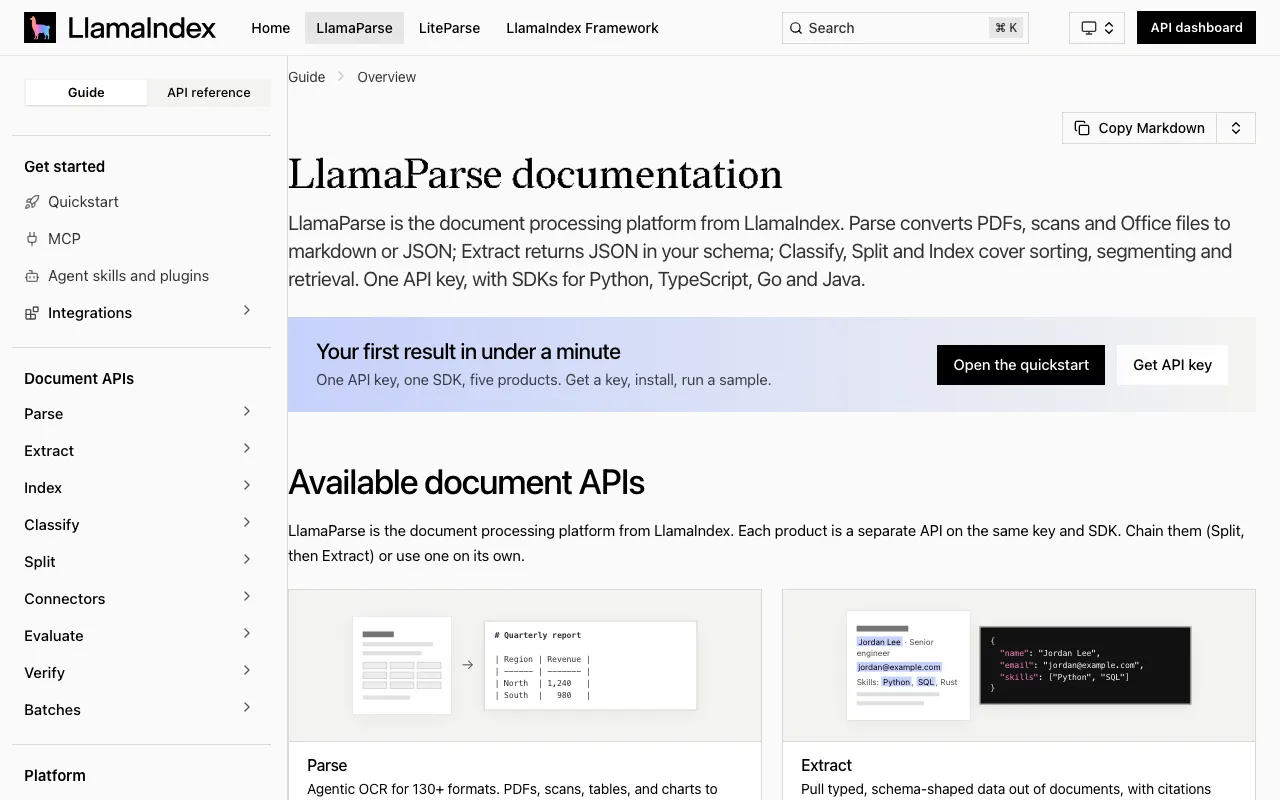
LlamaIndex is an open toolkit for building applications that combine large language models with your own documents and databases. The company behind it also markets LlamaParse for document parsing, but this framework remains a standalone orchestration layer you can adopt with or without that cloud service.
At a high level, the library ingests varied sources such as APIs, PDFs, office files, and SQL, structures them into indices or graphs, and exposes retrieval interfaces that return relevant context for a prompt. Integrations cover many LLM, embedding, and vector store providers through optional packages layered on a small core module.
Beginners can wire ingestion and querying in a handful of lines, while advanced users can customize connectors, retrievers, query engines, and reranking steps. Examples show persisting indices to disk, reloading them later, and hooking into surrounding app stacks mentioned in the docs.
Related commercial APIs documented under the LlamaIndex brand—Parse, Extract, Classify, Split, and Index—handle OCR, schema-shaped extraction, classification, segmentation, and managed RAG ingestion. The Python framework can complement those services but is not limited to them.
End-to-end machine learning platform and tooling ecosystem
TensorFlow is a machine learning platform with Python and C++ APIs, optional GPU packages, and companion libraries for data, training, deployment, and visualization.

Shared model definitions for multimodal ML workloads
Transformers is a Python library that defines pretrained text, vision, audio, and multimodal models once in PyTorch for shared inference and training across the ecosystem.

Open-source RAG engine and agent context platform
RAGFlow ingests heterogeneous documents, builds retrievable knowledge, and supports agent workflows with citations. It can run on your own hardware with Docker or a from-source server stack.

Local LLM context compression library and proxy
Headroom shrinks tool outputs, logs, JSON, and chat history before LLM calls to cut input tokens while preserving retrievable originals. It offers a Python library, proxy, MCP tools, and agent wrappers.

Local desktop workspace to run and fine-tune AI models
Unsloth is a desktop application to chat with, fine-tune, and serve LLMs, diffusion, audio, and embedding models on your own hardware with optional agent integrations.

TensorFlow reference models and modeling utilities collection
The TensorFlow Model Garden hosts implementations of models and modeling solutions for TensorFlow, installable via pip as tf-models-official.