qmetrics.net

LiveSvelte

Svelte components integrated with Phoenix LiveView

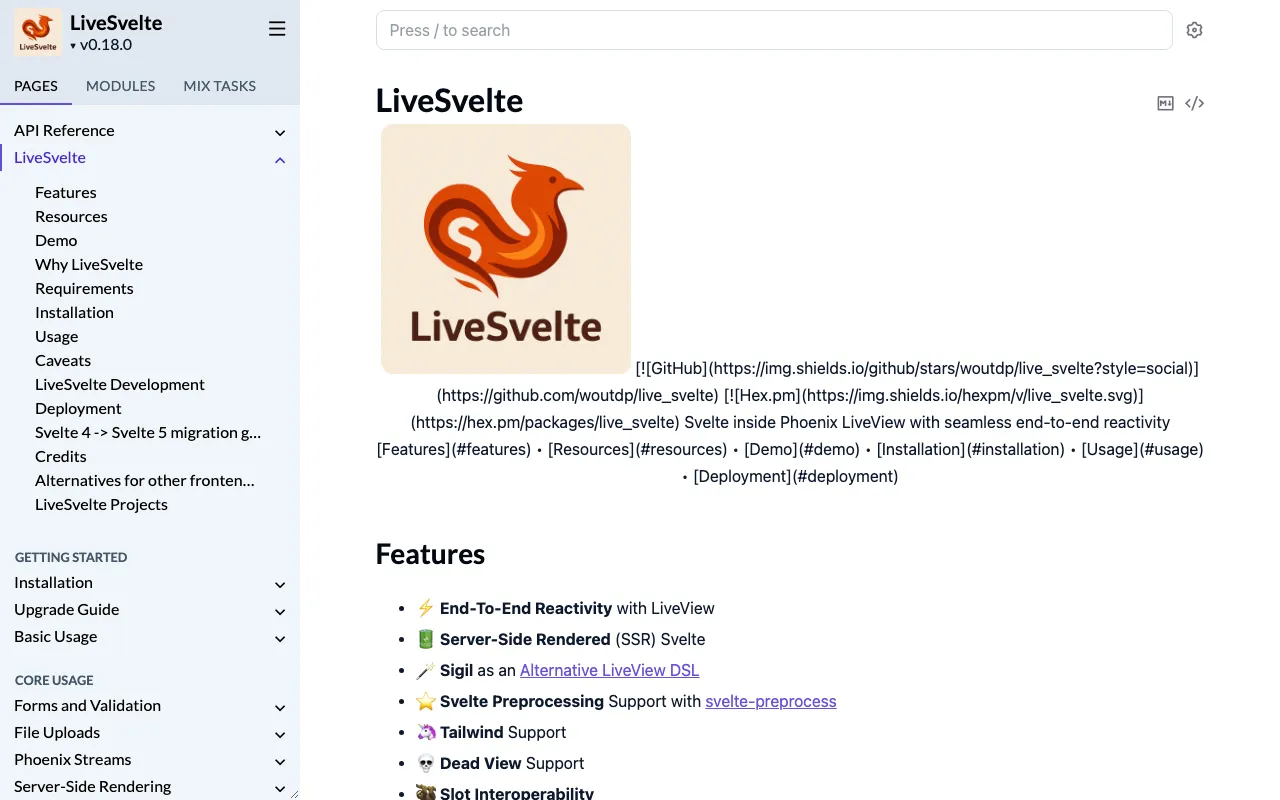
LiveSvelte screenshot

An Elixir library that embeds Svelte in Phoenix LiveView apps for client-side state and server-driven updates over websockets.

Overview

LiveSvelte lets Phoenix LiveView applications embed Svelte components while keeping real-time sync through the existing LiveView websocket. State changes still flow from the server, but Svelte handles DOM updates and local UI state instead of relying only on server-rendered HTML patches.

It supports end-to-end reactivity with LiveView, optional server-side rendering of Svelte, Tailwind and TypeScript for client assets, slot interoperability with LiveView, and a sigil-based DSL as an alternative to HEEx templates. Components live under assets/svelte and connect via props, hooks, and LiveView JavaScript interop helpers such as pushEvent and handleEvent.

Installation targets Phoenix 1.8+ projects and integrates Vite through phoenixvite, with an Igniter-based installer or manual steps. Development can hot-reload Svelte and CSS through an embedded Vite watcher; production SSR typically needs Node.js 19 or later, with Bun optional for package management and builds.

The package suits teams that want Svelte animations, scoped CSS, or richer client state without abandoning LiveView’s server-centric model. SSR can be toggled globally or per component when first paint or hydration behavior matters.

Key features

  • LiveView websocket sync with Svelte components
  • Optional server-side rendering for Svelte
  • Vite and phoenixvite asset pipeline
  • Sigil DSL alternative to HEEx
  • Tailwind and TypeScript client support
  • Slot interoperability with LiveView
  • Components macro for JSX-like usage
  • Dead view and preprocessing support

Use cases

  • Complex local UI state in LiveView apps
  • Chat and real-time interfaces with Svelte UI
  • Svelte animations alongside server state
  • Hybrid LiveView forms with Svelte widgets
  • Scoped CSS in Phoenix full-stack projects

Tags

Similar software

ECC

Open-source agent engineering toolkit for coding harnesses

ECC adds planning, verification, review, memory, skills, and security scanning to coding agents such as Claude Code, Codex, and Cursor. It installs as plugins, packages, and managed adapters across multiple harnesses.

★ 311.7k⟳ 8 days agoMIT
Frameworks & PlatformsDesktop/CLI app

React

JavaScript library for web and native user interfaces

React helps developers build interfaces from reusable components that manage their own state. Views update declaratively when underlying data changes.

★ 253k⟳ 2 days agoMIT
Frameworks & PlatformsDesktop/CLI app

Flutter

Open-source UI framework for multi-platform apps from one codebase

Flutter is an SDK for building user experiences for mobile, web, and desktop from a single codebase. It uses the Dart language and compiles to native machine code or web targets.

★ 181.5k⟳ todayBSD-3-Clause
Open Source Alternative to:Ionic Enterprise

Bootstrap

Responsive HTML, CSS, and JavaScript front-end toolkit

Bootstrap supplies CSS, JavaScript, and Sass-based styles for building responsive, mobile-first sites. It ships prebuilt grid layouts, UI components, and optional JavaScript plugins.

★ 175.1k⟳ 2 days agoMIT

Langflow

Visual low-code builder for AI agents and workflows

Langflow is a visual builder for AI agents and workflows. Flows can be customized in Python and deployed as an API or as an MCP server, with support for major LLMs and vector databases.

★ 157k⟳ todayMIT
Open Source Alternative to:Relevance AIVoiceflow

LangChain

Framework for agents and LLM-powered applications

LangChain helps developers chain interoperable components and integrations to build agents and LLM-powered applications. It offers a standard interface for models, embeddings, vector stores, and related pieces.

★ 150.1k⟳ 2 days agoMIT






