
TensorFlow
End-to-end machine learning platform and tooling ecosystem
TensorFlow is a machine learning platform with Python and C++ APIs, optional GPU packages, and companion libraries for data, training, deployment, and visualization.
Graph-based retrieval-augmented generation framework with WebUI
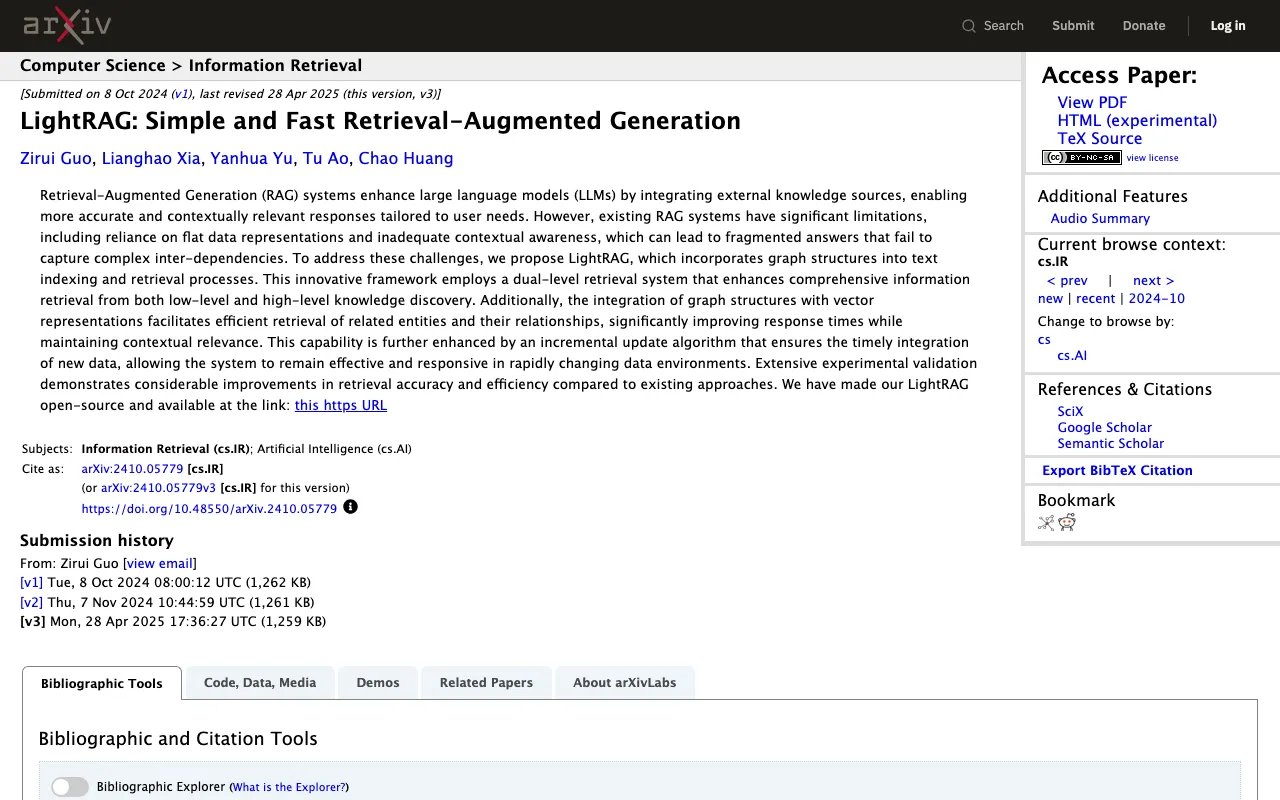
LightRAG augments LLM answers by indexing documents with graph and vector structures. You run a server with a WebUI and API for ingest, query, and visualization.
LightRAG is a retrieval-augmented generation system that combines knowledge graphs with vector embeddings so queries can pull both specific facts and broader context. The design targets scalable indexing and retrieval without relying solely on flat chunk search.
A dual-level retrieval approach is described for low-level detail and higher-level conceptual matches. Graph structure is integrated with vector representations to relate entities and relationships, and the framework supports incremental updates and selective document deletion with knowledge graph regeneration.
Deployment options include installing from PyPI, cloning the source tree, or launching via Docker Compose. A WebUI lets you insert documents, run queries, and visualize the knowledge graph, alongside REST API documentation. Storage backends mentioned include local files, PostgreSQL, MongoDB, Neo4J, and OpenSearch, with optional Docker-based setup for embeddings, reranking, and storage.
Document ingestion supports multiple parsers such as native handling, MinerU, and Docling, configurable text chunking strategies, role-specific LLM settings, reranking, citations, and evaluation hooks via RAGAS and tracing via Langfuse according to project news notes.
End-to-end machine learning platform and tooling ecosystem
TensorFlow is a machine learning platform with Python and C++ APIs, optional GPU packages, and companion libraries for data, training, deployment, and visualization.

Shared model definitions for multimodal ML workloads
Transformers is a Python library that defines pretrained text, vision, audio, and multimodal models once in PyTorch for shared inference and training across the ecosystem.
Open-source RAG engine and agent context platform
RAGFlow ingests heterogeneous documents, builds retrievable knowledge, and supports agent workflows with citations. It can run on your own hardware with Docker or a from-source server stack.

Local LLM context compression library and proxy
Headroom shrinks tool outputs, logs, JSON, and chat history before LLM calls to cut input tokens while preserving retrievable originals. It offers a Python library, proxy, MCP tools, and agent wrappers.

Local desktop workspace to run and fine-tune AI models
Unsloth is a desktop application to chat with, fine-tune, and serve LLMs, diffusion, audio, and embedding models on your own hardware with optional agent integrations.
TensorFlow reference models and modeling utilities collection
The TensorFlow Model Garden hosts implementations of models and modeling solutions for TensorFlow, installable via pip as tf-models-official.