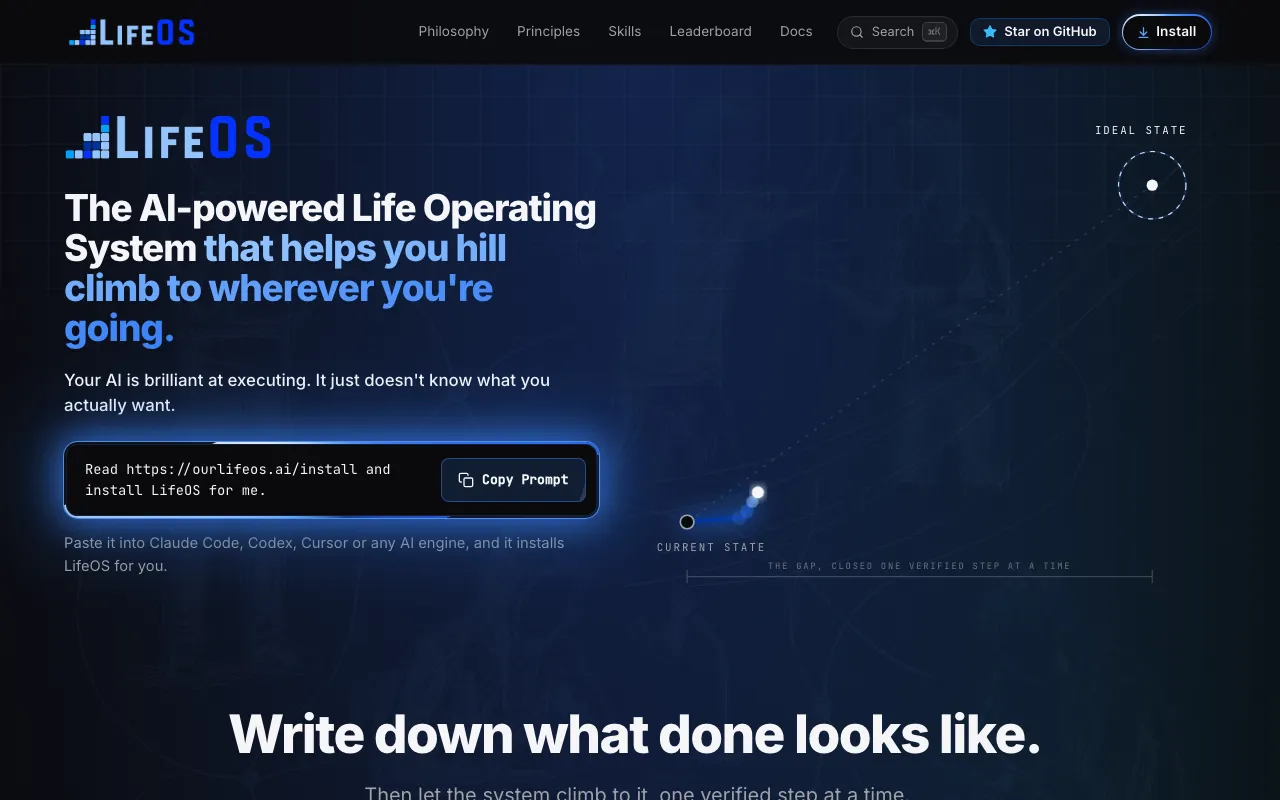
LifeOS layers persistent context, custom skills, and routing on top of capable AI coding agents. It tracks goals and verifies progress from current toward ideal states.
Overview
LifeOS is a general-purpose AI harness for personal and professional work. It stores who you are, what matters to you, and where you are headed, then applies that context across tasks handled by an AI assistant.
Core ideas include TELOS for mission and goals, the Algorithm loop for articulating criteria, climbing toward them, verifying with tool evidence, and recording learnings. ISA documents define what “done” looks like as checkable criteria. Named subsystems include Cortex for memory, Synapse for input routing, skills libraries, hooks, and optional components such as Pulse, Doctor, and Hermes terminal access.
Installation is driven through an AI agent: users paste an install prompt into tools like Claude Code, Cursor, or Codex, which read install guidance and perform setup with permission prompts. A terminal shortcut exists for Claude Code on macOS and Linux using bun.
Many public skills cover research, security, writing, media, and home topics. The design is harness-agnostic, with TypeScript and Bash implementation, though the author primarily runs it on Claude Code.
Key features
- Persistent session and decision memory
- Bundled public task skills library
- TELOS goal and context capture
- Algorithm verify-with-evidence loop
- Agent-driven install and upgrades
- Hook and routing customization layer
- Optional Doctor health reporting
- Hermes terminal agent sidecar
Use cases
- Personal AI with long-lived context
- Goal-driven project workflows
- Repeatable verified task execution
- Extending Claude Code or Cursor setups

 ChatGPT
 Claude Cowork