qmetrics.net

Leptos

Full-stack isomorphic Rust framework for reactive web UIs

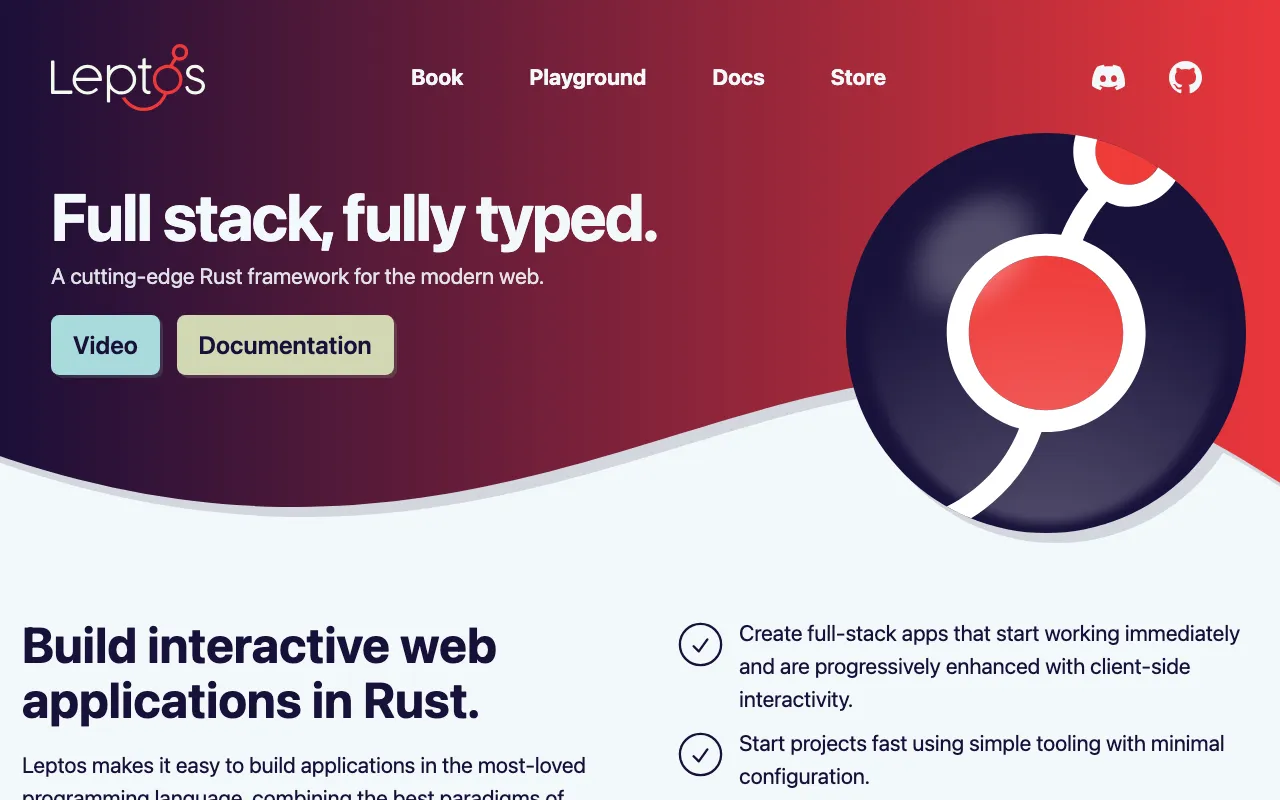
Leptos screenshot

Leptos is a Rust web framework with fine-grained reactivity, JSX-like views, and routing on server and client. Server functions bridge backend logic and UI code.

Overview

Leptos targets full-stack web applications written in Rust. It combines a reactive system, templating, and a router that can run on both server and client, with an isomorphic model so UI logic can span environments.

Fine-grained reactivity means updates can touch individual DOM nodes, classes, or elements when signals change, rather than relying on a virtual DOM diff for every state change. Components are described declaratively while the framework maps that structure to browser updates.

Server integration features include server functions that call backend Rust from the client without hand-rolling separate API endpoints for each action. Documentation describes progressive enhancement: pages can render on the server first and gain client-side interactivity afterward, including streaming HTML modes mentioned in comparisons with other Rust UI stacks.

The cargo-leptos tool is intended to simplify building client-and-server apps with starter templates for Actix or Axum. Companion tooling includes a language server and VS Code extension, plus hot-reloading for template edits.

Key features

  • Fine-grained reactive signal updates
  • JSX-like view templating macro
  • Client and server-side routing
  • Server functions across client boundary
  • Streaming and SSR HTML rendering
  • cargo-leptos client-server builds
  • VS Code extension and language server
  • WASM client deployment support

Use cases

  • Full-stack Rust web applications
  • Interactive UIs with server-first HTML
  • Shared types between client and server
  • Component-based sites with reactive state

Tags

Similar software

ECC

Open-source agent engineering toolkit for coding harnesses

ECC adds planning, verification, review, memory, skills, and security scanning to coding agents such as Claude Code, Codex, and Cursor. It installs as plugins, packages, and managed adapters across multiple harnesses.

★ 311.7k⟳ 8 days agoMIT
Frameworks & PlatformsDesktop/CLI app

React

JavaScript library for web and native user interfaces

React helps developers build interfaces from reusable components that manage their own state. Views update declaratively when underlying data changes.

★ 253k⟳ 2 days agoMIT
Frameworks & PlatformsDesktop/CLI app

Flutter

Open-source UI framework for multi-platform apps from one codebase

Flutter is an SDK for building user experiences for mobile, web, and desktop from a single codebase. It uses the Dart language and compiles to native machine code or web targets.

★ 181.5k⟳ todayBSD-3-Clause
Open Source Alternative to:Ionic Enterprise

Bootstrap

Responsive HTML, CSS, and JavaScript front-end toolkit

Bootstrap supplies CSS, JavaScript, and Sass-based styles for building responsive, mobile-first sites. It ships prebuilt grid layouts, UI components, and optional JavaScript plugins.

★ 175.1k⟳ 2 days agoMIT

Langflow

Visual low-code builder for AI agents and workflows

Langflow is a visual builder for AI agents and workflows. Flows can be customized in Python and deployed as an API or as an MCP server, with support for major LLMs and vector databases.

★ 157k⟳ todayMIT
Open Source Alternative to:Relevance AIVoiceflow

LangChain

Framework for agents and LLM-powered applications

LangChain helps developers chain interoperable components and integrations to build agents and LLM-powered applications. It offers a standard interface for models, embeddings, vector stores, and related pieces.

★ 150.1k⟳ 2 days agoMIT






