
TensorFlow
End-to-end machine learning platform and tooling ecosystem
TensorFlow is a machine learning platform with Python and C++ APIs, optional GPU packages, and companion libraries for data, training, deployment, and visualization.

Multi-modal data labeling and AI evaluation platform
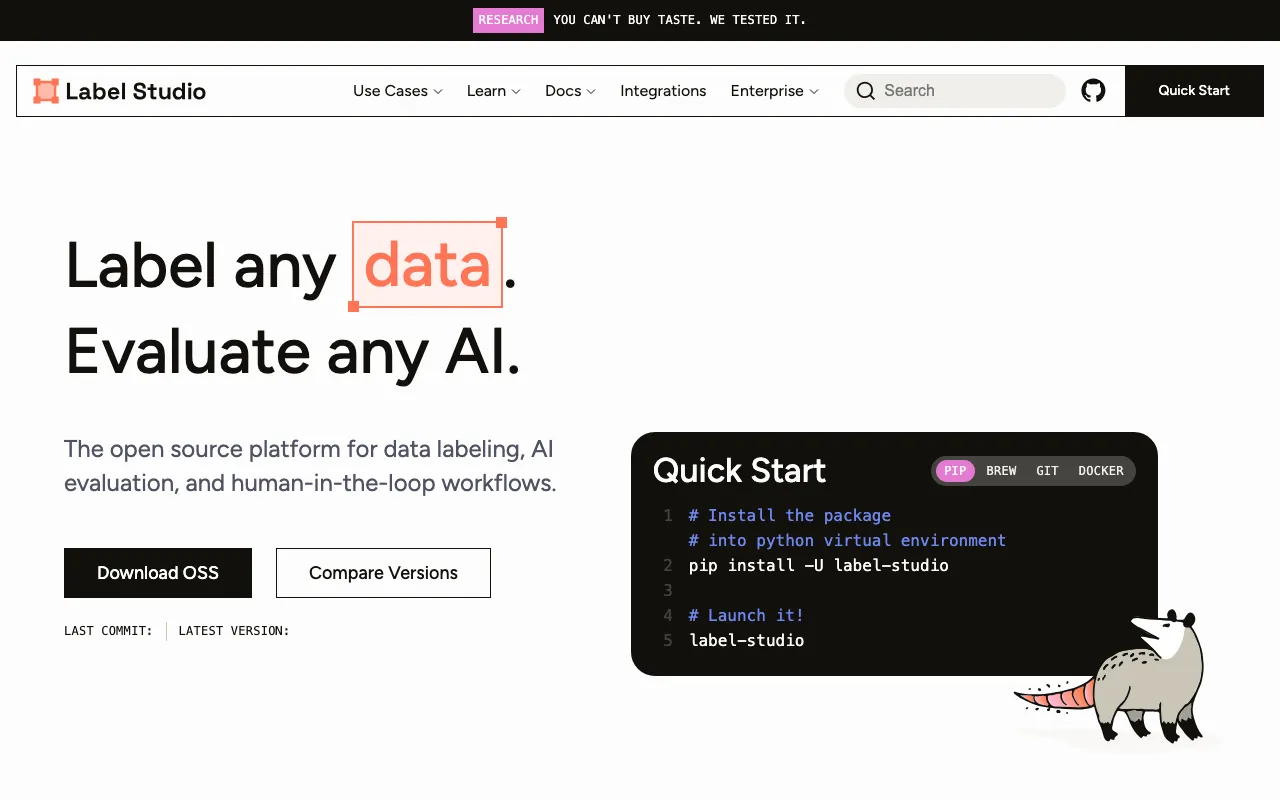
Label Studio provides a web UI to annotate images, text, audio, video, and time series, then export labels for machine learning pipelines.
Label Studio helps teams prepare and refine training data through human annotation. Annotators work in a browser across modalities such as images, audio, text, HTML, video, and time series, using templates or custom labeling configurations for tasks like classification, detection, segmentation, transcription, and named entity recognition.
Projects can run on a single instance with multi-user sign-in, separate datasets per project, and imports from local files or cloud buckets on Amazon S3 and Google Cloud Storage. Exports align with common model training formats, and a REST API supports embedding labeling into automated data pipelines.
Machine learning integrations connect prediction servers for pre-labeling, online learning, and active learning workflows. Configurable layouts adapt to agent traces, LLM evaluations, RLHF preferences, document AI, and retrieval QA review when teams extend the default templates.
You can install with pip, Docker, Docker Compose stacks that include databases and reverse proxies, or one-click cloud templates. A command-line launcher starts the local server, and official container images persist project data through mounted volumes.
End-to-end machine learning platform and tooling ecosystem
TensorFlow is a machine learning platform with Python and C++ APIs, optional GPU packages, and companion libraries for data, training, deployment, and visualization.

Shared model definitions for multimodal ML workloads
Transformers is a Python library that defines pretrained text, vision, audio, and multimodal models once in PyTorch for shared inference and training across the ecosystem.

Open-source RAG engine and agent context platform
RAGFlow ingests heterogeneous documents, builds retrievable knowledge, and supports agent workflows with citations. It can run on your own hardware with Docker or a from-source server stack.

Local LLM context compression library and proxy
Headroom shrinks tool outputs, logs, JSON, and chat history before LLM calls to cut input tokens while preserving retrievable originals. It offers a Python library, proxy, MCP tools, and agent wrappers.

Local desktop workspace to run and fine-tune AI models
Unsloth is a desktop application to chat with, fine-tune, and serve LLMs, diffusion, audio, and embedding models on your own hardware with optional agent integrations.

TensorFlow reference models and modeling utilities collection
The TensorFlow Model Garden hosts implementations of models and modeling solutions for TensorFlow, installable via pip as tf-models-official.