qmetrics.net

Kusion

Intent-driven internal developer platform orchestrator

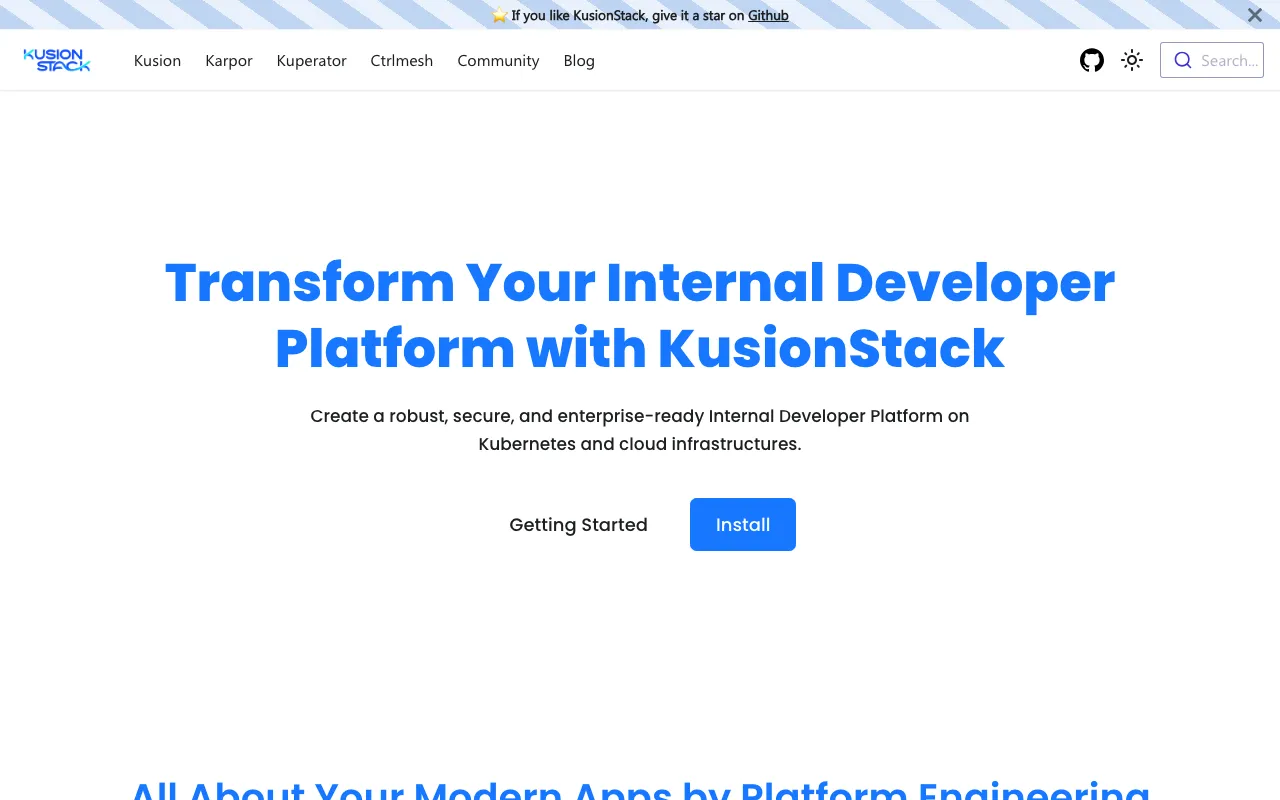
Kusion screenshot

Kusion is a platform orchestrator for internal developer platforms: one AppConfiguration spec drives workloads and dependencies across environments.

Overview

Kusion is an intent-driven platform orchestrator meant to sit at the core of an internal developer platform. Application teams describe workloads and resource dependencies in a single AppConfiguration document without baking in environment-specific values; the platform fills in what is needed for the app to run in each landing zone.

Platform engineers use Day 0 workflows to publish shared modules and workspace definitions that encode security, compliance, and cost rules. Application engineers use Day 1 workflows to deploy through those modules in a repeatable self-service model while the platform team maintains the shared building blocks.

Kusion Server runs as a long-running service with a Developer Portal and REST APIs. It mirrors CLI capabilities and adds centralized metadata and visualized application resource graphs for projects, stacks, workspaces, and runs. Installation expects access to a Kubernetes cluster via kubeconfig.

The stack is Kubernetes-first and targets cloud-native landing zones. It supports codified validation, collaboration between app and platform roles, and enterprise-oriented cluster controls as described on the project website.

Key features

  • AppConfiguration application spec
  • Shared platform modules
  • Workspace landing zones
  • Kusion Server and Developer Portal
  • REST APIs for integrations
  • Visual application resource graphs
  • Kubernetes-targeted deployments
  • CLI and server workflows

Use cases

  • Building an internal developer platform
  • Standardized app delivery to Kubernetes
  • Platform engineer module sharing
  • Self-service application deployment
  • Multi-environment intent-driven releases

Tags

Similar software

Coolify

Self-hostable PaaS for apps, databases, and one-click services

Coolify deploys static sites, databases, and full-stack apps on servers you control, with a dashboard similar to managed hosting platforms. Configurations stay on your machines over SSH.

★ 66.7k⟳ todayApache-2.0
Build & DeploymentSelf-hostable
Open Source Alternative to:HerokuNetlify+3

Dokploy

Self-hostable PaaS for apps and databases

Dokploy is a self-hostable platform-as-a-service for deploying applications and databases on your own VPS. It supports Docker, Compose, multi-server setups, backups, and monitoring.

★ 38.7k⟳ yesterdayApache-2.0
Build & DeploymentSelf-hostable
Open Source Alternative to:HerokuNetlify+3

Dokku

Docker-powered mini PaaS on your own hardware

Dokku is a small platform-as-a-service you install on a Linux VM. You push Git-based, Heroku-style apps that build with buildpacks and run in Docker containers.

★ 32.2k⟳ yesterdayMIT
Build & DeploymentSelf-hostable
Open Source Alternative to:HerokuNetlify+3

Colima

Minimal container runtimes on macOS and Linux

Colima launches Lima-based VMs with Docker, containerd, Kubernetes, or Incus so you can run containers locally on Mac or Linux with simple defaults and port forwarding.

★ 31.9k⟳ 1 month agoMIT
Build & DeploymentDesktop/CLI app
Open Source Alternative to:Docker Desktop

OpenTofu

Open-source infrastructure as code engine

OpenTofu is an open-source tool for building, changing, and versioning infrastructure safely. It manages popular cloud providers and custom in-house systems using declarative configuration.

★ 31k⟳ todayMPL-2.0
Build & DeploymentDesktop/CLI app
Open Source Alternative to:Terraform

Pulumi

Open-source infrastructure as code with familiar programming languages

Pulumi provisions and manages cloud resources through programs written in TypeScript, Python, Go, Java, and other languages. A CLI deploys stacks to AWS, Azure, Google Cloud, Kubernetes, and hundreds of providers.

★ 26k⟳ yesterdayApache-2.0
Build & DeploymentDesktop/CLI app
Open Source Alternative to:Terraform