qmetrics.net

Kratos

Go framework for cloud-native microservice projects

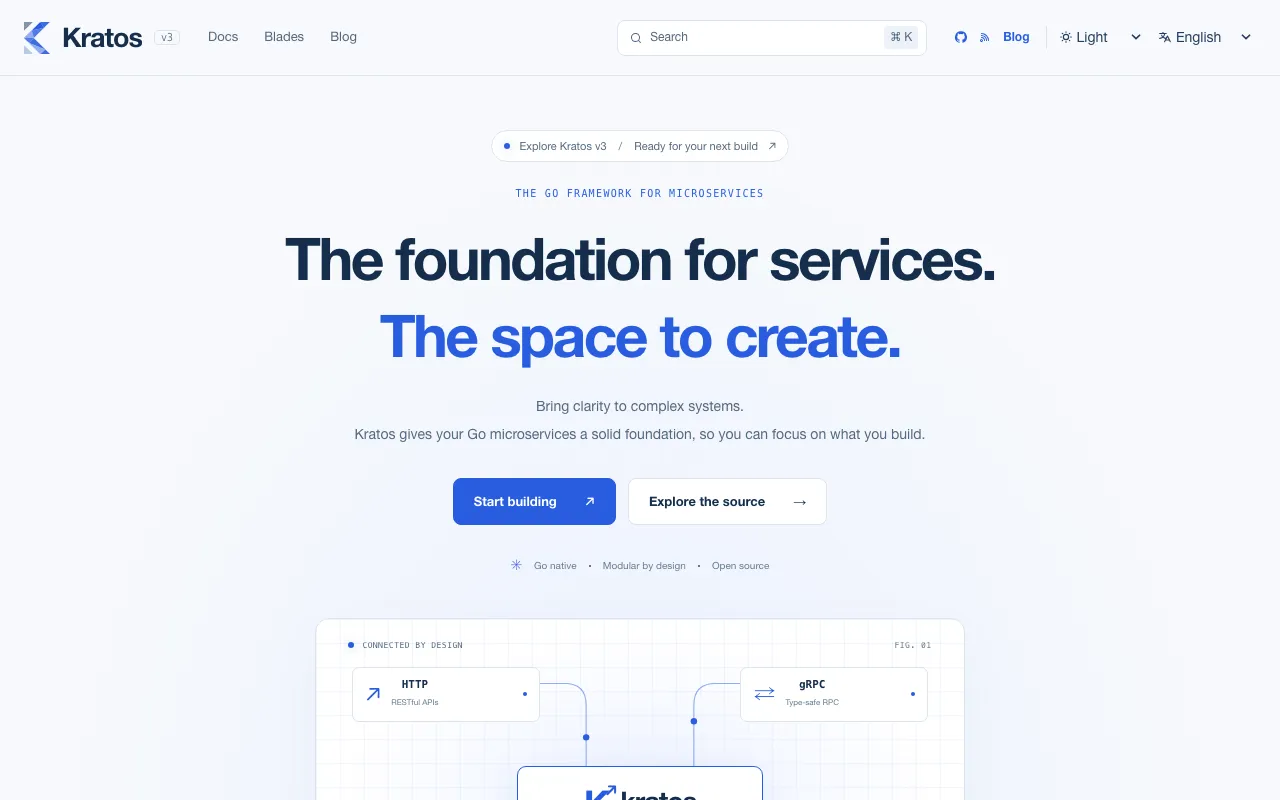
Kratos screenshot

Kratos is a lightweight Go toolkit for microservices with Protobuf-first APIs, shared HTTP and gRPC transports, and pluggable middleware.

Overview

Kratos helps teams build Go microservices with explicit APIs for networking, middleware, service discovery, configuration, logging, and encoding. The design keeps transport and infrastructure concerns separate so application code can stay focused on domain logic.

Development starts from Protobuf contracts that generate consistent HTTP and gRPC handlers. A unified transport layer routes both protocols through the same service definitions, while composable middleware covers recovery, logging, validation, tracing, metrics, and authentication.

Registry, configuration, and encoding backends are swappable, and logging builds on the standard log and slog packages with optional OpenTelemetry helpers in contrib modules. Shared tooling supports metadata, structured errors, validation, OpenAPI output, and code generation workflows.

A contrib collection adds optional integrations for registries, configuration stores, encodings, and observability vendors. A command-line tool scaffolds new services from templates, and migration guidance documents changes between major versions for production upgrades.

Key features

  • Protobuf-first API contracts
  • Unified HTTP and gRPC transport
  • Composable middleware stack
  • Pluggable registry and config
  • slog-based logging hooks
  • OpenTelemetry contrib support
  • Code generation workflows
  • CLI service scaffolding

Use cases

  • Bootstrap new Go microservices
  • Expose both REST and gRPC from one contract
  • Standardize tracing and metrics middleware
  • Integrate custom service discovery
  • Migrate services between Kratos major versions

Tags

Similar software

ECC

Open-source agent engineering toolkit for coding harnesses

ECC adds planning, verification, review, memory, skills, and security scanning to coding agents such as Claude Code, Codex, and Cursor. It installs as plugins, packages, and managed adapters across multiple harnesses.

★ 311.7k⟳ 8 days agoMIT
Frameworks & PlatformsDesktop/CLI app

React

JavaScript library for web and native user interfaces

React helps developers build interfaces from reusable components that manage their own state. Views update declaratively when underlying data changes.

★ 253k⟳ 2 days agoMIT
Frameworks & PlatformsDesktop/CLI app

Flutter

Open-source UI framework for multi-platform apps from one codebase

Flutter is an SDK for building user experiences for mobile, web, and desktop from a single codebase. It uses the Dart language and compiles to native machine code or web targets.

★ 181.5k⟳ todayBSD-3-Clause
Open Source Alternative to:Ionic Enterprise

Bootstrap

Responsive HTML, CSS, and JavaScript front-end toolkit

Bootstrap supplies CSS, JavaScript, and Sass-based styles for building responsive, mobile-first sites. It ships prebuilt grid layouts, UI components, and optional JavaScript plugins.

★ 175.1k⟳ 2 days agoMIT

Langflow

Visual low-code builder for AI agents and workflows

Langflow is a visual builder for AI agents and workflows. Flows can be customized in Python and deployed as an API or as an MCP server, with support for major LLMs and vector databases.

★ 157k⟳ todayMIT
Open Source Alternative to:Relevance AIVoiceflow

LangChain

Framework for agents and LLM-powered applications

LangChain helps developers chain interoperable components and integrations to build agents and LLM-powered applications. It offers a standard interface for models, embeddings, vector stores, and related pieces.

★ 150.1k⟳ 2 days agoMIT






