
MemPalace
Local-first semantic memory for AI agents
MemPalace stores conversation text verbatim and retrieves it with semantic search. It exposes an MCP server and CLI for coding agents.
Desktop local RAG over your own documents
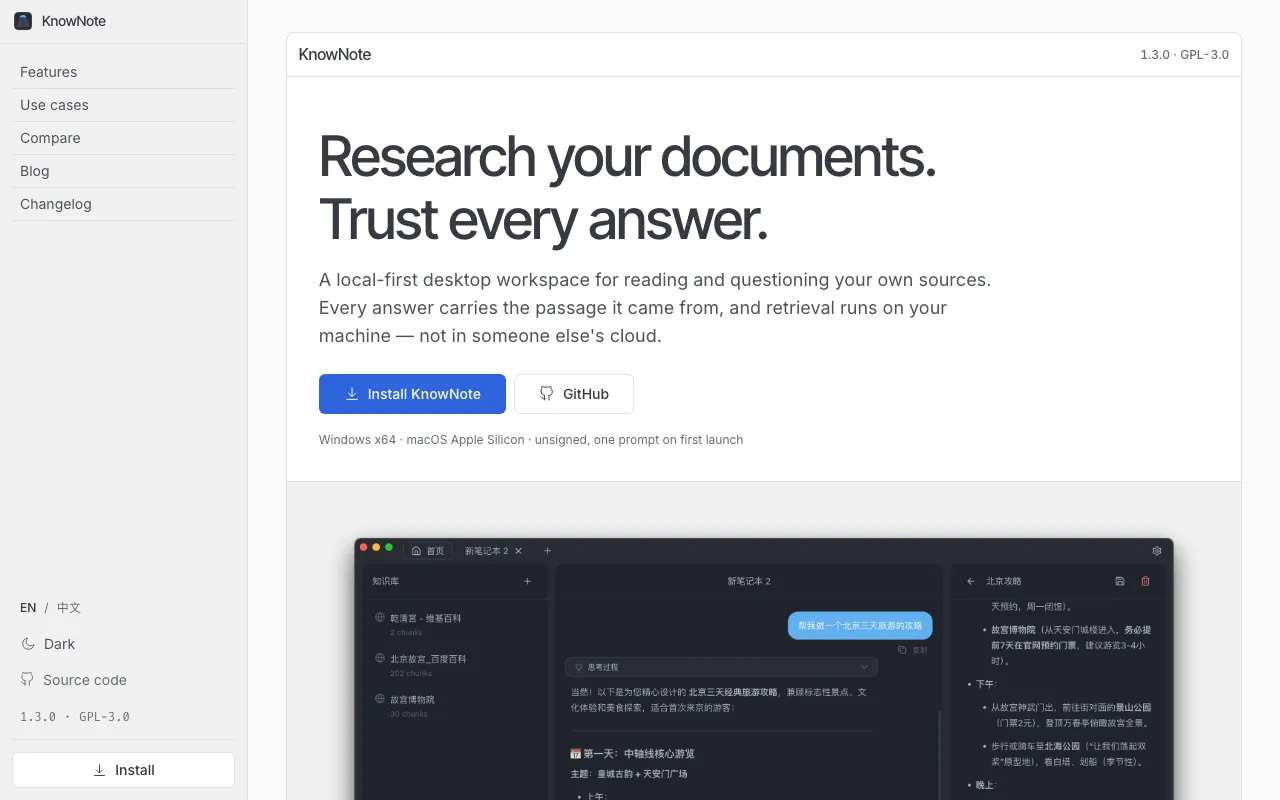
KnowNote is a desktop app that ingests PDFs, Office files, and web pages, embeds them locally, and answers questions with citations. You bring your own chat model endpoint; no server or account is required.
KnowNote is a single-user desktop research workspace built with Electron. You import documents, which are parsed, split into passages, and embedded inside the application using an on-device embedding model, so retrieval can continue offline after models are cached.
Answers in the Q&A panel attach to the passages they used, including positional references in the extracted text so you can verify claims. Chat completions go to whichever OpenAI-, Anthropic-, or Google-compatible endpoint you configure, including local servers such as Ollama. Notebooks can also produce structured notes and mind maps beside the sources.
An optional read-only MCP server exposes the same library to external agents over stdio without write tools or model calls. The project positions itself against hosted research notebooks while deliberately omitting accounts, sync, collaboration, and telemetry. Linux builds and several planned generators are not shipping yet.
“A local-first AI knowledge base & NotebookLM alternative built with Electron.” source
Local-first semantic memory for AI agents
MemPalace stores conversation text verbatim and retrieves it with semantic search. It exposes an MCP server and CLI for coding agents.
Self-hosted, privacy-focused AI research notebook and Notebook LM alternative
Open Notebook is a self-hosted research workspace where you add sources, chat with AI about them, take notes and generate podcasts. It works with 20+ cloud or local AI providers.

Self-hostable personal AI assistant for searching docs and the web
Khoj is an open-source personal AI app that chats with local or online LLMs and answers questions from your documents and the web. It supports custom agents, scheduled automations and research.
Unofficial Python and CLI client for Gemini Notebook
notebooklm-py exposes Google Gemini Notebook (formerly NotebookLM) through a Python API, shell commands, MCP, and REST hooks. It targets automation and agent workflows beyond the web interface.
Private, offline NotebookLM-style AI desktop app for confidential documents
Free, open-source desktop app acting as a private AI agent over your own files. It answers with citations, edits and converts documents, and runs offline with a local or remote model, with no account.
Shared personal memory and skills across coding agents
memU captures agent session history into reusable Markdown skills and retrieves them before new tasks. Host adapters exist for Codex, Claude Code, Cursor, OpenClaw, and others.