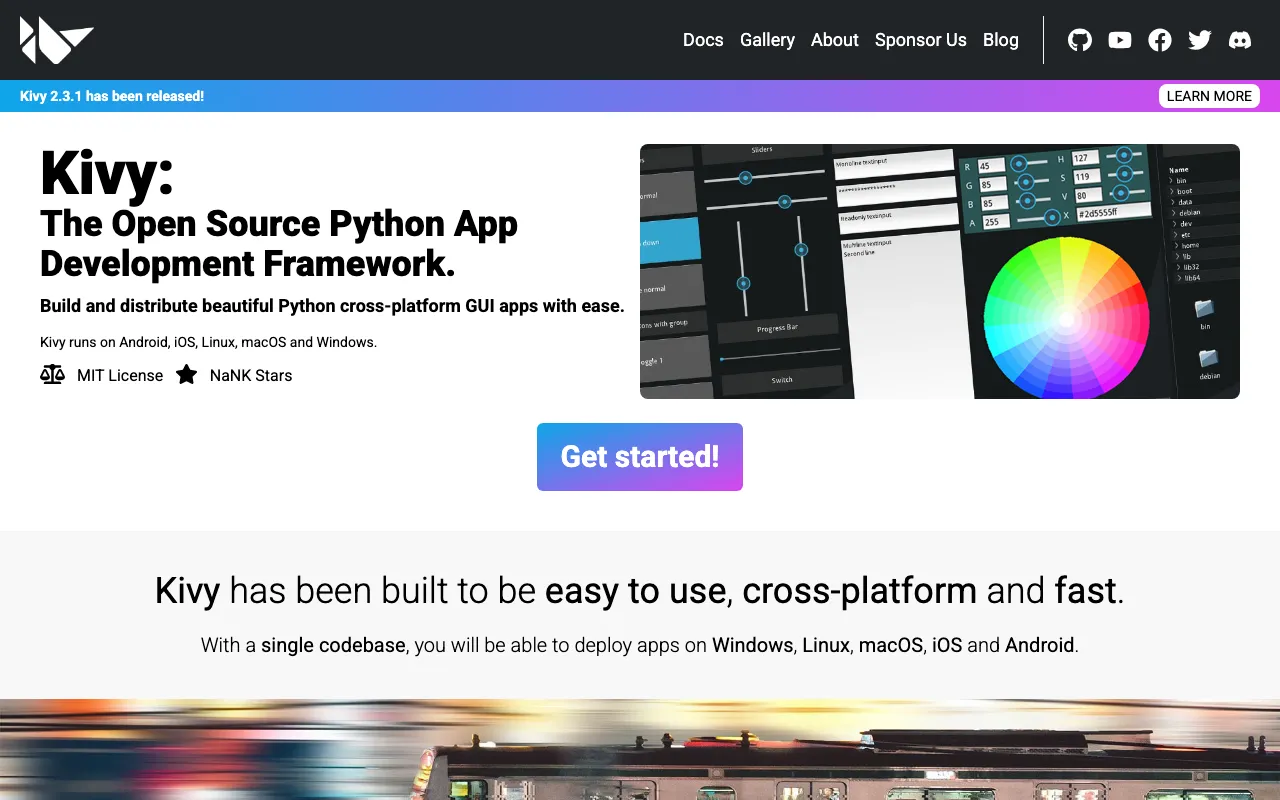
Kivy is a Python framework for GUI apps on desktop, mobile, and embedded targets. One codebase can ship to Windows, macOS, Linux, Android, and iOS.
Overview
Kivy is a Python framework for building graphical applications that run across desktop, mobile, and embedded devices. It focuses on interaction design and rapid prototyping while keeping application code reusable across targets.
The core is written in Python and Cython and renders through OpenGL ES 2.0. It accepts diverse input devices and ships an extensible widget library where every widget supports multitouch.
With a single codebase, developers can target Windows, macOS, Linux (including Raspberry Pi OS), Android, and iOS. Documentation includes installation guides, tutorials, an API reference, and bundled example projects.
The Kivy organization also maintains related projects for packaging on mobile, desktop windowing, audio I/O, and community-contributed widget gardens.
Key features
- Python and Cython with OpenGL ES 2.0 rendering
- Multitouch-enabled widget library
- Windows, macOS, Linux, Android, and iOS targets
- Broad input device support
- Rapid prototyping oriented API
- Shipped example applications
- Extensible widgets and community gardens
Use cases
- Cross-platform desktop GUI tools
- Multitouch mobile applications
- Embedded interfaces on Raspberry Pi
- Interactive prototypes with shared code




 Ionic Enterprise


