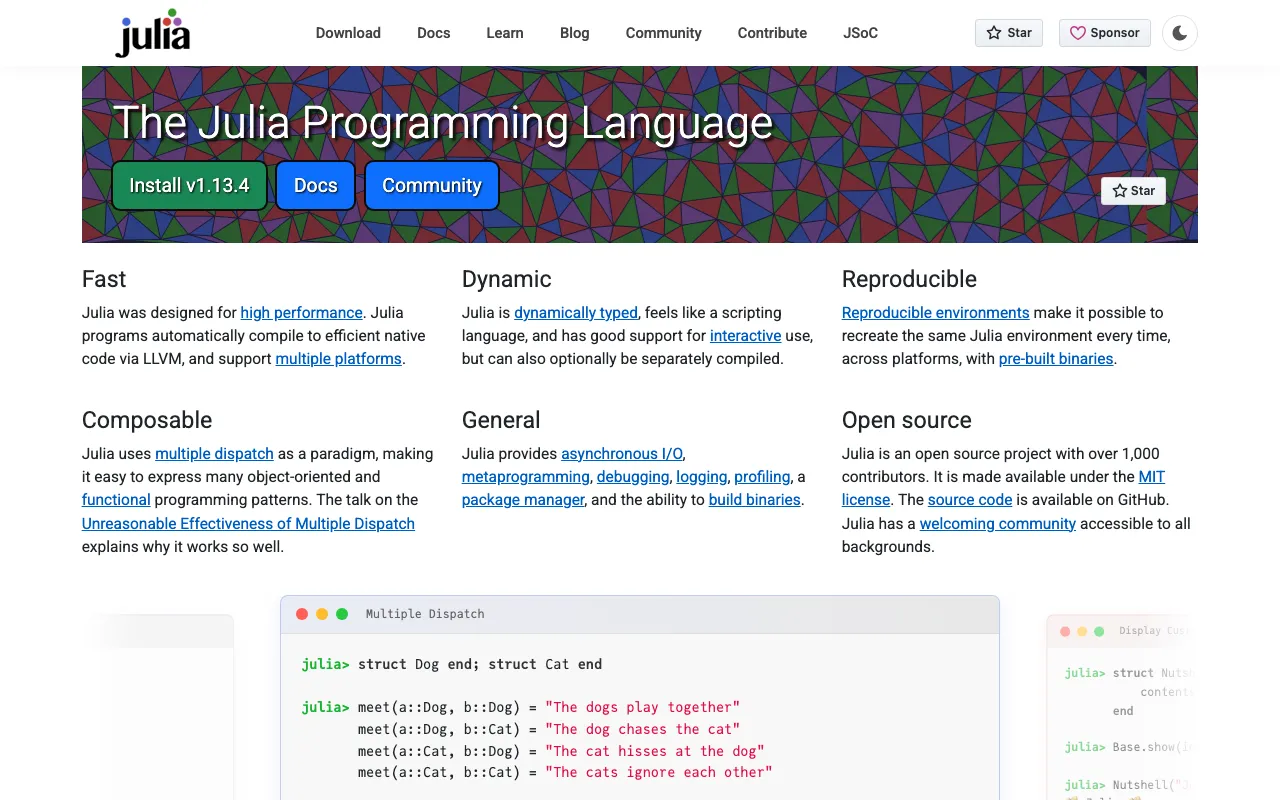
Julia is a high-level, high-performance dynamic language aimed at numerical work, data science, and machine learning. Programs compile to native code via LLVM.
Overview
Julia is a programming language built for technical computing where speed and expressiveness both matter. It is dynamically typed and supports interactive use in a REPL, while still allowing separate compilation when you want it. The implementation targets efficient native code generation across multiple platforms.
Language features emphasized in the official materials include multiple dispatch, metaprogramming, asynchronous I/O, debugging, logging, and profiling, plus a built-in package manager for adding libraries such as DataFrames. Unicode and math-oriented syntax are first-class in day-to-day coding examples.
The ecosystem spans visualization, general computing, data science, machine learning, and domain-specific science stacks. Foreign-function interfaces are documented for many languages, and tools like PackageCompiler are described for producing binaries or embedding Julia in other runtimes.
Parallel and heterogeneous computing primitives are built in, from multi-threading to GPU-oriented workflows, with higher-level packages for distributed arrays and task orchestration. Reproducible environments are supported so teams can recreate the same dependency set across machines using pre-built binaries where available.
Key features
- LLVM-backed native code generation
- Multiple dispatch programming model
- Interactive REPL with package mode
- Built-in package manager
- Multi-threading and GPU workflows
- Metaprogramming and macros
- Foreign language interfaces
- Reproducible environment tooling
Use cases
- Numerical and scientific simulation
- Data science with tabular data
- Machine learning model development
- High-performance parallel computation




 Ionic Enterprise


