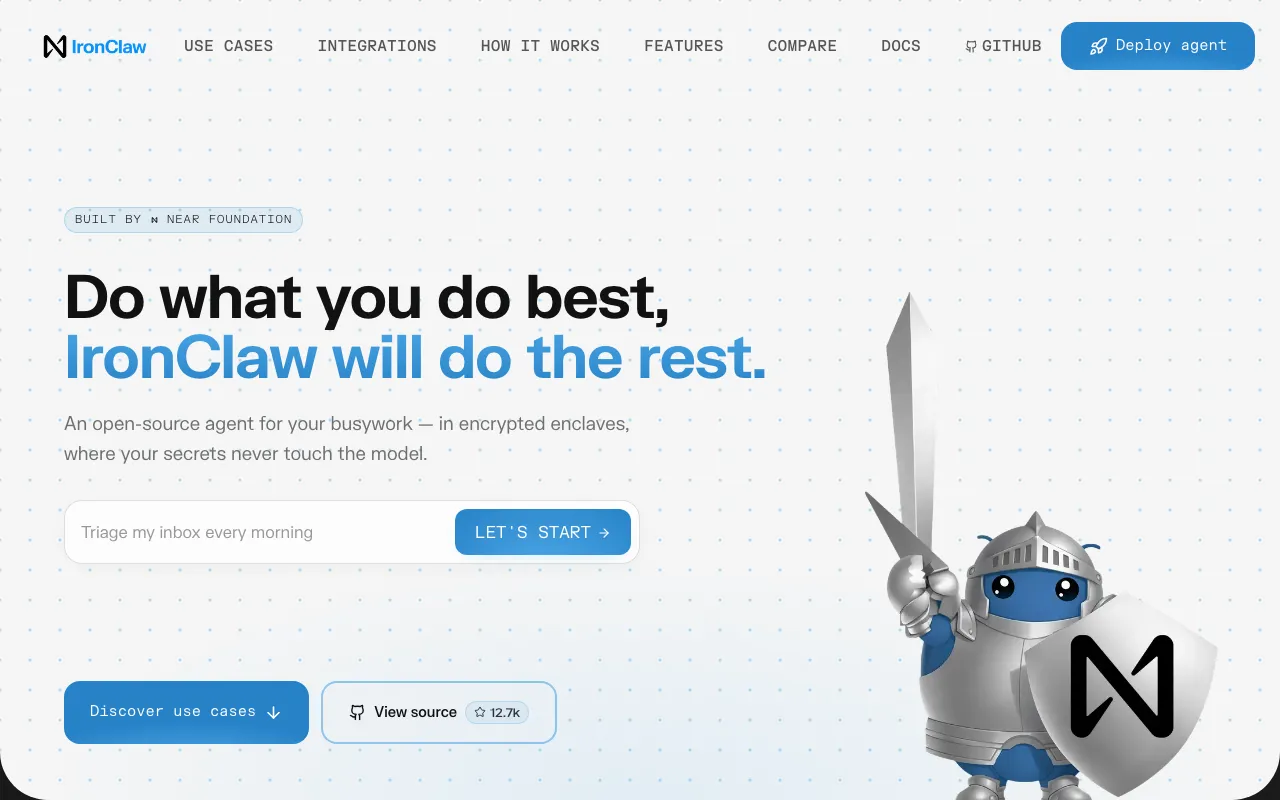
Rust-based personal AI agent that stores data locally, runs untrusted tools in WebAssembly sandboxes and keeps credentials hidden from the model. Includes a web UI, chat channels and background automation.
Overview
IronClaw is a personal AI assistant and agent runtime written in Rust. It is built around keeping user data under the user's control: information is stored locally, secrets are encrypted with AES-256-GCM, and it includes no telemetry or analytics. It is a Rust reimplementation inspired by OpenClaw, with a stronger focus on security.
Security is handled in layers. Untrusted tools run in isolated WebAssembly containers with capability-based permissions, endpoint allowlists, rate limits and resource limits. Credentials are injected at the host boundary so tools and the model never see raw values, and requests and responses are scanned for leak attempts. Pattern detection, sanitization and policy rules defend against prompt injection, and tool executions are written to an audit log.
The agent can be reached through a REPL, HTTP webhooks, a browser-based web gateway with real-time streaming, and channels such as Telegram and Slack. It runs background work through cron routines, event triggers, webhooks and a heartbeat system, handles several jobs in parallel, and can use Docker sandboxes. It can build new WASM tools on request and connect to Model Context Protocol servers.
Memory is persistent, with a workspace filesystem for notes and context, identity files for a consistent personality, and hybrid full-text and vector search. Setup is a guided onboarding command that picks an LLM provider, stores its API key in the encrypted store and creates a WebUI login. On macOS and Linux it also installs a background service. A Windows installer and source builds are available, and a one-click hosted deployment on NEAR AI Cloud inside a trusted execution environment is also offered.
Key features
- WASM sandbox for untrusted tools
- Encrypted credential store with host-boundary injection
- Prompt injection defense and leak detection
- Endpoint allowlisting
- Web gateway with streaming chat
- Telegram and Slack channels
- Cron, event and webhook routines
- Hybrid full-text and vector memory search
Use cases
- Personal AI assistant that keeps data local
- Inbox triage and daily briefings
- Monitoring and alerting from chat
- Building custom tools by describing them
- Connecting MCP servers to an agent

 ChatGPT


 Anthropic Claude