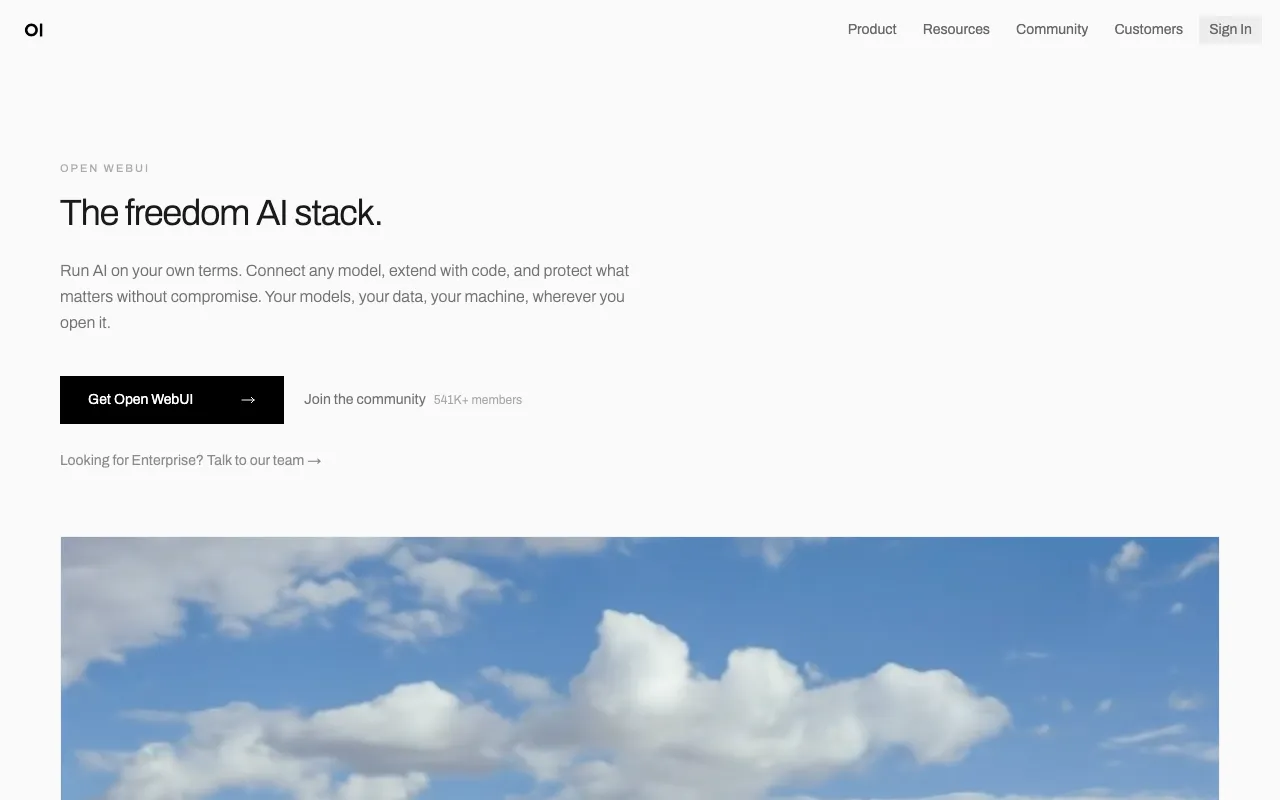
Open WebUI is a self-hosted AI platform that runs offline and connects to local models through Ollama or to cloud models through OpenAI-compatible APIs. It can be extended with Python.
Overview
Open WebUI is a self-hosted platform for working with AI models from one interface. It is built to run entirely offline. You can connect local models through Ollama, or use OpenAI-compatible APIs for local and cloud models. The website also names Anthropic as a supported provider.
The platform covers voice, vision, retrieval, generation and search. It can be extended with Python through models (personas and configurations), skills (reusable instructions and supporting files), tools (such as RAG, search and execution) and functions (Python pipelines). A community site hosts models, skills, tools and functions that others have shared, and you can install them.
Installation is by pip or Docker. Docker images come in several variants: a standard image, a slim image that relies on external services for embeddings, document extraction and voice, a CUDA image for GPU acceleration, one bundled with Ollama, and a development build. A native desktop app is also offered for macOS, Windows and Linux. Docker Compose and Kubernetes setups are described in the documentation.
For organizations, the project lists SSO, role-based access control, audit logs, data residency, and on-premises or air-gapped deployment. Related products from the same project include Open Terminal, which gives a model a computer to run commands and edit files, and Terminals, which runs a sandboxed computer for each person, chat or model on your own servers.
Key features
- Connects to Ollama and OpenAI-compatible APIs
- Runs fully offline
- Extensible with Python models, skills, tools and functions
- Retrieval (RAG), web search, voice and vision
- Community library of shareable models and tools
- Docker images including CUDA, slim and bundled Ollama
- SSO, RBAC and audit logs for enterprises
- Native desktop app
Use cases
- Chat with local models through Ollama
- Run a private AI interface for a team or company
- Air-gapped AI deployment in regulated industries
- Build document retrieval and Python tool workflows
- Use one interface for local and cloud models
Does the same job as
Open WebUI doesn't name these products itself, but its own description shows it does the same job.

 Anthropic Claude
 ChatGPT