qmetrics.net

Iris

Batteries-included HTTP web framework for Go

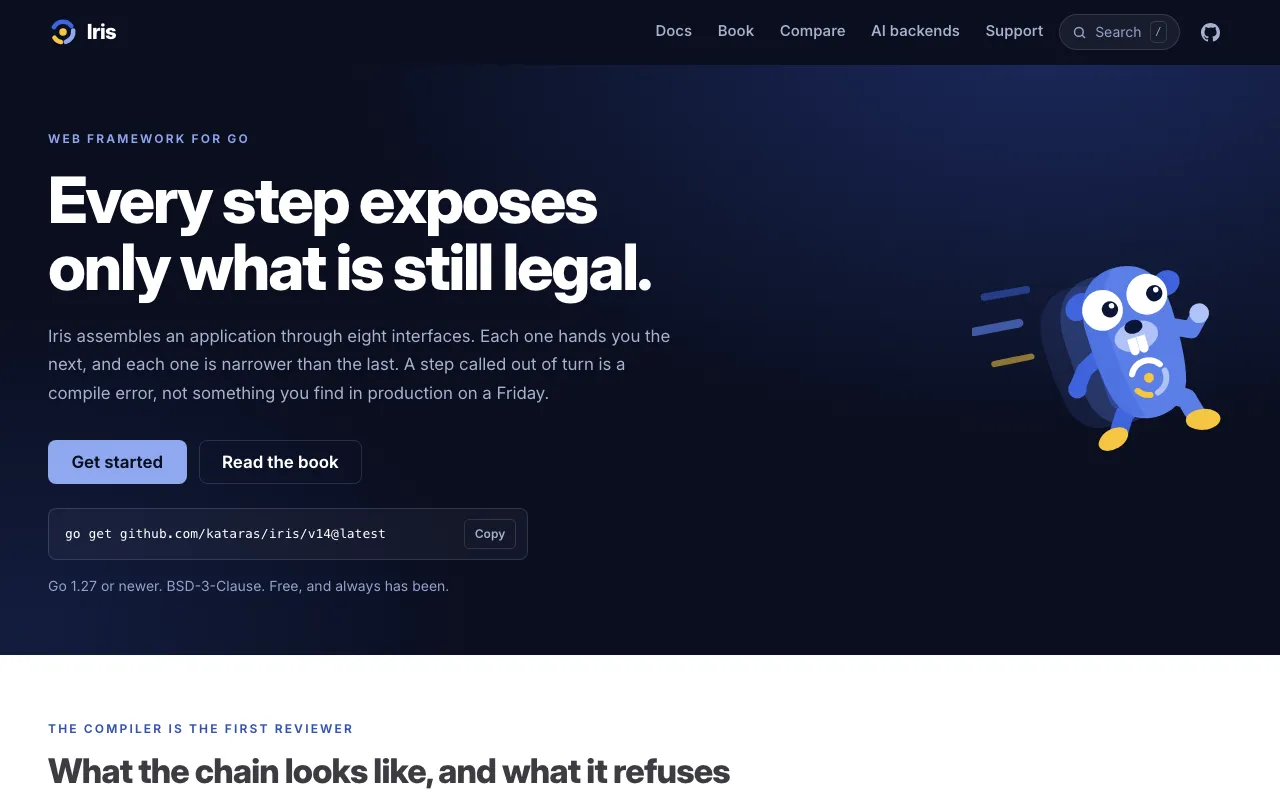
Iris screenshot

Iris helps you build Go APIs and websites with typed routes, centralized errors, dependency injection, and many built-in middleware pieces. Version 14 centers on a compile-checked application builder.

Overview

Iris is a Go web framework aimed at HTTP APIs and sites. It offers expressive routing with typed path parameters, macros, and constraints so invalid input fails before your handler runs.

The iris.NewBuilder pattern wires CORS, compression, access logging, health checks, error mapping, services, and API groups in an order the compiler enforces. Handlers can stay short because decoding, validation, and error rendering are configured once through rest helpers and a central error map.

Dependency injection resolves controllers and services from constructors, with startup and shutdown hooks. The stack includes extensive middleware, multiple auth options, MVC on generics, WebSockets, gRPC serving, view engines, sessions, localization, and rich response formats including streaming and server-sent events.

Learning material includes a getting-started tutorial, many runnable examples, a free online and downloadable book, and optional AI assistants that understand Iris APIs. In-memory HTTP testing runs the full router without opening ports.

Key features

  • Typed path parameters and route macros
  • Compile-checked NewBuilder application chain
  • Central error map and thin handlers
  • Dependency injection container
  • Broad built-in middleware set
  • JWT, API keys, and identity patterns
  • WebSockets, gRPC, and API versioning
  • In-memory httptest without network

Use cases

  • Production REST APIs in Go
  • MVC-style web applications
  • Services needing structured error responses
  • Apps with auth, sessions, and rate limits
  • Streaming and AI-backed HTTP endpoints

Tags

Similar software

ECC

Open-source agent engineering toolkit for coding harnesses

ECC adds planning, verification, review, memory, skills, and security scanning to coding agents such as Claude Code, Codex, and Cursor. It installs as plugins, packages, and managed adapters across multiple harnesses.

★ 311.7k⟳ 8 days agoMIT
Frameworks & PlatformsDesktop/CLI app

React

JavaScript library for web and native user interfaces

React helps developers build interfaces from reusable components that manage their own state. Views update declaratively when underlying data changes.

★ 253k⟳ 2 days agoMIT
Frameworks & PlatformsDesktop/CLI app

Flutter

Open-source UI framework for multi-platform apps from one codebase

Flutter is an SDK for building user experiences for mobile, web, and desktop from a single codebase. It uses the Dart language and compiles to native machine code or web targets.

★ 181.5k⟳ todayBSD-3-Clause
Open Source Alternative to:Ionic Enterprise

Bootstrap

Responsive HTML, CSS, and JavaScript front-end toolkit

Bootstrap supplies CSS, JavaScript, and Sass-based styles for building responsive, mobile-first sites. It ships prebuilt grid layouts, UI components, and optional JavaScript plugins.

★ 175.1k⟳ 2 days agoMIT

Langflow

Visual low-code builder for AI agents and workflows

Langflow is a visual builder for AI agents and workflows. Flows can be customized in Python and deployed as an API or as an MCP server, with support for major LLMs and vector databases.

★ 157k⟳ todayMIT
Open Source Alternative to:Relevance AIVoiceflow

LangChain

Framework for agents and LLM-powered applications

LangChain helps developers chain interoperable components and integrations to build agents and LLM-powered applications. It offers a standard interface for models, embeddings, vector stores, and related pieces.

★ 150.1k⟳ 2 days agoMIT






