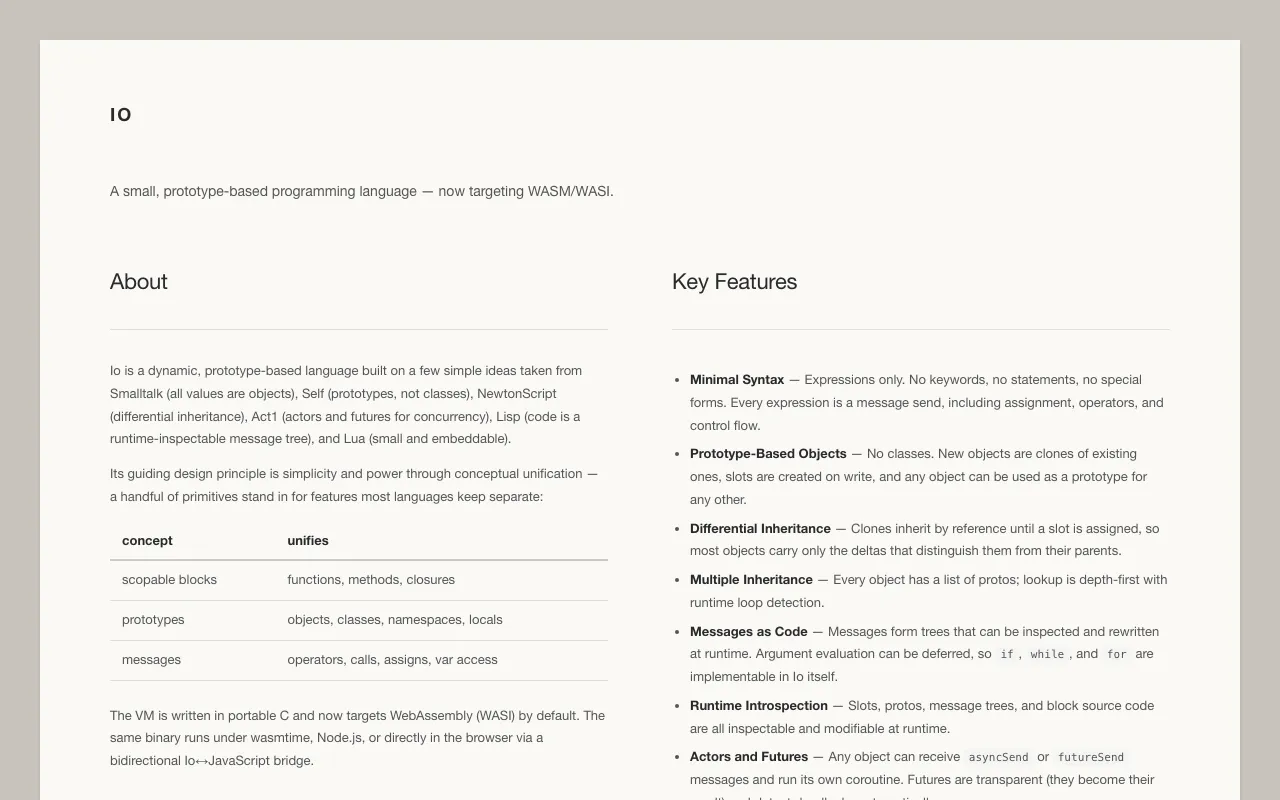
Io is a small prototype-based programming language in the Self and Smalltalk family. The maintained build targets WebAssembly and WASI for CLI, Node, and browser hosts.
Overview
Io treats everything as message sends between objects. It unifies functions, methods, and closures as scopable blocks; objects, namespaces, and locals as prototypes; and operators, calls, and assignments as messages. The virtual machine is written in portable C and ships primarily as a WASI WebAssembly module.
You can run Io without compiling via a browser live interpreter, the npm package for JavaScript hosts, or a released static WASM binary executed with wasmtime. The browser build includes a REPL and a bidirectional bridge so Io code can call JavaScript and JavaScript can call Io methods, with coroutines and actors integrated into the JS event loop on that target.
Language features described in project materials include differential and multiple inheritance, runtime-inspectable message trees, actors and futures for concurrency, cooperative coroutines, first-class continuations, and a unified Sequence type for strings and numeric vectors. Native addon loading from older releases is replaced by the JavaScript bridge on WASM.
Building from source uses wasi-sdk and wasmtime, with make targets for the CLI binary, tests, and browser artifacts. Earlier native CMake builds remain on a separate branch but are no longer maintained.
Key features
- Prototype-based object model
- Message-based syntax without keywords
- Actors, futures, and coroutines
- First-class continuations
- WebAssembly and WASI default target
- Browser REPL and live interpreter
- Io and JavaScript interop bridge
- npm package for JS embeddings
Use cases
- Experimenting with prototype languages
- Embedding Io in browser pages
- Calling Io from Node or browser JS
- Running Io scripts under wasmtime
- Teaching message-oriented language design




 Ionic Enterprise


