
TensorFlow
End-to-end machine learning platform and tooling ecosystem
TensorFlow is a machine learning platform with Python and C++ APIs, optional GPU packages, and companion libraries for data, training, deployment, and visualization.
Multi-language library for validated LLM structured output
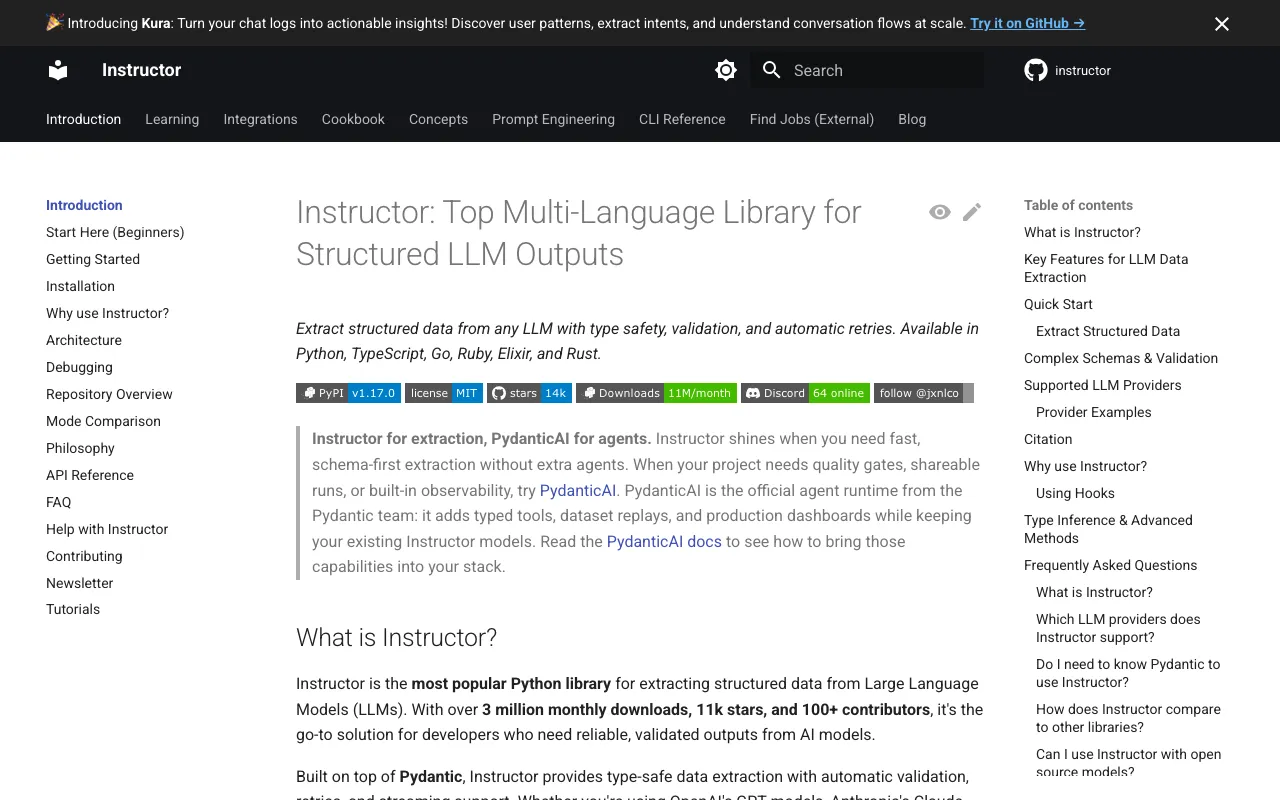
Instructor layers Pydantic-style schemas onto LLM APIs so responses parse into typed models with retries, streaming, and nested fields.
Instructor targets developers who need reliable structured data from language models instead of hand-parsed JSON. You define models describing the desired fields, call a unified client interface, and receive validated objects with IDE-friendly typing. The project builds on Pydantic for validation and exposes parallel implementations in Python, TypeScript, Ruby, Go, Rust, and Elixir according to its documentation.
The client helpers wrap numerous providers—including OpenAI, Anthropic, Google, Mistral, Cohere, Ollama, and DeepSeek—so the same schema-first code can switch models via configuration. When validation fails, built-in retry logic can re-ask the model with error context, and streaming APIs emit partial structures as tokens arrive.
Complex nested lists, enums, and custom field validators are supported, which suits extraction pipelines for support tickets, entities in text, or other domain objects. The maintainers position Instructor for focused extraction workloads, noting that PydanticAI extends similar models when teams need fuller agent runtimes, observability, and evaluation tooling.
Install paths cover common Python package managers, and cookbooks document provider-specific examples alongside CLI helpers that open documentation in a browser for quick reference during development.
End-to-end machine learning platform and tooling ecosystem
TensorFlow is a machine learning platform with Python and C++ APIs, optional GPU packages, and companion libraries for data, training, deployment, and visualization.

Shared model definitions for multimodal ML workloads
Transformers is a Python library that defines pretrained text, vision, audio, and multimodal models once in PyTorch for shared inference and training across the ecosystem.

Open-source RAG engine and agent context platform
RAGFlow ingests heterogeneous documents, builds retrievable knowledge, and supports agent workflows with citations. It can run on your own hardware with Docker or a from-source server stack.

Local LLM context compression library and proxy
Headroom shrinks tool outputs, logs, JSON, and chat history before LLM calls to cut input tokens while preserving retrievable originals. It offers a Python library, proxy, MCP tools, and agent wrappers.

Local desktop workspace to run and fine-tune AI models
Unsloth is a desktop application to chat with, fine-tune, and serve LLMs, diffusion, audio, and embedding models on your own hardware with optional agent integrations.

TensorFlow reference models and modeling utilities collection
The TensorFlow Model Garden hosts implementations of models and modeling solutions for TensorFlow, installable via pip as tf-models-official.