qmetrics.net

Inferno

React-like JavaScript UI rendering library

Frameworks & PlatformsDesktop/CLI app
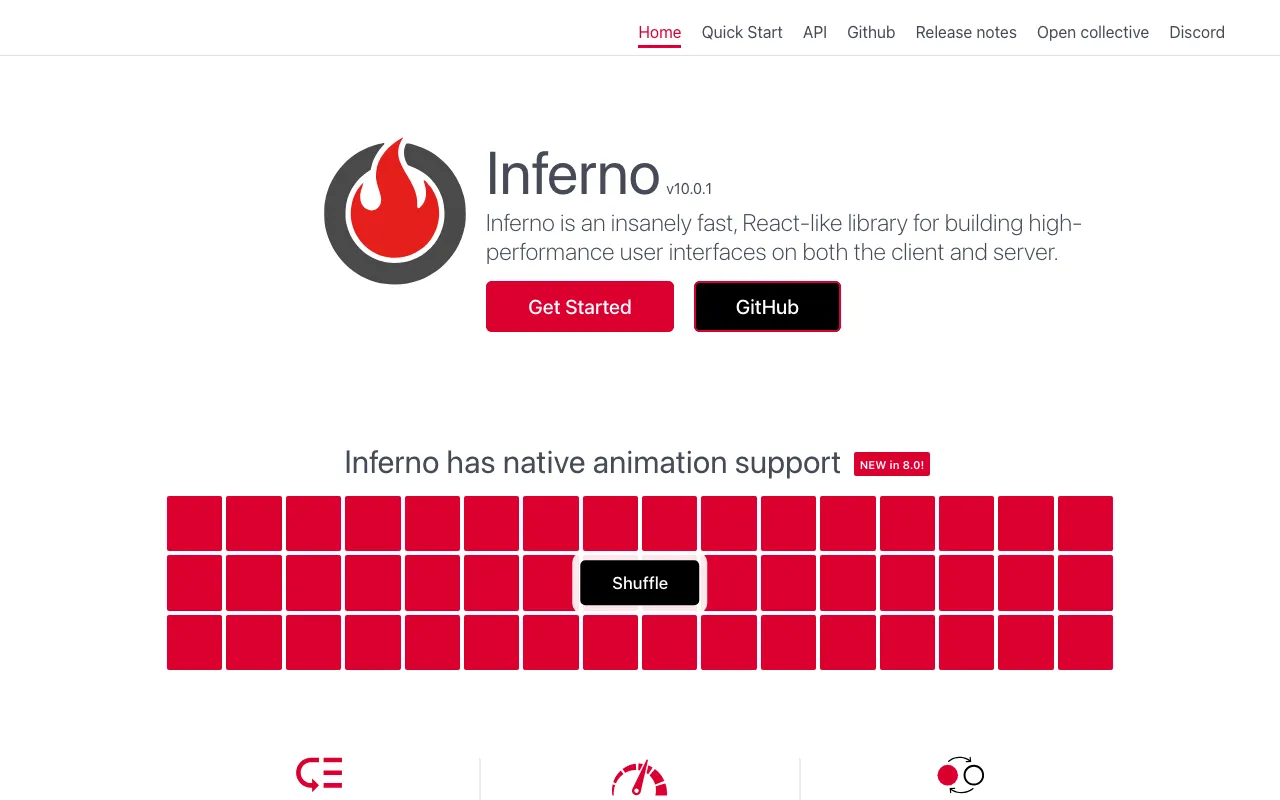
Inferno screenshot

A JavaScript library for high-performance user interfaces with a React-like API, usable on the client and server.

Overview

Inferno is a JavaScript library for building user interfaces with a component model, one-way data flow, and lifecycle behavior similar to React. It targets fast runtime performance, including large DOM trees and views that update with live data.

It supports isomorphic rendering on both browser and server through inferno-server, JSX via a dedicated Babel plugin, fragments, refs, and portals. Functional components can receive lifecycle callbacks, and form controls can be implemented as controlled components for inputs, selects, and text areas.

The event layer is only partly synthetic: selected events such as clicks are delegated for cross-browser behavior, while other events follow native DOM naming (for example input rather than change for text fields). Utilities include linkEvent for attaching data to handlers without extra bindings, createRenderer for reactive integrations, and optional packages for Redux, MobX, and animation.

Inferno is aimed at the DOM in browsers and on the server; it does not support React Native. Compatibility with existing React code paths is available through inferno-compat, with documented differences around events, refs, and style syntax.

Key features

  • React-like component API
  • Client and server isomorphic rendering
  • Partial synthetic event delegation
  • Controlled form components
  • Functional component lifecycle hooks
  • JSX compile-time optimizations
  • linkEvent handler helper
  • createPortal for out-of-tree UI

Use cases

  • High-frequency DOM updates
  • Isomorphic JavaScript applications
  • Migrating React apps with inferno-compat
  • Lightweight functional components
  • Large real-time data views

Tags

Similar software

ECC

Open-source agent engineering toolkit for coding harnesses

ECC adds planning, verification, review, memory, skills, and security scanning to coding agents such as Claude Code, Codex, and Cursor. It installs as plugins, packages, and managed adapters across multiple harnesses.

★ 311.7k⟳ 8 days agoMIT
Frameworks & PlatformsDesktop/CLI app

React

JavaScript library for web and native user interfaces

React helps developers build interfaces from reusable components that manage their own state. Views update declaratively when underlying data changes.

★ 253k⟳ 2 days agoMIT
Frameworks & PlatformsDesktop/CLI app

Flutter

Open-source UI framework for multi-platform apps from one codebase

Flutter is an SDK for building user experiences for mobile, web, and desktop from a single codebase. It uses the Dart language and compiles to native machine code or web targets.

★ 181.5k⟳ todayBSD-3-Clause
Open Source Alternative to:Ionic Enterprise

Bootstrap

Responsive HTML, CSS, and JavaScript front-end toolkit

Bootstrap supplies CSS, JavaScript, and Sass-based styles for building responsive, mobile-first sites. It ships prebuilt grid layouts, UI components, and optional JavaScript plugins.

★ 175.1k⟳ 2 days agoMIT

Langflow

Visual low-code builder for AI agents and workflows

Langflow is a visual builder for AI agents and workflows. Flows can be customized in Python and deployed as an API or as an MCP server, with support for major LLMs and vector databases.

★ 157k⟳ todayMIT
Open Source Alternative to:Relevance AIVoiceflow

LangChain

Framework for agents and LLM-powered applications

LangChain helps developers chain interoperable components and integrations to build agents and LLM-powered applications. It offers a standard interface for models, embeddings, vector stores, and related pieces.

★ 150.1k⟳ 2 days agoMIT