qmetrics.net

Immutable.js

Persistent immutable collections for JavaScript and TypeScript

Frameworks & PlatformsDesktop/CLI app
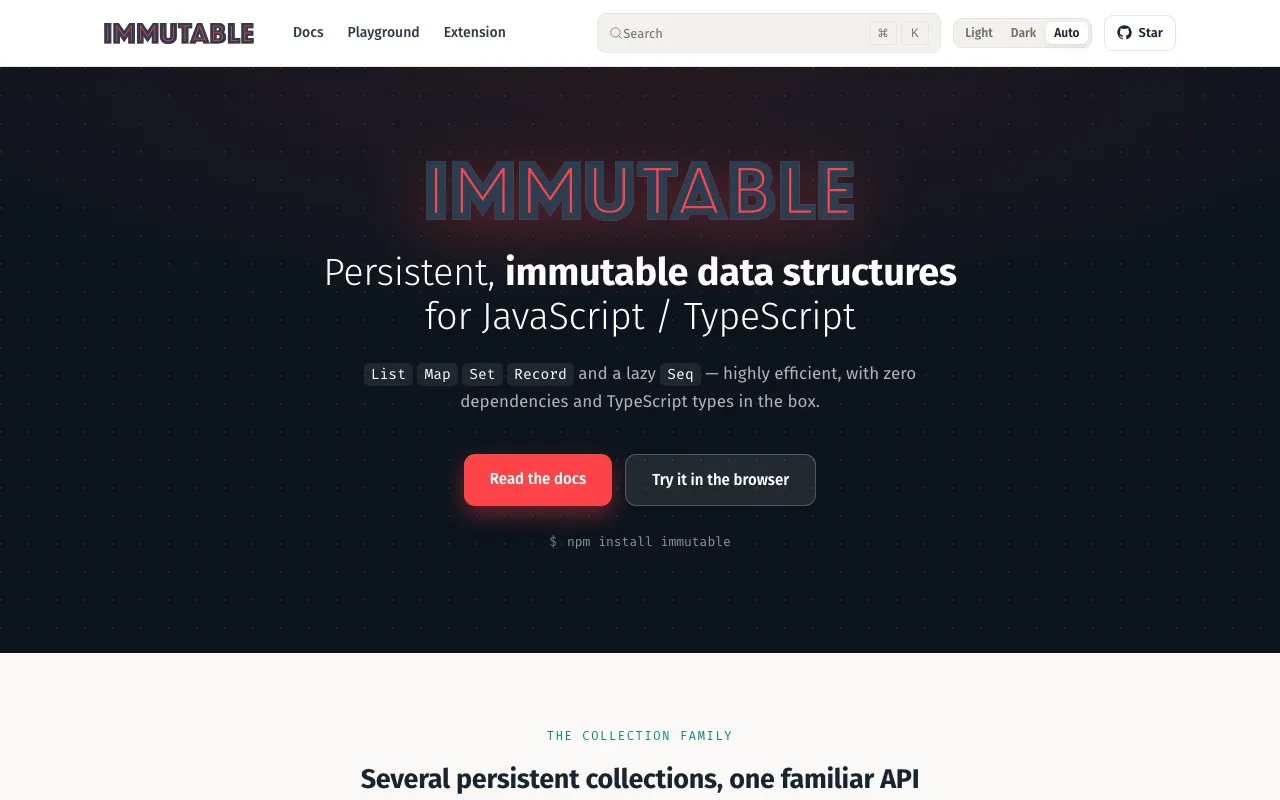
Immutable.js screenshot

Immutable.js provides persistent List, Map, Set, Record, and lazy Seq collections that return new data on change instead of mutating in place, with structural sharing for efficiency and bundled Flow and TypeScript types.

Overview

Immutable.js offers persistent immutable data structures for JavaScript programs where updates always yield new collections rather than changing existing objects in place. The goal is simpler state flow, less defensive copying, and straightforward change detection when data is treated as values compared by equality instead of reference.

Collections include List, Stack, Map, OrderedMap, Set, OrderedSet, and Record, implemented with structural sharing via hash-array mapped tries and vector tries. A lazy Seq allows chaining map, filter, and similar operations without building intermediate arrays. Utilities such as fromJS, toJS, getIn, setIn, and updateIn help convert plain objects and navigate nested trees.

The API mirrors familiar ES2015 Array, Map, and Set patterns while mutative-sounding methods return new immutables. Collections interoperate with plain JavaScript objects and arrays, support JSON serialization, and work with module bundlers or script tags in browsers. Type definitions ship with the npm package for Flow and TypeScript.

Batch local edits can use withMutations for performance when several changes precede returning an immutable snapshot. The library positions itself as a fit for React-style unidirectional data and memoization patterns where referential stability matters.

Key features

  • Persistent List Map Set Record types
  • Lazy Seq with Range and Repeat
  • Structural sharing for updates
  • Deep getIn setIn updateIn helpers
  • fromJS and toJS plain object bridge
  • Value equality via is and equals
  • Bundled TypeScript and Flow types
  • withMutations batch editing

Use cases

  • React and Redux application state
  • Undo-redo friendly data models
  • Memoized derived view computations
  • Nested configuration trees

Similar software

ECC

Open-source agent engineering toolkit for coding harnesses

ECC adds planning, verification, review, memory, skills, and security scanning to coding agents such as Claude Code, Codex, and Cursor. It installs as plugins, packages, and managed adapters across multiple harnesses.

★ 311.7k⟳ 8 days agoMIT
Frameworks & PlatformsDesktop/CLI app

React

JavaScript library for web and native user interfaces

React helps developers build interfaces from reusable components that manage their own state. Views update declaratively when underlying data changes.

★ 253k⟳ 2 days agoMIT
Frameworks & PlatformsDesktop/CLI app

Flutter

Open-source UI framework for multi-platform apps from one codebase

Flutter is an SDK for building user experiences for mobile, web, and desktop from a single codebase. It uses the Dart language and compiles to native machine code or web targets.

★ 181.5k⟳ todayBSD-3-Clause
Open Source Alternative to:Ionic Enterprise

Bootstrap

Responsive HTML, CSS, and JavaScript front-end toolkit

Bootstrap supplies CSS, JavaScript, and Sass-based styles for building responsive, mobile-first sites. It ships prebuilt grid layouts, UI components, and optional JavaScript plugins.

★ 175.1k⟳ 2 days agoMIT

Langflow

Visual low-code builder for AI agents and workflows

Langflow is a visual builder for AI agents and workflows. Flows can be customized in Python and deployed as an API or as an MCP server, with support for major LLMs and vector databases.

★ 157k⟳ todayMIT
Open Source Alternative to:Relevance AIVoiceflow

LangChain

Framework for agents and LLM-powered applications

LangChain helps developers chain interoperable components and integrations to build agents and LLM-powered applications. It offers a standard interface for models, embeddings, vector stores, and related pieces.

★ 150.1k⟳ 2 days agoMIT