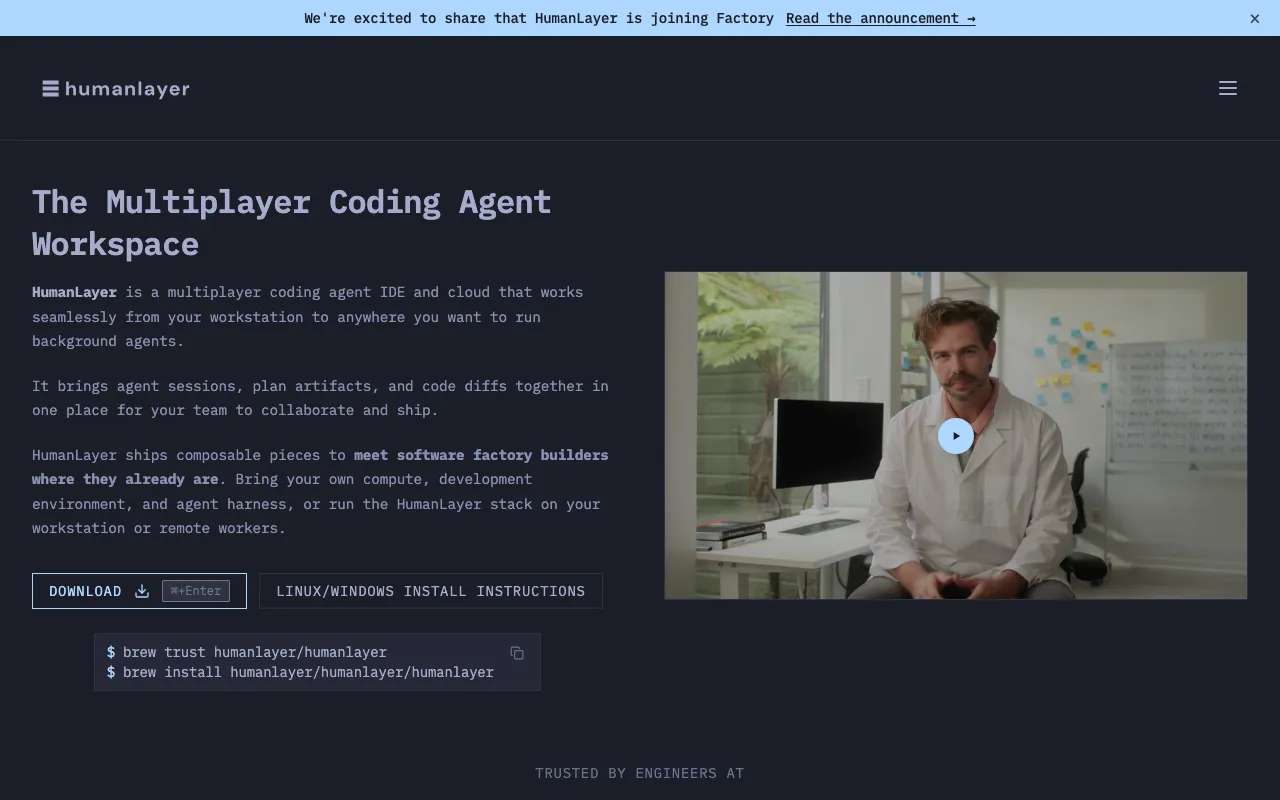
HumanLayer runs Claude Code, Codex, OpenCode, and Pi sessions on your machines while syncing tasks, plans, and reviews across desktop, web, and per-host daemons.
Overview
HumanLayer is a multiplayer environment for teams working with coding agents. A daemon on each host runs agent sessions; desktop and web apps show the same tasks, artifacts, and diffs so engineers can collaborate on long-running agent work without losing context when someone closes a laptop.
Tasks group sessions, design artifacts, and git worktrees. Structured QRSPI-style flows move from questions and research through design, structure, plans, and implementation with checkpoints where humans comment on docs before large code drops. Plugins mirror Claude Code, OpenCode, and Pi activity into the workspace, and artifacts such as research or design markdown stay versioned beside the task.
The stack is a Bun Turborepo with API, cloud admin, CLI, Electron and native macOS shells, and optional AWS Lambda maintenance jobs. Local devstack runs the full stack with Docker; telemetry vendors stay disabled unless environment variables are set.
Hosted HumanLayer Cloud runs the same codebase on AWS, and the project ships a reference self-host guide with placeholder secrets for Pulumi stacks and deployment order, though operators must adapt it themselves.
Key features
- Per-host agent daemons
- Synced web and desktop UI
- Task and artifact grouping
- QRSPI structured agent workflow
- Inline design doc comments
- Claude Code and OpenCode plugins
- Cloud and local session sync
- Command-palette navigation
Use cases
- Team oversight of coding agents
- Shared design review before implementation
- Parallel agent sessions on one machine
- Background agents with mobile visibility