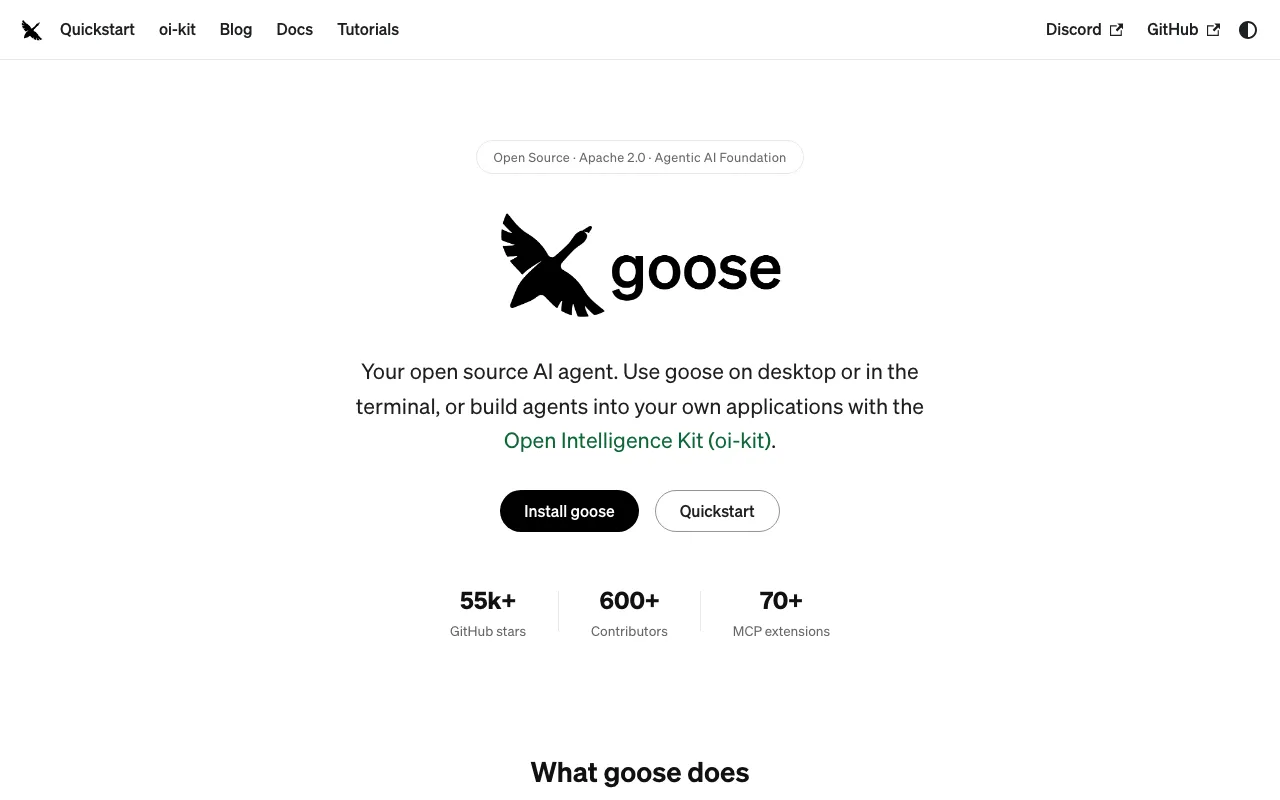
goose is an open-source AI agent that runs on your machine as a desktop app or CLI. It connects to many model providers and local models, and uses MCP extensions for tools and data.
Overview
goose is a general-purpose AI agent for coding, research, writing, automation and data analysis. It runs on your machine as a native desktop app for macOS, Linux and Windows, or as a command-line tool for terminal workflows. It is built in Rust and is part of the Agentic AI Foundation at the Linux Foundation.
For models, goose can load supported local models directly, without Ollama or a separate inference server. It can also connect to more than 85 providers, including Anthropic, OpenAI, Gemini, OpenRouter and Amazon Bedrock. Tools and data sources are connected through the Model Context Protocol (MCP), and the project documents more than 70 extensions. Extensions can also render interactive interfaces inside the desktop app.
Workflows can be saved as recipes, which are portable YAML configs. A recipe can hold instructions, extensions, parameters and subrecipes, and teams can share recipes or run them in CI. Subagents can take on tasks in parallel, such as code review or research, so the main conversation stays clean. Security features include prompt injection detection, tool permission controls, a sandbox mode and an adversary reviewer that watches for unsafe actions.
goose can also act as the agent behind your own application through the Agent Client Protocol (ACP). Your app starts the goose binary as a subprocess, sends prompts, and receives streamed responses, tool activity and permission requests. Editors such as Zed, JetBrains and VS Code can connect over ACP. The same repository holds oi-kit, a set of reusable Rust components for building agents. Its core runtime can run in native apps, on servers or in WebAssembly hosts, and agents can resume from saved state.
Key features
- Desktop app for macOS, Linux and Windows
- Command-line interface
- 85+ model providers
- Direct local model loading
- MCP extensions
- Recipes as shareable YAML workflows
- Subagents for parallel tasks
- ACP server for building apps and editor integration
Use cases
- Coding assistance and automation in the terminal
- Research and writing tasks
- Data analysis
- Running repeatable agent workflows in CI
- Embedding an agent backend in your own application