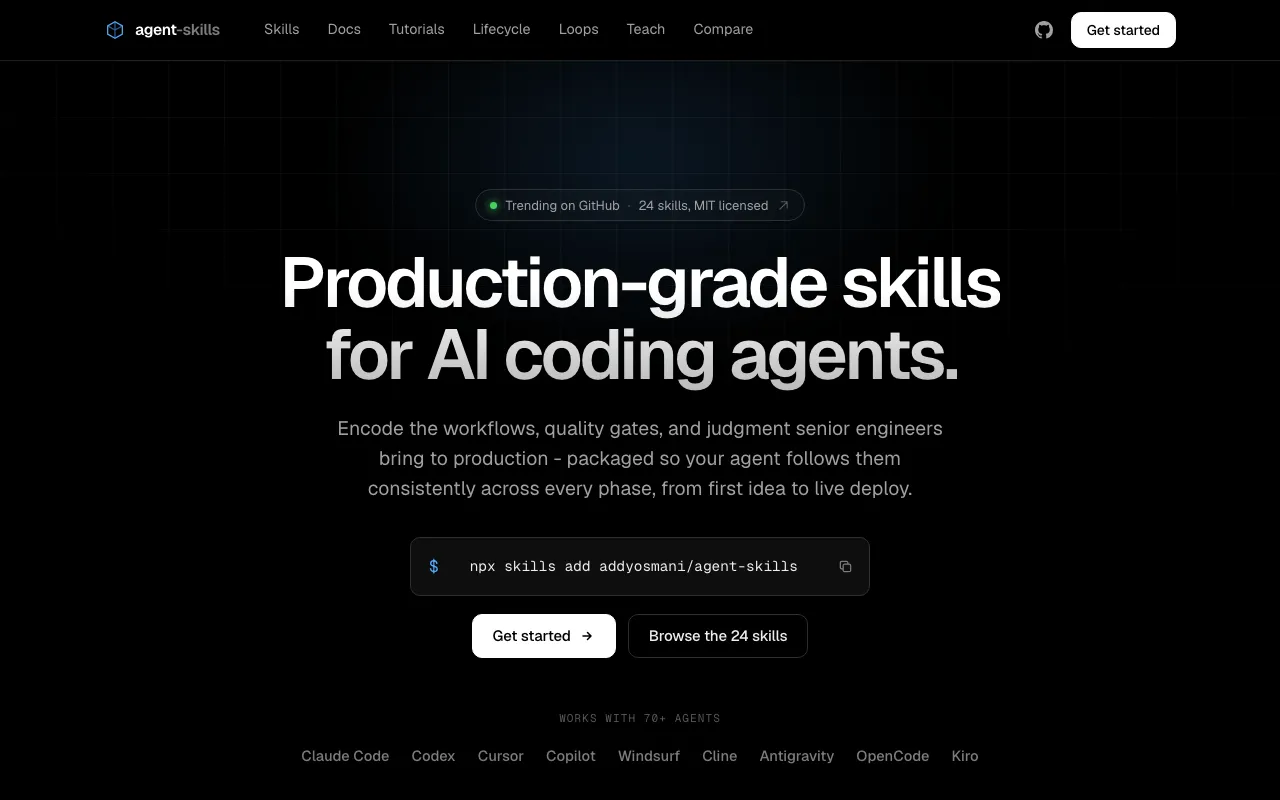
Agent Skills packages senior-engineer workflows as Markdown skills and slash commands for Claude Code, Cursor, Codex, and many other coding agents, covering spec through ship.
Overview
Agent Skills is a pack of structured engineering workflows written for AI coding agents. Each skill encodes steps, verification gates, and guardrails meant to mirror how experienced engineers plan, build, test, review, and deploy software.
Ten slash commands align with common lifecycle phases, from defining work with /spec and breaking it down with /plan to incremental /build, proof-oriented /test, merge-ready /review, and production /ship. Additional commands cover constraints, web performance, accessibility, and code simplification. Skills can also activate automatically when your task matches their domain, such as API design or frontend UI work.
The catalog lists 26 skills in total, including a meta skill for routing work to the right workflow. Topics span interviewing for requirements, PRDs, task breakdown, test-driven development, debugging, security hardening, performance work, accessibility audits, CI/CD, documentation, and observability. Many skills end with explicit exit criteria rather than informal completion.
Installation paths vary by host: a shared open skills CLI can install into dozens of agents with one command, while native plugins or copied skill folders integrate with Claude Code, Cursor, Codex, Gemini CLI, OpenCode, Copilot, and others. Skills are plain Markdown so any agent that reads instruction files can use them. An adoption guide describes rolling the pack out on greenfield or existing codebases.
Key features
- 26 lifecycle skills with verification gates
- Ten slash commands mapped to SDLC phases
- Automatic skill routing by task type
- Anti-rationalization tables in workflows
- Parallel specialist personas on ship flow
- One-command install via open skills CLI
- Native plugins for major coding agents
- Plain Markdown portable skill files
Use cases
- Keeping agents on spec-before-code discipline
- Running test-driven incremental implementation
- Structured code review before merge
- Accessibility and web performance audits
- Rolling consistent practices across many agent hosts