
REA
MCP and CLI reverse-engineering toolkit for agents
REA connects coding agents and terminals to local analysis tools for binaries, Electron apps, websites, .NET, and Android targets. Setup registers MCP access and investigation skills via npm.

HTTP security headers middleware for Node apps
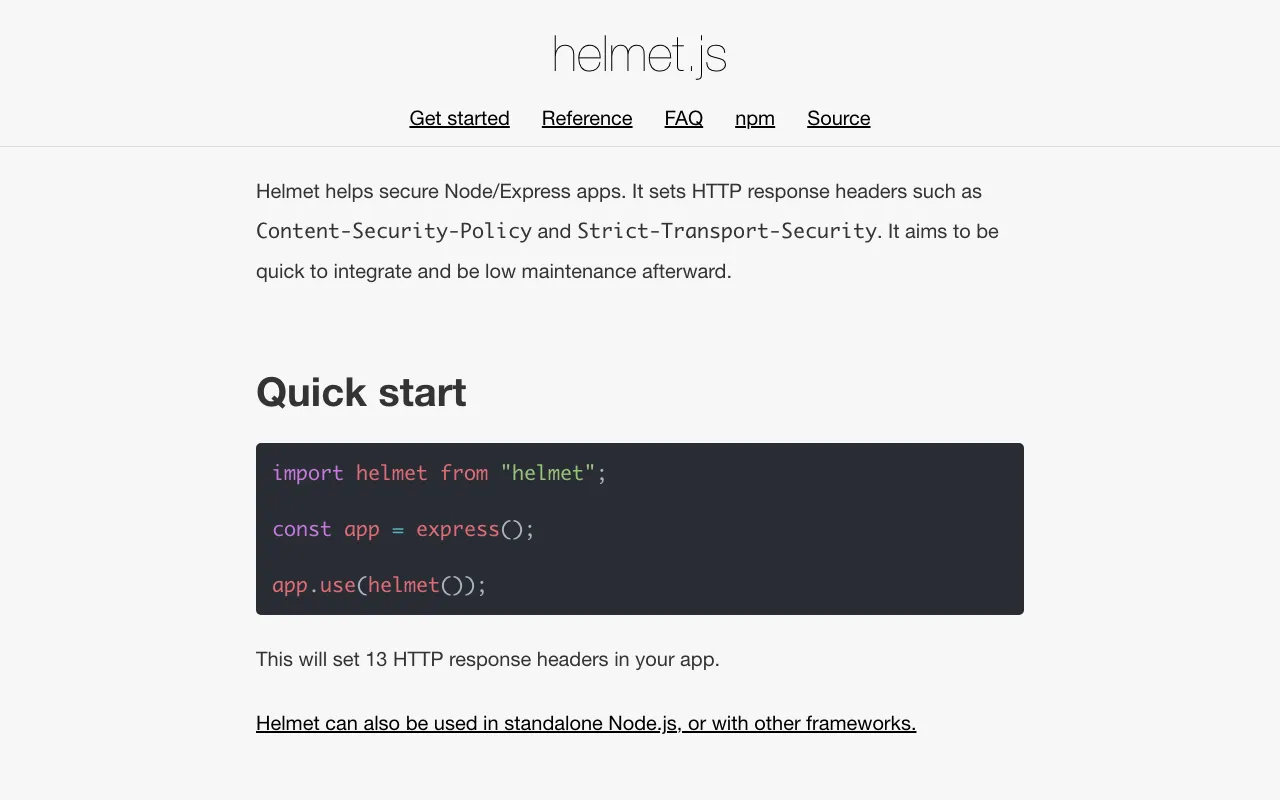
Helmet is middleware that sets HTTP response headers for Node and Express applications. A default install applies multiple security-related headers with options to tune or disable each one.
Helmet helps secure Node and Express applications by configuring response headers such as Content-Security-Policy and Strict-Transport-Security. The design goal stated in the documentation is quick integration followed by low ongoing maintenance.
Calling the default middleware sets thirteen headers, including Content-Security-Policy with mergeable directives, Cross-Origin-Opener-Policy, Cross-Origin-Resource-Policy, Referrer-Policy, Strict-Transport-Security with max-age and preload options, X-Content-Type-Options, X-Frame-Options, and removal of X-Powered-By. Each header can be turned off or configured through dedicated options objects.
Content-Security-Policy support covers default directive bundles, report-only mode, nonce-friendly script-src functions, and disabling upgrade-insecure-requests during local HTTP development. Standalone sub-middleware functions exist for individual headers when you do not want the full bundle.
Helmet can run with Express, standalone Node.js, or other frameworks according to the project site. Validation of CSP strings is intentionally minimal; external CSP checkers are recommended for policy review.
MCP and CLI reverse-engineering toolkit for agents
REA connects coding agents and terminals to local analysis tools for binaries, Electron apps, websites, .NET, and Android targets. Setup registers MCP access and investigation skills via npm.
AI-guided terminal toolkit for authorized security testing
Hackingtool bundles many security utilities in one console with optional AI help to pick tools and commands. It targets Linux and macOS and is meant for authorized testing only.

AI-driven penetration testing for developers
Strix runs autonomous AI agents that probe applications like attackers, validate issues with proofs of concept, and integrate into CLI and CI workflows.
Android customization suite with root and modules
Magisk is open source software for tailoring Android 7.0 and newer devices. It provides root access, systemless module installs, boot image tools, and per-app code injection via Zygisk.

Autonomous AI penetration tester for web apps and APIs
Shannon analyzes web application source code, plans attack paths, and runs real exploits against staging targets. Only vulnerabilities confirmed with a working proof of concept appear in reports.

POSIX shell client for ACME SSL automation
acme.sh issues, renews, and installs SSL and TLS certificates via the ACME protocol using a single shell script with no Python dependency.