qmetrics.net

Hashids.js

JavaScript encoder for short obfuscated numeric IDs

Frameworks & PlatformsDesktop/CLI app
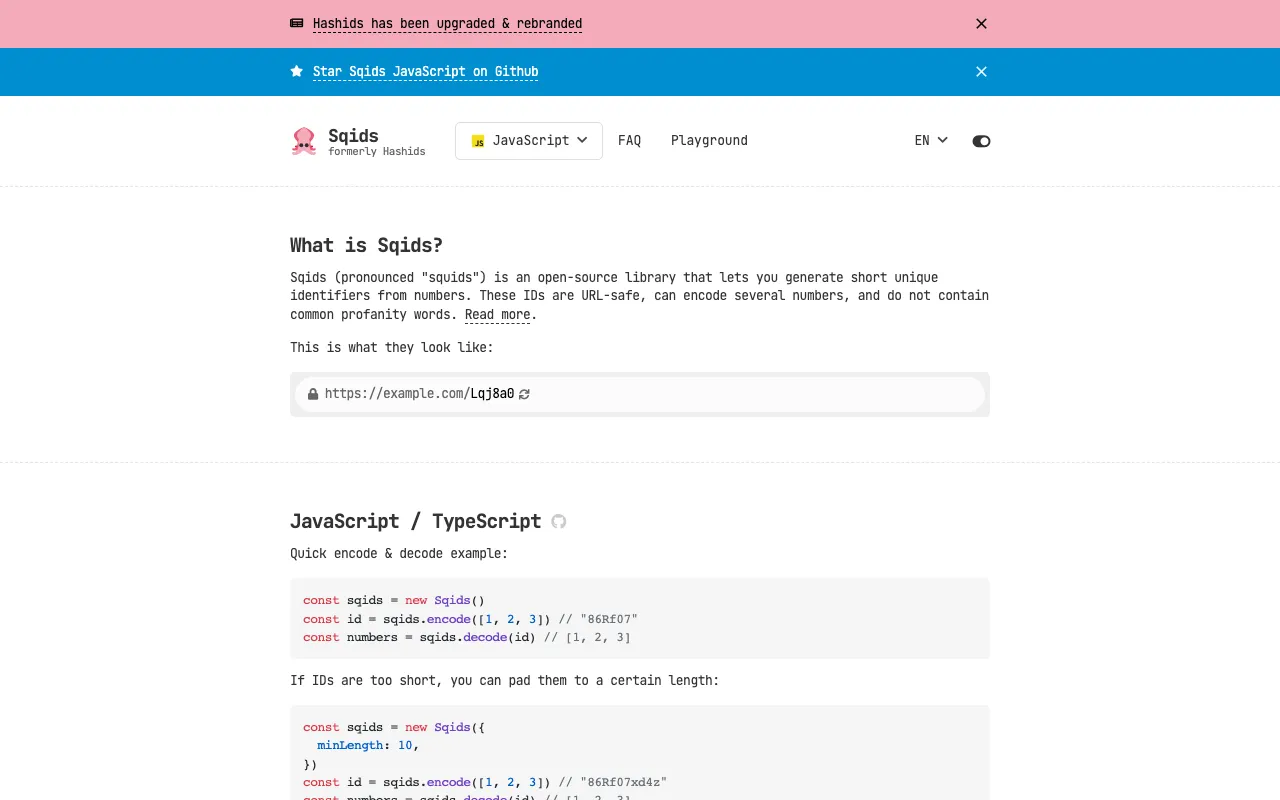
Hashids.js screenshot

Hashids.js turns numbers into short, URL-friendly strings so database IDs are not exposed directly, with salts, padding, and custom alphabets.

Overview

Hashids.js is a small JavaScript library that generates YouTube-style identifiers from one or more non-negative numbers. The goal is visual obfuscation of primary keys and similar counters, not encryption or secrecy.

Install via npm for Node, import in ESM or CommonJS setups, or load a browser build as a global where ES modules are available. TypeScript projects can import the package or the dedicated CommonJS entry; BigInt encoding is supported when the runtime provides BigInt.

Encoding accepts integers, arrays of numbers, hex strings, or BigInt values. Optional salt and minimum length settings make IDs unique to a project or longer than the default short form. You can replace the default alphanumeric alphabet, including emoji alphabets since v2.0. Decoding always returns an array of numbers; negative inputs are not supported.

The algorithm avoids common English profanity pairings by default and can skip predictable patterns in sequential IDs. Documentation stresses that bogus encode input yields empty strings and that the library must not be used to protect sensitive data.

Key features

  • Encode numbers to short strings
  • Decode back to number arrays
  • Salt and minimum-length padding
  • Custom and emoji alphabets
  • Hex string encoding mode
  • BigInt support when available
  • ESM, CommonJS, and browser builds
  • Profanity-avoiding default alphabet rules

Use cases

  • Hide sequential database IDs in URLs
  • Encode multiple integers in one token
  • Obfuscate counters in public links
  • Encode hex values like ObjectId strings
  • Generate non-repeating-looking public IDs

Tags

Similar software

ECC

Open-source agent engineering toolkit for coding harnesses

ECC adds planning, verification, review, memory, skills, and security scanning to coding agents such as Claude Code, Codex, and Cursor. It installs as plugins, packages, and managed adapters across multiple harnesses.

★ 311.7k⟳ 8 days agoMIT
Frameworks & PlatformsDesktop/CLI app

React

JavaScript library for web and native user interfaces

React helps developers build interfaces from reusable components that manage their own state. Views update declaratively when underlying data changes.

★ 253k⟳ 2 days agoMIT
Frameworks & PlatformsDesktop/CLI app

Flutter

Open-source UI framework for multi-platform apps from one codebase

Flutter is an SDK for building user experiences for mobile, web, and desktop from a single codebase. It uses the Dart language and compiles to native machine code or web targets.

★ 181.5k⟳ todayBSD-3-Clause
Open Source Alternative to:Ionic Enterprise

Bootstrap

Responsive HTML, CSS, and JavaScript front-end toolkit

Bootstrap supplies CSS, JavaScript, and Sass-based styles for building responsive, mobile-first sites. It ships prebuilt grid layouts, UI components, and optional JavaScript plugins.

★ 175.1k⟳ 2 days agoMIT

Langflow

Visual low-code builder for AI agents and workflows

Langflow is a visual builder for AI agents and workflows. Flows can be customized in Python and deployed as an API or as an MCP server, with support for major LLMs and vector databases.

★ 157k⟳ todayMIT
Open Source Alternative to:Relevance AIVoiceflow

LangChain

Framework for agents and LLM-powered applications

LangChain helps developers chain interoperable components and integrations to build agents and LLM-powered applications. It offers a standard interface for models, embeddings, vector stores, and related pieces.

★ 150.1k⟳ 2 days agoMIT






