
Fleet
Open device management and security for many OSes
Fleet is an open platform for IT and security teams to manage, patch, deploy software, and inventory computers and mobile devices. It supports GitOps, APIs, webhooks, and a web UI.

Userspace application kernel for isolated Linux containers
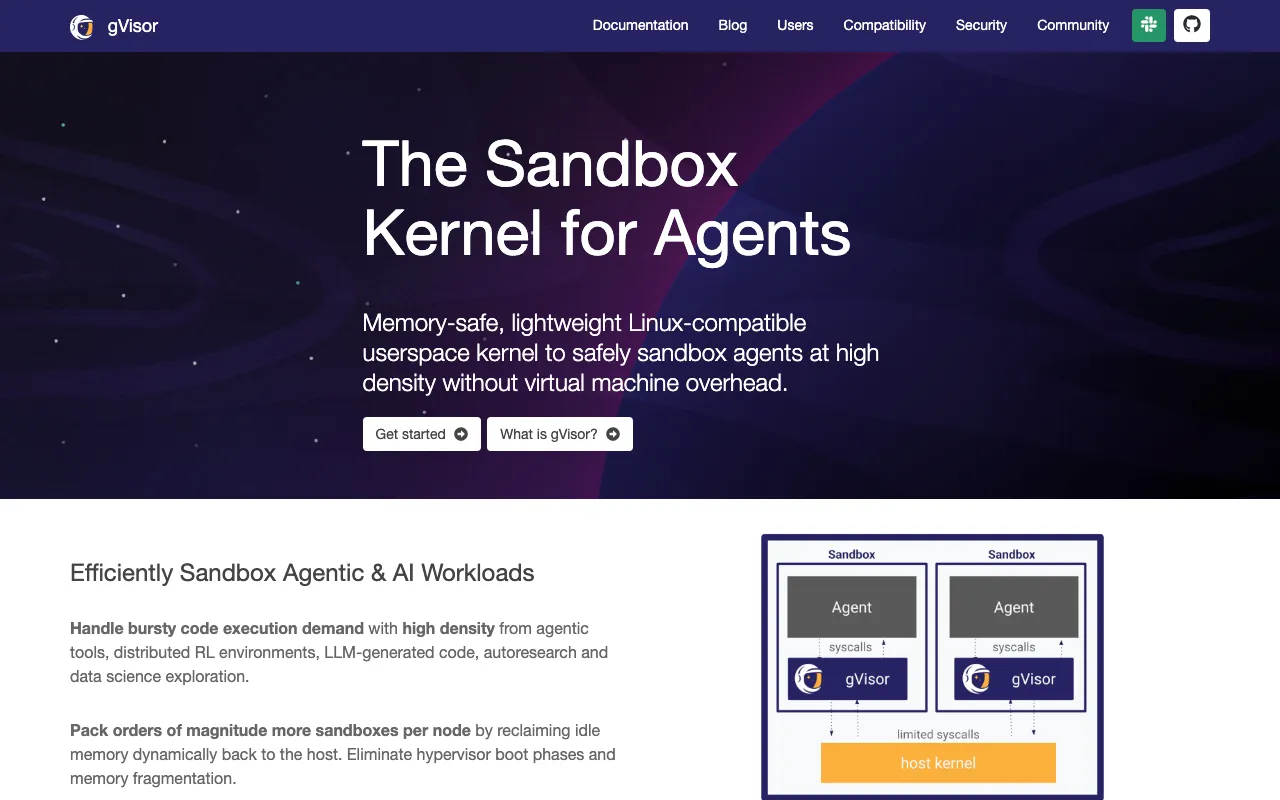
gVisor implements a Linux-like kernel in Go that runs in userspace between container workloads and the host. The runsc OCI runtime plugs into Docker and Kubernetes to run sandboxed containers.
gVisor adds a boundary between containerized applications and the host operating system. It exposes familiar Linux syscalls through an application kernel written in a memory-safe language, while keeping host kernel exposure smaller than typical container sharing.
The runsc runtime follows the Open Container Initiative spec and works with Docker, containerd, and Kubernetes RuntimeClass so teams can swap the runtime without changing ordinary container workflows. It is neither a seccomp filter nor a full hardware virtual machine; the project positions it between VMs and standard containers on isolation and footprint.
Core components emulate process management, memory layout, networking, and filesystem behavior in user space, with optional userspace networking via Netstack for Go consumers. Documentation covers installation, architecture, checkpoint and restore, GPU and TPU pass-through, and integration with monitoring tools.
Builds target x86_64 and ARM64 Linux hosts. Release artifacts bundle runsc, a containerd shim, and helper binaries expected alongside the runtime in a gvisor-bin directory.
Open device management and security for many OSes
Fleet is an open platform for IT and security teams to manage, patch, deploy software, and inventory computers and mobile devices. It supports GitOps, APIs, webhooks, and a web UI.

MCP and CLI reverse-engineering toolkit for agents
REA connects coding agents and terminals to local analysis tools for binaries, Electron apps, websites, .NET, and Android targets. Setup registers MCP access and investigation skills via npm.
Core operating system kernel for Linux systems
The Linux kernel is the core of any Linux operating system. It manages hardware, system resources, and provides fundamental services for other software.
AI-guided terminal toolkit for authorized security testing
Hackingtool bundles many security utilities in one console with optional AI help to pick tools and commands. It targets Linux and macOS and is meant for authorized testing only.

AI-driven penetration testing for developers
Strix runs autonomous AI agents that probe applications like attackers, validate issues with proofs of concept, and integrate into CLI and CI workflows.
Android customization suite with root and modules
Magisk is open source software for tailoring Android 7.0 and newer devices. It provides root access, systemless module installs, boot image tools, and per-app code injection via Zygisk.