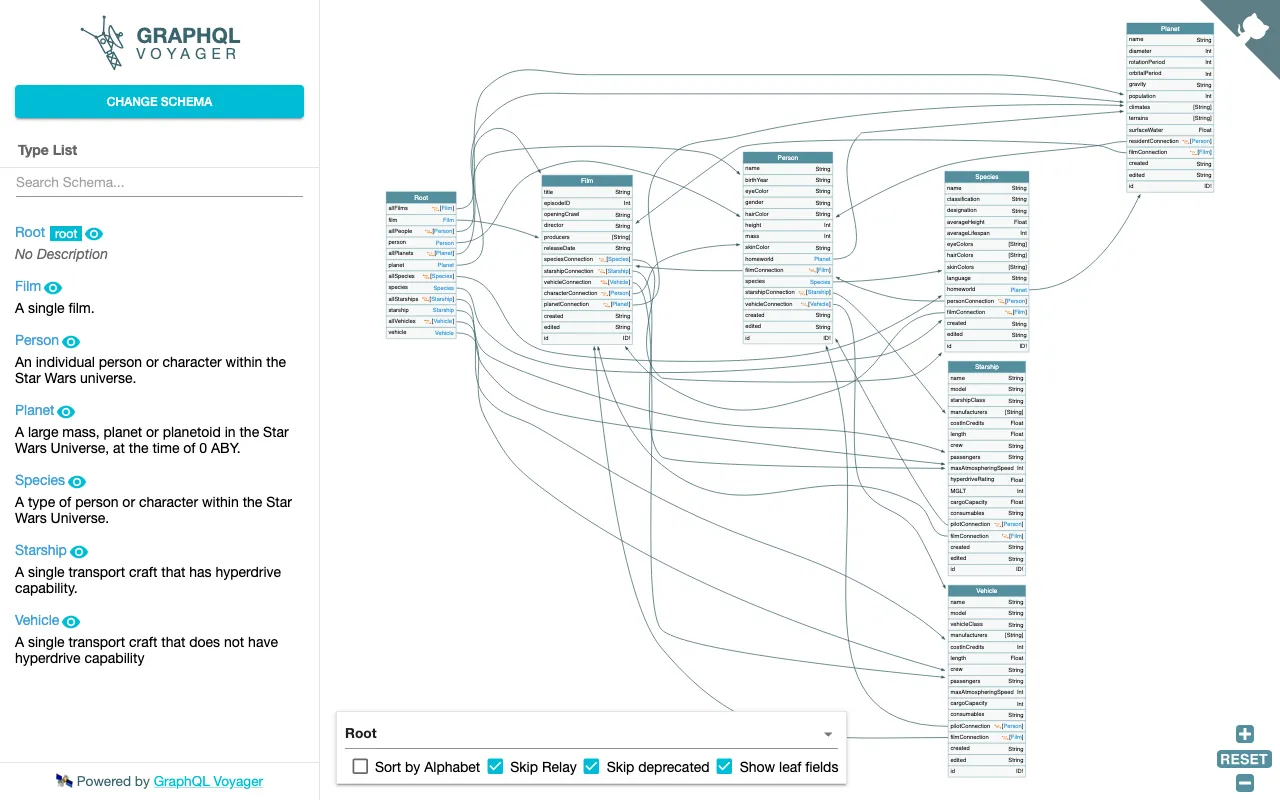
GraphQL Voyager turns a GraphQL API into an explorable graph so you can see types and relationships. It ships as a React component and supports connecting to your own endpoint or bundled demos.
Overview
GraphQL Voyager helps teams understand a GraphQL data model by rendering the schema as an interactive graph instead of a flat text document. It is useful when designing a new API or reviewing how types connect, and it can load example public schemas or introspection from a live endpoint you provide.
The Voyager React component accepts an introspection result or a function that fetches introspection, plus display options such as skipping Relay wrapper types, hiding deprecated fields, choosing a root type, sorting fields alphabetically, and toggling leaf scalars and enums. You can allow users to switch schemas in the UI and hide docs, settings, or branding when embedding the viewer.
Distribution options include npm bundles, a standalone script that includes React, webpack integration, and middleware helpers for Express, Hapi, and Koa that serve a prebuilt explorer pointed at a configurable GraphQL URL with optional header expressions. The tool was inspired by earlier GraphQL visualizer projects and is meant to be dropped into web tooling rather than used as a standalone product on its own.
Navigation features include quick movement across the graph, a side panel with per-type detail, and controls to simplify Relay-heavy schemas. Teams often pair it with design discussions, onboarding, and API documentation workflows where seeing the graph structure matters as much as reading field lists.
Key features
- Interactive schema graph navigation
- Introspection-driven type exploration
- Skip Relay and deprecated field options
- Selectable root type for the graph
- Voyager React component and init helper
- Express, Hapi, and Koa middleware
- Standalone bundled browser build
- Example public GraphQL schemas
Use cases
- Exploring GraphQL schema structure visually
- Design reviews for new GraphQL APIs
- Embedding schema docs in developer portals
- Onboarding developers to an existing API
- Demoing public GraphQL endpoints


 Miro